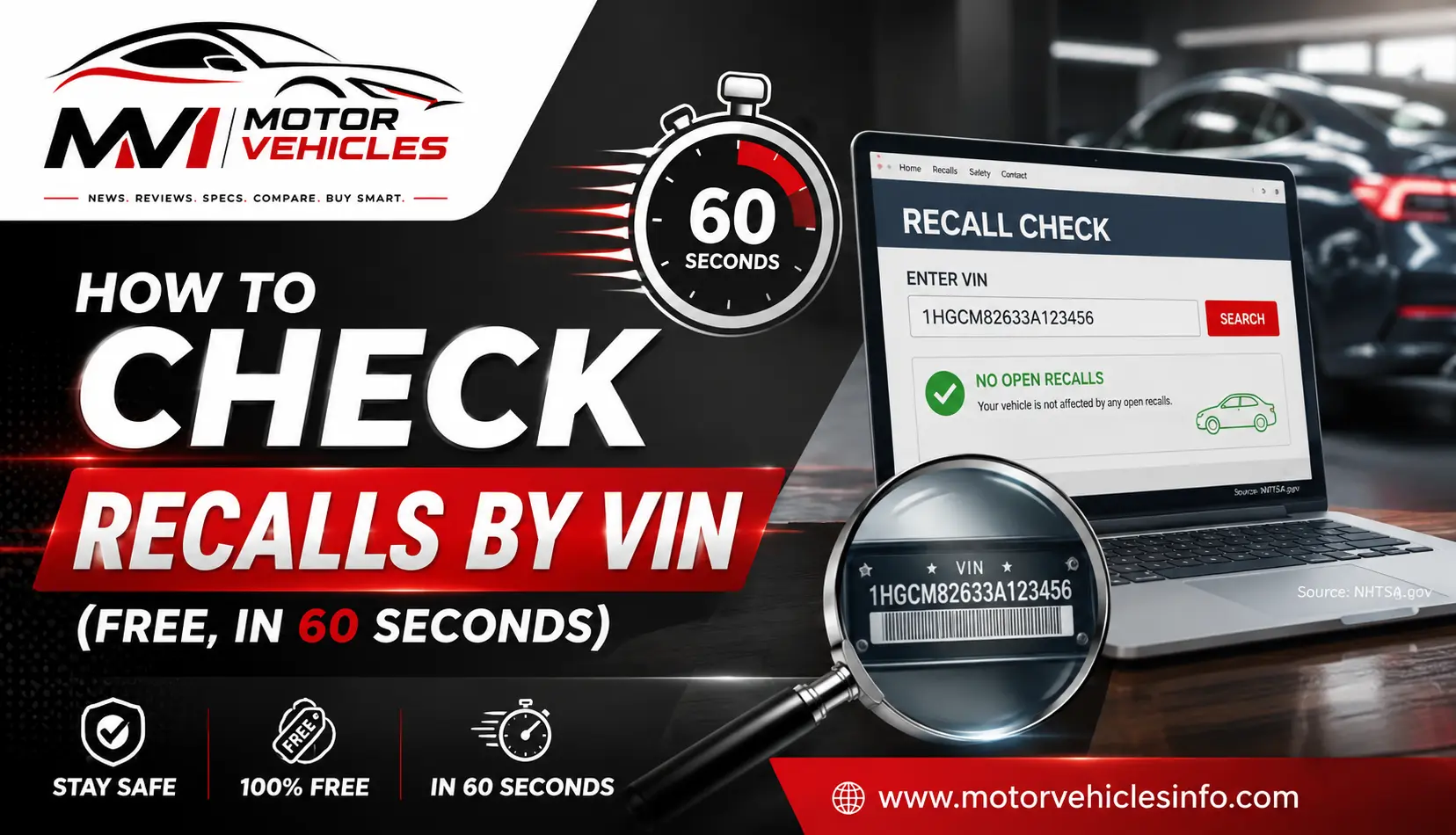
Every year, tens of millions of vehicles get hit with a safety recall — and most owners never find out until something breaks. If you want to check recalls by VIN today, the good news is that it takes less time than making a cup of coffee, and it costs nothing.
This guide walks you through exactly how to check recalls by VIN using the same free government tools that dealers use, why an open recall matters more than most drivers realize, and what to do the moment you find one. Whether you own a Ford, a Toyota, or you’re about to buy a used car from a stranger on Facebook Marketplace, a 60-second VIN recall check could save you thousands of dollars — or your life.
What is a car recall check?
A recall refers to the issuance of a notice from either the automobile manufacturing company or safety regulators on account of discovering any issue associated with the automobiles that makes driving the car hazardous or causes a violation of a safety standard. Recalls are not customer satisfaction initiatives but a serious regulated procedure of ensuring consumers’ safety.
A recall may take several forms, such as defective airbags, leaking brake lines, fuel pumps that make cars stall, unreceptive seat belts, and software problems that influence driving by affecting car acceleration and steering. A number of recalls are insignificant and may be solved just by doing some updates. However, there are other huge recalls including the Takata airbag problem, which affects over 100 million cars all over the world. But that notice only reaches you if your registration is current — which is exactly why so many used-car owners never hear about an open recall on their vehicle at all, and why it’s worth learning to check recalls by VIN yourself instead of waiting on the mail.
What is a VIN and where do you find it?
A VIN, short for Vehicle Identification Number, is the 17-character code stamped onto pretty much every car, truck, or motorcycle built since 1981. No two vehicles share the same one – it’s as close to a fingerprint as a car gets.
Every chunk of that code means something. Part of it points to the manufacturer, part of it describes the model, and the rest works like a serial number that separates your car from the thousands of identical ones that rolled off the same line.
Dealers use it to confirm factory specs. Insurers use it to price a policy. Police use it to check whether a car’s been reported stolen. The VIN number of a car does a lot of quiet work behind the scenes.
There are a few main places where you can find the VIN on a car:
You do not have to look far because they are rarely seen by anyone who is looking for them. All you have to do is get out of the car and look through the lower right-hand corner of the windshield.
A few other places worth checking:
- The door jamb on the driver’s side, usually on a sticker near the hinge
- Stamped right into the engine block
- Printed on your title, registration, or insurance card
- Near the windshield washer fluid reservoir on some models
If you’re looking at a used car and something feels off, check two or three of these spots and compare them. If the numbers don’t match, walk away – that’s not a paperwork mix-up; that’s a warning sign.
Why VIN Recall Matters?
A VIN recall search matters because it’s the only way to know, with certainty, whether your specific car has an unresolved safety defect. If your search is by manufacturer and car model alone, all you get to know is that there has been a recall for the line of cars you own — not whether the defect has actually found its way into your car before.
It becomes even more important when purchasing a used car. Private sellers rarely mention an open recall, and many don’t even know one exists. A used car’s full history — accidents, title status, and recalls together — gives you a much clearer picture than the seller’s word alone. Running a VIN recall check before you sign anything is one of the cheapest forms of insurance you’ll ever use.
Insurance companies and lenders increasingly factor recall status into their risk assessments too, since an unrepaired recall can affect a vehicle’s resale value and, in rare cases, its insurability.
Check Recalls by VIN in 60 Seconds (Step-by-Step)
This is exactly how you should perform a vehicle recall search by VIN in 60 seconds from start to finish.
Step 1: Find Your 17-Digit VIN Number
Look it up on the windshield, door jamb, or registration document. Write it down or take a picture of it to be able to write the whole number later, because even one mistake will prevent the results from being shown.
Step 2: Look for an Official Recall Website
Head to NHTSA’s official recall lookup tool if you’re in the United States. This is the government-run database that every automaker is legally required to report to.
Step 3: Type Your VIN Precisely
Enter the 17-digit VIN without spaces. Pay attention that VIN never use the letters I, O, or Q – and make sure not to type an “O” instead of “0” or an “I” instead of “1.”
Step 4: Check out the Results
It won’t take long before the site reveals one of two things: either “0 unrepaired recalls associated with this VIN,” or the number of open recalls with detailed information.
Step 5: Bookmark the Website or Take a Screenshot
In case of finding a recall, make sure to print this web page. It will be used as a reference point during the talk with a dealer concerning the required repair.
This is pretty much everything – the real-time check of auto recalls by VIN number can easily be done within 60 seconds by anyone who knows their vehicle’s VIN code.
Free Recall Check by VIN: Best Official Tools
Not every “free recall check” tool online is trustworthy. Some others could be websites designed to collect your information and sell it to dealerships. Always use authentic resources when doing recall research by VIN.
NHTSA (United States)
NHTSA.gov/recalls is the definitive free recall check by VIN tool for any vehicle sold in the US. This comes from data directly provided by the companies, and it is refreshed on a minimum weekly basis.
Ford Recalls (Manufacturer-Specific)
If Ford recalls are what you’re after specifically, Ford’s own recall portal lets you search by VIN and shows repair scheduling options through your local dealer. Major manufacturers such as General Motors, Toyota, and Honda all provide a very similar VIN check facility on their websites.
DVSA Vehicle Recall Check (United Kingdom)
UK drivers can run a free car recall check through GOV.UK’s official recall checker, run by the Driver and Vehicle Standards Agency. It searches by make, model, and registration rather than VIN alone.
Vehicle Recalls Australia
Australian drivers can check recalls by VIN or registration through vehiclerecalls.gov.au, the federal government’s official vehicle safety recall database.
Third-Party Report Sites
Services like Carfax and AutoCheck sometimes bundle recall data into a broader vehicle history report. If you’re weighing which paid report is worth it, our comparison of Carfax vs AutoCheck and our breakdown of Bumper vs Carfax can help you decide — though for recalls alone, the free government tools are just as accurate.
NHTSA Recall: How the Government Database Works
The reason behind the NHTSA recall process is that Congress has made this a mandate through the National Traffic and Motor Vehicle Safety Act. The manufacturers have to report every safety issue they face to the NHTSA, and in turn, NHTSA will investigate consumer complaints independently and may issue a recall even if the manufacturer disputes it.
As soon as you enter your VIN to look up your car’s recall status at the NHTSA website, the system compares it to the manufacturer data submitted and tells you whether there is an open recall, a closed recall, a recent one which isn’t mapped completely to all the vehicles, or a recall that is over fifteen years old.
NHTSA’s database also lets you search recalls by make, model, and year without a VIN, plus separate databases for tires, car seats, and equipment. It’s genuinely one of the most transparent public safety datasets available anywhere in the world.
Will a Recall Impact My Car Insurance Rates or Resale Value?
It is highly unlikely that a car recall would impact your premiums or coverage with regard to car insurance. Insurers do not penalize the policyholder because they have a car with a recall issued by the manufacturer. But ignoring such a recall and causing any accident or damage might put you at higher risk or even liability.
When it comes to resale, open recalls will depreciate the value of your car and make it hard for you to sell it.
VIN Recall Check vs License Plate Recall Check
Both methods can work, but they’re not identical. Here’s how they compare:
| Feature | VIN Recall Check | License Plate Recall Check |
| Accuracy | Matches your exact vehicle build | Usually accurate, but tied to registration records |
| Works for unregistered/imported cars | Yes | Often no |
| Available internationally | Yes (US, UK, AU, and more) | Limited by country/state |
| Best for | Buying used cars, private sales | Quick checks on your own registered vehicle |
| Data source | Manufacturer VIN records | DMV/registration database |
For most situations — especially used car shopping — a VIN recall check is the more reliable option because it isn’t dependent on current registration data being accurate or up to date.
Why you should never ignore a recall
An open recall isn’t a paperwork issue — it’s a documented safety defect that a manufacturer or regulator has already confirmed. Ignoring it means driving with a known risk that could affect braking, steering, airbag deployment, or fire risk, depending on the recall.
There’s also a resale angle. An open recall won’t affect your insurance premium, but it will depreciate your car’s value and make it harder to sell — buyers who run an NHTSA recall search on a listed vehicle will see the open item and use it to negotiate, walk away, or ask you to fix it first. Buyers increasingly check recalls car by car the same way they check for a flood-damaged car or a rolled-back odometer before committing to a purchase.
Because recall repairs cost you nothing, there’s genuinely no financial reason to skip one. The only cost is the ten minutes it takes to book the appointment — and running a VIN recall check regularly means you’ll catch that window the moment it opens, not months later.
Common Mistakes to Avoid When Checking a Car Recall
Searching by make and model only instead of running a proper VIN recall check. This tells you a recall exists somewhere in that vehicle line, not whether your VIN is affected.
Using unofficial third-party sites. Some sites charge for information that’s free on government databases, or worse, harvest personal data.
Assuming a used car is recall-free because it “looks fine.” Most safety defects aren’t visible; that’s exactly why they’re dangerous. Pairing a VIN recall check with a lien check before buying covers two of the most commonly overlooked risks in a private sale.
Mistyping the VIN. A single wrong digit returns a “no recalls found” result that’s simply inaccurate, not reassuring.
Ignoring older recalls. Some safety recalls, like Takata airbags, remained open on vehicles more than a decade after the original notice.
Not rechecking after a repair. Confirm the fix was logged; paperwork errors at the dealer level do happen.
Frequently Asked Questions
Is it really free to check recalls by VIN?
Yep, totally free. NHTSA, manufacturer sites, DVSA, and vehiclerecalls.gov.au don’t charge a cent for a VIN recall check. If a site wants your card details to “unlock” results, close the tab.
How often should I check for recalls by VIN?
Every few months is a good habit. Always check right before buying a used car — recalls get added all the time.
Can I check recalls by VIN for a car I don’t own yet?
Yes. Any VIN works, owned or not. Ask the seller for a photo of the door jamb sticker and run the check before you even go see the car.
Does a recall check by VIN cost anything through a dealership?
No. Dealers run a recall check by VIN for free, and the repair itself is free too if there’s an open recall — no hidden fees.
What if my car has an open recall but I bought it used?
Doesn’t matter who owned it first. The recall follows the VIN, so you get the same free repair.
Why didn’t I get a recall notice in the mail?
The letter went to whoever’s name was on the registration at the time — probably not you. That’s exactly why it’s worth checking your own VIN instead of waiting on the mail.
Do older cars still qualify for free recall repairs?
Usually yes, up to 15 years from the sale date, and sometimes longer. Don’t assume your older car has “aged out” — just check.
Is a VIN recall check the same as a full vehicle history report?
No. It only covers safety recalls, not accidents or title issues. For the fuller picture, check out Carfax vs AutoCheck.
Can I check for Ford recalls specifically without my VIN?
Yes, Ford lets you search by year and model too. It’s just less precise than a VIN-based check.
What happens if I ignore an open recall?
Nothing happens overnight. But it can hurt your resale value, and if that defect ever causes an accident, you’re looking at real liability. Not worth skipping.
Final Thoughts
A recall notice can feel alarming, but the process to fix it is simple, fast, and free. The real risk isn’t the recall itself — it’s never knowing about it in the first place. Taking sixty seconds to check recalls by VIN, whether you’re a long-time owner or about to buy your next used car, is one of the easiest safety habits you can build into your routine. Make a VIN recall check part of your regular car-maintenance rhythm, the same way you’d check your oil or your tire pressure.