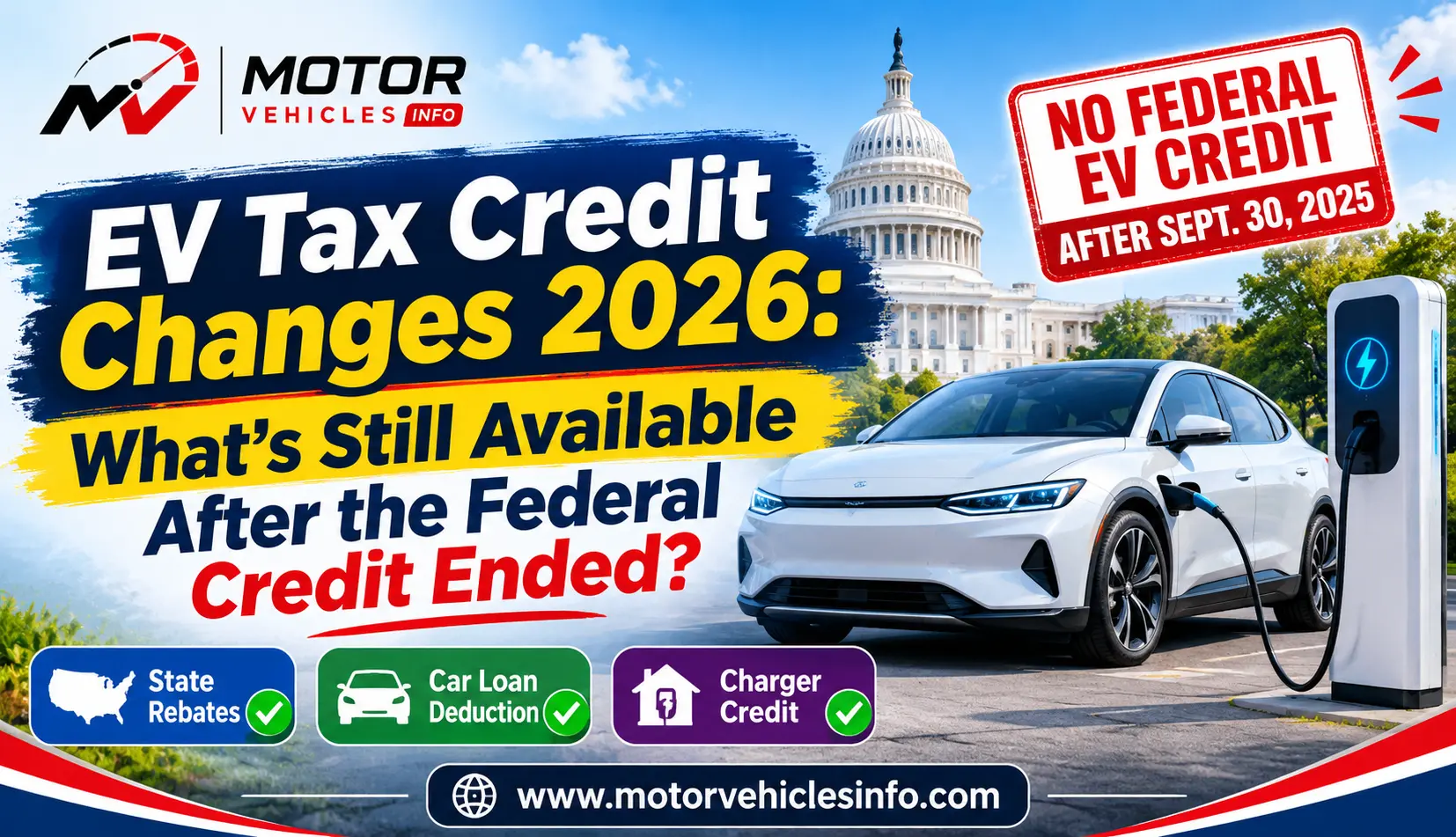
If you are shopping for an electric car this winter, one question comes first: is there still an EV tax credit in 2026? For most U.S. buyers, the federal answer is no. The $7,500 credit stopped applying to vehicles acquired after September 30, 2025, and the home charger credit closed on June 30, 2026.
That does not mean all help is gone. The EV tax credit 2026 picture now runs through state rebates, one federal deduction, utility programs, and automaker deals. Below are exact dates, real dollar examples, and a clear map of what you can still claim.
Key Takeaways
- The federal EV tax credit 2026 shoppers once counted on has ended for vehicles acquired after September 30, 2025.
- A binding contract plus a payment made by that date can still unlock the old electric car tax credit.
- The EV charger tax credit 2026 deadline was June 30, 2026, so only chargers placed in service by then qualify.
- The used EV tax credit 2026 buyers search for no longer exists, so state programs now fill part of the gap.
- The car loan interest deduction, up to $10,000 a year, is the main federal break left. It applies only to new, U.S.-assembled vehicles.
- State rebates now carry the 2026 EV tax credit story, and several have deadlines or funding limits.
Is There an EV Tax Credit in 2026?
For a vehicle you buy or lease today, there is no federal EV tax credit. The new, used and commercial credits all ended for vehicles acquired after September 30, 2025, according to the IRS clean vehicle credit page.
EV Tax Credit 2026 Status at a Glance
| Credit | Old value | Status in late 2026 |
|---|---|---|
| New Clean Vehicle Credit (30D) | Up to $7,500 | Ended for vehicles acquired after Sept. 30, 2025 |
| Previously-Owned Clean Vehicle Credit (25E) | Up to $4,000 | Same cutoff |
| Commercial Clean Vehicle Credit (45W) | Up to $7,500 | Same cutoff |
| Home charger credit (30C) | 30% up to $1,000 | Property must be placed in service by June 30, 2026 |
| Car loan interest deduction | Up to $10,000 of interest | Available for tax years 2025–2028 |
In plain terms, the EV tax credit 2026 story has shifted from one national check to a patchwork. Your savings now depend on where you live, what you buy, and when you signed.
So the honest answer to any search for an electric vehicle tax credit 2026 is the same on every official page: the federal vehicle credits are closed.
EV Federal Tax Credit Ending: Exact Dates for Every Credit (30D, 25E, 45W, 30C)
Why the EV Tax Credit 2026 Rules Changed
Congress passed the One, Big, Beautiful Bill (Public Law 119-21) on July 4, 2025. It moved up the end dates for several energy credits. The IRS then published FAQs on the early terminations with a date for each credit. These dates define the EV tax credit changes 2026 shoppers face.
The Four Cutoff Dates
- 30D (new EVs): not allowed for vehicles acquired after September 30, 2025.
- 25E (used EVs): same September 30, 2025 cutoff.
- 45W (commercial EVs): same cutoff, which also ended the old leasing pass-through.
- 30C (chargers): not allowed for property placed in service after June 30, 2026.
If an ad or salesperson still mentions the federal EV tax credit 2026 buyers “get,” treat it as outdated. Ask for the deal in writing, with no federal credit built into the price.
Signed a Contract Before September 30, 2025? How to Still Claim the Electric Car Tax Credit
How the 2026 EV Tax Credit Works for 2025 Contracts
The IRS treats a vehicle as “acquired” when two things have happened: you signed a written binding contract, and you made a payment. A down payment or trade-in counts. If both happened by September 30, 2025, you can claim the credit once you take possession, even if delivery came later.
Picture a buyer who signed in September 2025 and a deposit cleared, but the truck arrived in January 2026. That buyer can still claim the electric car tax credit on the return for the delivery year. It is the only route to a 2026 EV tax credit on a new vehicle.
Paperwork to Keep
- Your signed purchase contract and proof of payment.
- The time-of-sale report your dealer must give you when you take possession, or within three days after.
- Form 8936, which you file with your tax return.
Without the dealer’s report, the claim can fail. Ask for it at delivery.
Used EV Tax Credit Is Gone: What Used-EV Buyers Can Get Instead
Used EV Tax Credit 2026: What Replaced the $4,000?
The used EV tax credit offered up to $4,000 on qualifying dealer purchases. It no longer applies to vehicles acquired after September 30, 2025. Searching for a used EV tax credit 2026 will not turn up a federal option. Used buyers now rely on state and utility programs.
A few examples:
- California: MyFirstEV gives first-time buyers $1,750 off a used zero-emission vehicle priced up to $25,000, sold through a manufacturer’s certified pre-owned program, per the California Air Resources Board.
- Illinois: the state rebate covers new or used all-electric vehicles, as described by the Illinois EPA.
Before you buy any used EV, run its VIN through the NHTSA VIN decoder and check for open recalls. A cheaper price means little if the car carries unresolved problems.
EV Lease Tax Credit Explained: Why Lease Deals Still Exist Without the $7,500
The Old Lease Workaround
Leasing used to be the loophole. The consumer credit had income and price limits, but the commercial 45W credit did not. A leasing company could claim it and pass the savings to you as a lower payment.
EV Tax Credit 2026 and Leasing Today
Section 45W ended on the same date as the consumer credit. So no EV lease tax credit 2026 flows through to you anymore.
Some leases still look attractive. Automakers now fund discounts themselves, and residual values can help. A lease can make sense, but only if the numbers work on their own. States may still help: Colorado applies its credit to leases, per the Colorado Department of Revenue. Rising prices matter here too, as our guide on new car tariffs in 2026 explains.
Equinox EV After the Tax Credit: Real Price, Current Deals and Whether It’s Still Worth It
What the Equinox EV Costs Now
The Chevy Equinox EV is a good test case because it is one of the cheaper EVs. The 2026 model starts at $34,995 before destination, which is about $36,795 with the $1,800 destination charge. The 2027 model starts near $37,195 with destination and tops out near $46,595. Chevrolet lists up to 319 EPA-estimated miles on front-wheel-drive versions.
Deals and Incentives
In November 2026, Chevrolet advertised a $1,000 cash allowance on both model years, plus financing and lease offers that run through November 30. Offers change monthly, so confirm them with a dealer. The Equinox EV tax credit 2026 answer is simple: no federal credit applies. California first-time buyers may also stack MyFirstEV, since General Motors is a participating automaker and the Equinox EV falls under the $50,000 price cap.
Does the EV Tax Credit 2026 Picture Change the Equinox EV Math?
Yes, in one more way. GM builds the Equinox EV in Mexico, so it likely fails the U.S. final-assembly test for the loan interest deduction covered below. Check the window sticker and VIN before counting on it. Whether it is still worth it comes down to mileage, home charging and local rebates. Our comparison of electric vs hybrid costs can help you run those numbers.
EV Charger Tax Credit: The Deadline Passed, But Here’s How to Claim It If You Installed by June 30, 2026
Who Can Still Claim the EV Charger Tax Credit
The EV charger tax credit 2026 deadline has passed. The IRS charger credit page says property placed in service after June 30, 2026 does not qualify. If your charger was installed and working by that date, you can still claim it for the year it started service. At a home, the credit is 30% of the cost, up to $1,000.
You also need an eligible census tract, meaning a low-income or non-urban area. Look up your tract with the Census Bureau tool, then check it against the IRS list.
How to File
- Gather receipts and installer invoices, including labor.
- Complete Form 8911, following the IRS instructions.
- File it with the 2026 return you submit in early 2027.
The credit is nonrefundable, so unused amounts are lost. Claim the EV charger tax credit 2026 only for equipment that met the deadline. A charger installed now does not qualify, but some utilities and states still pay charger rebates. Maryland and New Jersey are two examples.
The Federal Break That’s Left: Car Loan Interest Deduction, With a Real Dollar Example
How the EV Tax Credit 2026 Alternative Works
The new deduction is not an EV credit, though it is the closest federal EV tax credit 2026 substitute. It covers up to $10,000 a year of interest on a loan for a new vehicle, for tax years 2025 through 2028, according to IRS Publication 6126. The vehicle must weigh under 14,000 pounds, be for personal use and have final assembly in the United States. The deduction phases out above $100,000 of income for single filers and $200,000 for joint filers.
You claim it on Schedule 1-A with the VIN, even if you take the standard deduction. Leases and used cars do not qualify.
A Real Dollar Example
Say you finance $35,000 at 7% for 60 months. Your first-year interest is about $2,260. In the 22% bracket, that deduction saves roughly $497 in tax. A credit would cut your tax bill dollar for dollar, so this is far smaller than the old $7,500.
State, Utility and Dealer EV Incentives Still Open: Deadlines Closing in Late 2026 and 2027
State EV Tax Credit 2026 Options
State help is now the biggest piece of the EV tax credit 2026 puzzle. Programs change fast, so confirm each EV tax credit 2026 program with the agency before you buy.
| State | Incentive | Status or deadline |
|---|---|---|
| California | MyFirstEV: $3,500 new, $1,750 used (first-time buyers) | First-come, first-served while funding lasts |
| Colorado | $750 credit, plus $2,500 for new EVs under $35,000 MSRP | 2027 amount not yet set |
| Illinois | $2,000, or $4,000 for low-income applicants | Applications close December 31, 2026 |
| Oregon | Standard and Charge Ahead rebates | Window closed November 4, 2026 |
| New Mexico | $3,000 new, $2,500 used | Steps down in 2027 |
Other states, including New Jersey, New York and Massachusetts, also run rebate programs. Some, such as Pennsylvania and Texas, show closed or limited funding, so check each state EV tax credit 2026 program page directly. The Department of Energy’s Alternative Fuels Data Center lets you search by state.
Utility and Dealer Savings
Your electric utility may offer charger rebates or cheaper overnight rates. Dealers and automakers add cash allowances and financing deals. These stack with some state rebates but not all, so ask which ones combine.
Expert Tips for Using the EV Tax Credit 2026 Rules
- Ask a tax professional which EV tax credit 2026 items apply to you.
- Check state and utility programs before you sign, since some require pre-approval.
- Confirm the exact trim and MSRP against any price cap.
- Get each incentive listed separately on the contract.
- Budget for the full cost of ownership, including insurance and registration fees, since many states add an annual EV fee.
Common Mistakes With the 2026 EV Tax Credit
- Trusting an old article that still lists the $7,500 credit.
- Assuming delivery in 2026 counts, when the acquisition date decides.
- Expecting an EV lease tax credit 2026 to lower your payment.
- Buying before a program’s pre-approval step is complete.
- Counting on the loan interest deduction for a car built outside the United States.
Frequently Asked Questions
Is there an EV tax credit in 2026?
There is no federal EV tax credit for vehicles acquired after September 30, 2025, so the EV tax credit 2026 rules favor state programs. Some states, utilities and automakers still offer incentives, and a federal loan interest deduction exists for qualifying new vehicles.
Is the $7,500 EV tax credit still available?
Not for new purchases, and no 2026 EV tax credit replaced it. It remains available only if you signed a binding contract and made a payment on or before September 30, 2025, then took delivery later.
Is the used EV tax credit still available?
No. The used EV tax credit of up to $4,000 ended for vehicles acquired after September 30, 2025. Check state and utility used-EV programs instead.
Can I get an EV lease tax credit in 2026?
No. The commercial credit behind the old lease workaround ended on the same date as the consumer credit, so any good lease price now comes from automaker or state incentives.
Can I still claim the EV charger tax credit?
Only if the charger was placed in service by June 30, 2026, in an eligible census tract. You claim it with Form 8911 on the return for that tax year.
Does the Equinox EV qualify for any EV tax credit in 2026?
It qualifies for no federal credit. Depending on where you live, state rebates or Chevrolet cash allowances may apply, and California first-time buyers may use MyFirstEV.
Does the car loan interest deduction apply to electric vehicles?
Yes, if the EV is new, for personal use and had final assembly in the United States. Leases and used vehicles do not qualify.
Which states still have an EV tax credit or rebate in 2026?
California, Colorado, Illinois, New Mexico, New Jersey, New York and Massachusetts have active programs, though amounts and deadlines vary. Confirm current status with the state agency.
Will the federal EV tax credit come back?
No one can say. Congress has created, changed and ended these credits before, so avoid timing a purchase around a possible return.
Final Thoughts
The federal EV tax credit 2026 buyers remember is gone, but real savings remain. Treat the EV tax credit 2026 as a state-by-state hunt. Start with your state, add utility and dealer offers, and check whether the loan interest deduction fits your vehicle. Confirm dates before you commit.
Ready to compare your options? Explore more guides in our Electric Vehicles section, and talk with a tax professional before you file. This article is general information, not tax advice.