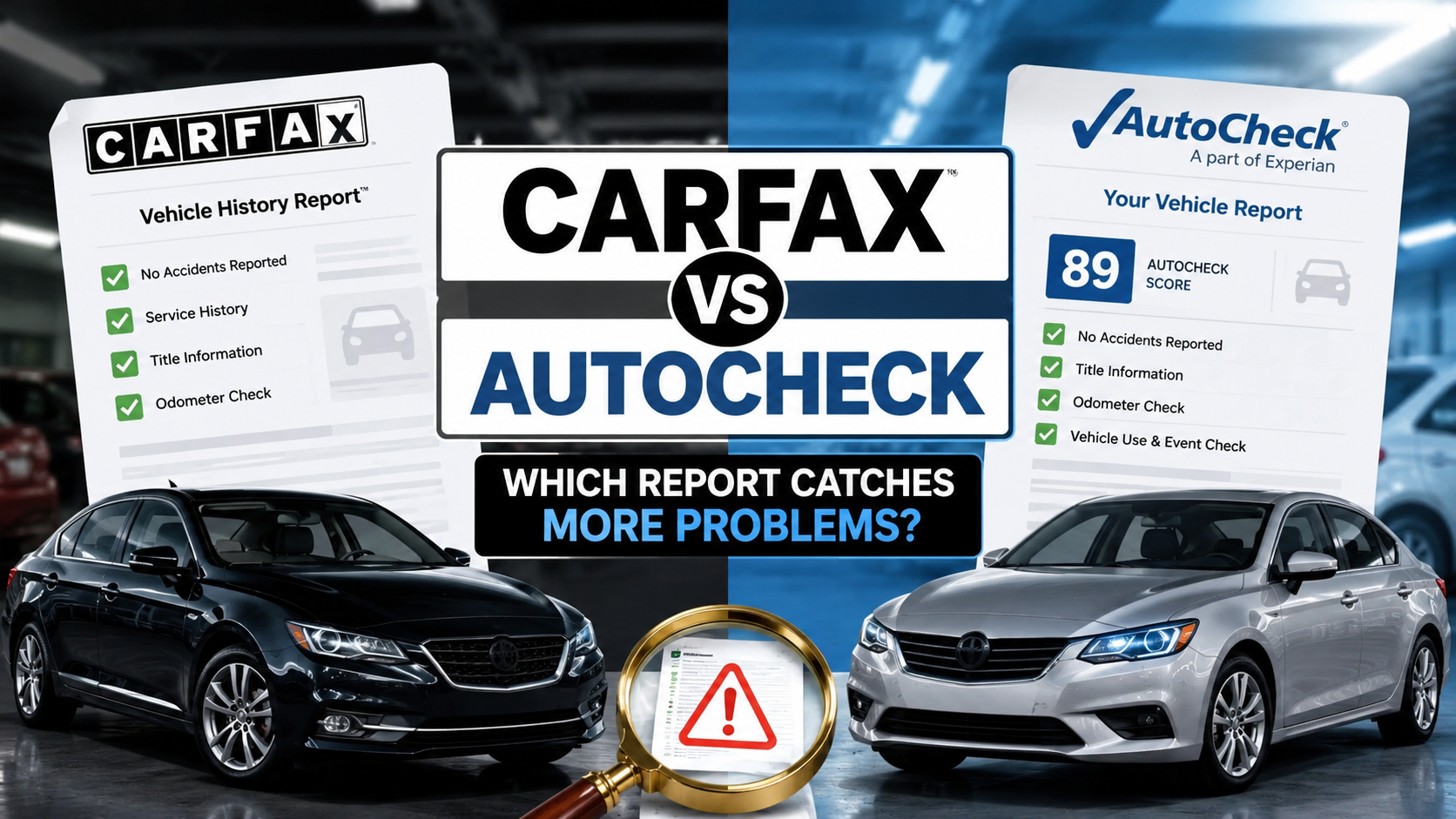
Buying a used car always involves some risk. A clean-looking vehicle can still hide expensive repairs, past accidents, or title issues. That’s why many buyers compare Carfax vs AutoCheck before making a decision. Both services provide a vehicle history report, but they collect data from different sources and present it in different ways.
So, which report catches more problems? In most cases, Carfax offers more detailed maintenance and service records, while AutoCheck often provides stronger auction history and a useful vehicle scoring system. Neither report is perfect because both depend on information reported by insurance companies, dealerships, repair shops, government agencies, and auctions. If an incident was never reported, neither report can include it.
In this guide, you’ll learn how each report works, what each one does well, where they fall short, and how to choose the best option for your situation.
Why a Vehicle History Report Matters
A vehicle history report tells the story of a car before you buy it. It helps you identify warning signs that may not appear during a quick inspection or test drive.
A quality report can help you:
Spot previous accidents before signing the paperwork.
Verify the number of previous owners.
Check for flood or salvage titles.
Detecting possible odometer fraud.
Review available maintenance history.
See whether the vehicle appeared at major auctions.
Confirm title status before transferring ownership.
While a history report reduces risk, it should never replace a professional inspection.
Carfax vs AutoCheck at a Glance
- Accident History: Carfax provides more detailed accident records than AutoCheck.
- Maintenance Records: Carfax offers more comprehensive service and maintenance history.
- Auction History: AutoCheck excels at tracking auction and wholesale vehicle history.
- Vehicle Score: AutoCheck includes an AutoCheck Score, while Carfax does not provide a similar scoring system.
- Report Packages: AutoCheck generally offers better value with multiple report package options.
- Dealer Usage: Both are widely used by dealerships, making this category effectively a tie.
Both reports cover many of the same categories, but they often display different details because they receive data from different partners.
How Carfax Collects Vehicle Data
Carfax gathers information from thousands of public and private sources.
Common sources include:
State DMV records
Insurance companies
Dealership service departments
Vehicle inspection stations
Registered repair facilities
Police accident reports
Emissions testing centers
Fleet companies
One reason many buyers prefer Carfax is its strong collection of maintenance records. If a dealership regularly services a vehicle and shares data with Carfax, you can often see oil changes, brake service, tire rotations, and scheduled maintenance.
How AutoCheck Collects Vehicle Data
AutoCheck is owned by Experian and focuses heavily on auction and dealer data.
Its information commonly comes from:
Dealer auctions
Insurance auctions
Fleet operators
Financial institutions
State agencies
Auto lenders
Vehicle registration databases
Because many dealerships buy inventory through auctions, AutoCheck often provides excellent information about auction history and wholesale transactions.
Which Report Finds More Accident History?
This question appears frequently because accident history greatly affects a vehicle’s value.
Generally:
Carfax usually provides more detailed accident descriptions.
AutoCheck may identify accidents missing from Carfax.
Both reports rely on third-party reporting.
For example, if an accident was repaired privately without an insurance claim or police report, neither report may include it.
This explains why two reports for the same VIN sometimes look different.
Learn more about used car accident history before making your purchase.
Maintenance Records Compared
Maintenance history can reveal how well previous owners cared for a vehicle.
Carfax usually provides more service information, including:
Oil changes
Brake replacements
Tire rotations
Battery replacement
Scheduled inspections
Dealer maintenance visits
AutoCheck sometimes includes service information, but it generally contains fewer maintenance entries. If long-term maintenance matters most, Carfax usually has the advantage.
Auction History Comparison
Auction history becomes especially important when buying vehicles from dealerships or online auctions.
AutoCheck often excels by showing:
Auction sales
Dealer-only auctions
Fleet vehicle sales
Rental vehicle history
Commercial use records
This information helps buyers understand how the vehicle changed hands before reaching the current seller.
Understanding the AutoCheck Score
One feature that makes AutoCheck unique is the AutoCheck Score. The score compares a vehicle with similar cars of the same age and class.
A higher score generally indicates:
Better ownership history
Fewer reported problems
Lower overall risk
However, you should never rely only on the score. Always read the complete report because one serious issue can matter more than a high rating.
Title History Comparison
Title issues often cost buyers thousands of dollars. Both reports check for major title brands, including:
Salvage title
Rebuilt title
Flood damage
Lemon buyback
Junk title
Fire damage
A branded title does not automatically mean you should avoid the vehicle, but it deserves careful investigation. Some rebuilt vehicles receive high-quality repairs, while others hide major structural damage.
Can Either Report Detect Odometer Fraud?
Both Carfax and AutoCheck track reported mileage over time.
They may detect:
Mileage inconsistencies
Odometer rollbacks
Recording errors
Missing mileage records
Unfortunately, sophisticated odometer fraud sometimes goes undetected if mileage was never officially reported. For that reason, compare dashboard wear, service stickers, maintenance receipts, and inspection records with the reported mileage.
Why the Same VIN Shows Different Results
Many buyers become confused when Carfax and AutoCheck show different information for the same vehicle. This is more common than you might think and doesn’t necessarily mean one report is wrong.
The biggest reason is that each company gathers data from different partners. One report may receive an accident record from an insurance company, while the other receives auction information from a wholesale marketplace.
Other reasons include:
Different reporting partners.
Delays in updating databases.
Missing records from independent repair shops.
Accidents repaired without insurance claims.
State agencies share information at different times.
For example, a car involved in a minor collision that was repaired with cash may never appear on either report. On the other hand, a vehicle sold through a major auction may appear in AutoCheck before it shows up in Carfax. The key takeaway is simple: different reports do not always mean incorrect reports. They reflect different data sources.
Problems Neither Report Can Detect
A vehicle history report is an important research tool, but it cannot reveal every issue. Even a report with no warnings does not guarantee that a used car is problem-free.
Both Carfax and AutoCheck may miss:
Cash-paid accident repairs.
Hidden frame repairs.
Engine problems.
Transmission damage.
Electrical faults.
Rust inside body panels.
Poor-quality repairs.
Water damage that was never reported.
Fake maintenance records.
Future mechanical failures.
This is why experts always recommend combining a history report with a professional pre-purchase inspection.
Should You Buy Both Reports?
For many everyday purchases, one report is enough. However, buying both reports makes sense in certain situations.
Consider purchasing both when:
The vehicle costs a significant amount.
You’re buying from a private seller.
The car has an unusually low price.
The seller cannot explain gaps in ownership.
You notice inconsistencies in the first report.
The vehicle has an auction history.
It’s a luxury, sports, or collector vehicle.
Paying for a second report can save thousands of dollars if it uncovers a major issue.
Which Report Is Better for Different Buyers?
Best Choice for First-Time Buyers
If this is your first used-car purchase, Carfax is usually easier to understand. Its reports clearly organize ownership history, maintenance records, accident reports, and title information.
Best Choice for Dealership Vehicles
Many dealerships use AutoCheck, especially those that purchase inventory through wholesale auctions. If the dealer already provides an AutoCheck report, review it carefully before deciding whether to purchase an additional Carfax report.
Best Choice for Private Seller Purchases
Private-party transactions carry more risk because there is often less documentation.
In these cases:
Review the VIN report.
Compare the seller’s story with the report.
Request maintenance receipts.
Arrange an independent inspection.
Best Choice for Auction Vehicles
AutoCheck often provides stronger auction history and vehicle scoring, making it particularly useful for auction purchases.
Expert Tips Before Buying Any Used Car
Even the best vehicle history report should be only one part of your buying process.
Follow these practical tips:
Compare the VIN on the dashboard and title.
Review every ownership transfer.
Check maintenance consistency.
Inspect tire wear carefully.
Test every electronic feature.
Look underneath for rust or leaks.
Drive at city and highway speeds.
Scan the vehicle for diagnostic trouble codes.
Hire a trusted mechanic before purchasing.
These simple steps can help uncover problems that no database can detect.
FAQs
Which is better, Carfax or AutoCheck?
Carfax or AutoCheck depends on what information you need most. Carfax usually provides more detailed maintenance and service records, while AutoCheck often offers stronger auction history and the AutoCheck Score. Compare both reports when buying an expensive used car, and always combine them with a professional inspection for the most reliable decision.
Does Carfax catch more problems than AutoCheck?
Carfax often catches more reported maintenance events and service history, but it does not always find more problems overall. AutoCheck may include auction records or ownership details that Carfax does not show. Both services rely on reported data, so neither report guarantees a complete vehicle history.
Can AutoCheck show accidents that Carfax misses?
Yes, AutoCheck can sometimes show accidents or vehicle events that Carfax does not list. Each company collects information from different data providers, so the same VIN may produce different reports. Reviewing both reports gives you a broader understanding of the vehicle’s history before buying.
Can Carfax miss an accident?
Yes, Carfax can miss an accident if no organization reports it. Cash repairs, unreported collisions, or repairs completed outside participating networks may never appear in a vehicle history report. A mechanic’s inspection remains essential because it can reveal damage that databases cannot detect.
What is the AutoCheck Score?
The AutoCheck Score compares one vehicle with similar models based on its reported history. A higher score generally suggests fewer reported issues than comparable vehicles. However, you should always read the complete report because the score alone cannot explain every important detail about a car.
Which report has better maintenance records?
Carfax usually offers better maintenance records because many dealerships and service centers share repair information with its database. You may find oil changes, brake service, inspections, and scheduled maintenance entries. AutoCheck includes some service information, but it generally focuses more on ownership and auction history.
Should I buy both Carfax and AutoCheck?
Buying both reports makes sense when you plan to purchase an expensive vehicle or notice missing information in one report. Since each service gathers data differently, reviewing both reports can reveal additional accident history, ownership records, or auction details before you complete the purchase.
Are Carfax and AutoCheck reports always accurate?
Carfax and AutoCheck strive to provide accurate information, but neither report is perfect. They depend on data submitted by government agencies, insurers, dealerships, repair shops, and auctions. If someone never reports an event, the report cannot include it, so verify important details independently.
Can a clean vehicle history report guarantee a good used car?
No, a clean vehicle history report cannot guarantee that a used car has no problems. Hidden mechanical issues, poor repairs, or unreported accidents may still exist. Always inspect the vehicle carefully, take a test drive, and hire a qualified mechanic before making your final decision.
What should I check besides a vehicle history report?
You should also inspect the vehicle’s condition, verify the VIN, review maintenance receipts, test every major feature, and arrange a professional pre-purchase inspection. These steps help confirm the information in your vehicle history report and reduce the risk of buying a car with hidden problems.
Final Verdict
When comparing Carfax vs AutoCheck, there is no single winner for every buyer. Choose Carfax if detailed service records, maintenance history, and easy-to-read accident reports are your top priorities. Choose AutoCheck if you’re researching auction vehicles, comparing several cars, or want the additional insight provided by the AutoCheck Score.
If you’re purchasing an expensive used vehicle or something with an uncertain history, using both reports provides broader coverage because each relies on different data sources. Most importantly, remember that no vehicle history report can replace a thorough inspection by a qualified mechanic.
A small investment in research today can help you avoid costly repairs and make a more confident used-car purchase tomorrow.
1. Reference link:
Used For: Check Carfax’s vehicle history report, maintenance records, accident history, title history, and data sources.
2. Reference Link:
Used For: Check AutoCheck’s AutoCheck Score, auction history, vehicle history report, and data coverage.
3. Reference Link: https://www.edmunds.com/car-buying/which-vehicle-history-report-is-right-for-you.html
Used For: Compare Used For: Compare Carfax vs AutoCheck, check the strengths and weaknesses of the two reports, and practical advice on how to use them. , check the strengths and weaknesses of the two reports, and practical advice on how to use them.
4. Reference Link: https://www.nerdwallet.com/article/loans/auto-loans/carfax-vs-autocheck-which-vehicle-history-report-is-better
Used For: Compare the two reports, check the price, features, and which one is best for which situation.
5. Reference Link: https://caredge.com/guides/autocheck-vs-carfax
Used For: Compare Carfax and AutoCheck features, compare auction data, and compare maintenance records.
6. Reference Link: https://www.nhtsa.gov/
Used For: Check VIN, vehicle safety, title issues, and other government information before buying a used car.
7. Reference Link: https://vehiclehistory.bja.ojp.gov/
Used For: Check NMVTIS (National Motor Vehicle Title Information System), title brands, salvage history, and vehicle title verification.