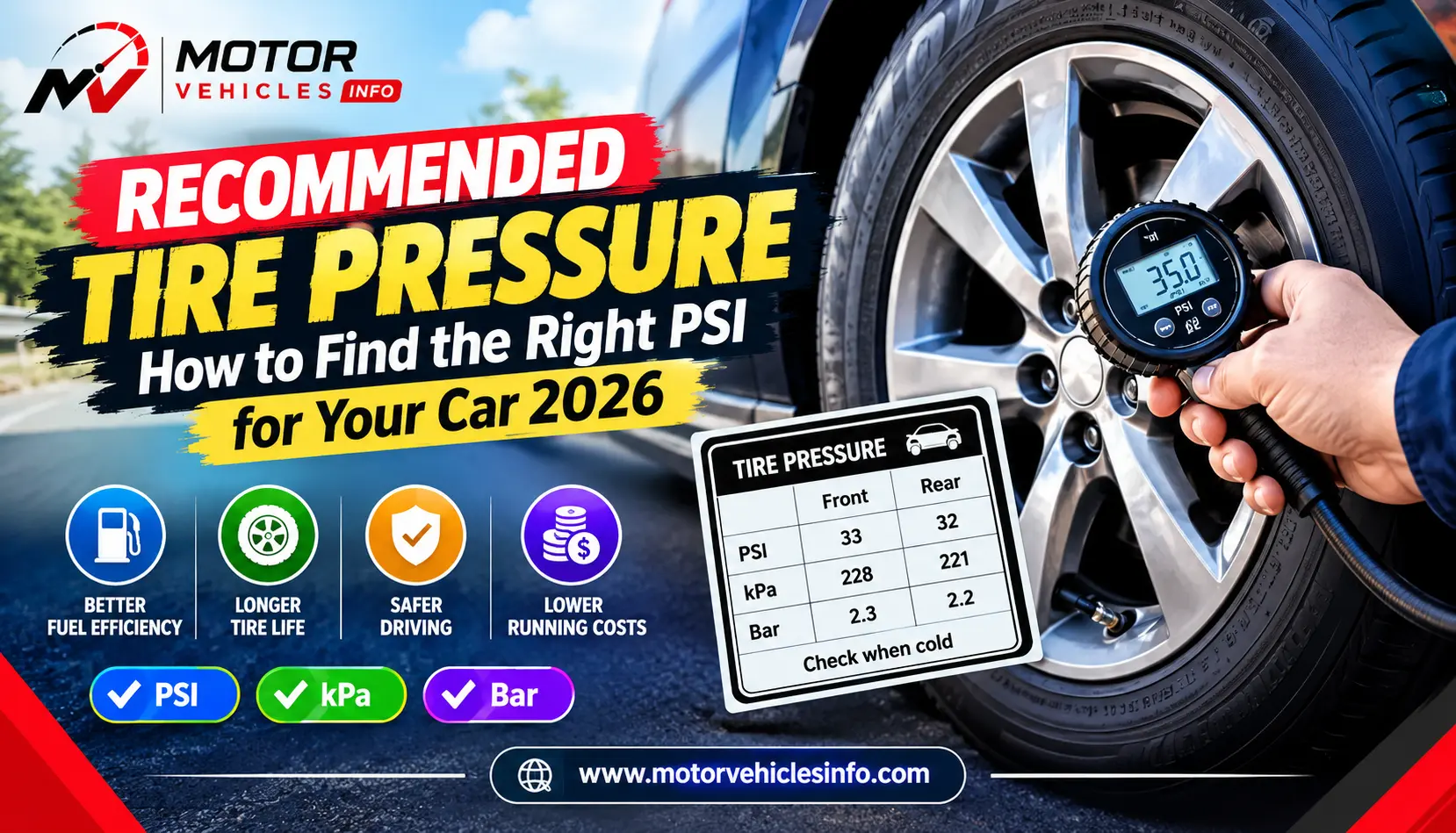
Your tires carry the whole weight of your car on four small patches of rubber. The air inside them does the heavy lifting. That is why the recommended tire pressure matters far more than most drivers realize, and why a two-minute check can save fuel, protect your tires, and keep you safer.
This guide will show you how to identify your car’s recommended tire pressure, how to check it using a tire pressure gauge, and how to adjust it within five minutes. The instructions are applicable for sedans, SUVs, trucks, and electric vehicles regardless of whether your gauge measures in PSI, kPa, or bar. (In the UK and Australia, people call it “tyre.”)
Key Takeaways
- The car manufacturer gives the recommended tire pressure, not the tire company. It is written on the door-jamb placard and also in the owner’s manual.
- Do not inflate your tires to the PSI shown on the tire sidewall. This is the maximum tire pressure.
- The recommended tire pressure needs to be checked regularly once a month using your tire pressure gauge.
- There are many factors that influence your tire pressure such as heat, cold weather conditions, load and trailer, so you may get your tire pressure lower than the recommended one.
- Usually, the low tire pressure light switches on if there is a gap between the recommended pressure and actual tire pressure about 25%.
What Is the Recommended Tire Pressure? PSI, kPa and Bar Explained
The proper tire pressure is the cold inflation pressure that was decided by the manufacturer of your car. This decision was made after considering many factors such as weight, handling, stopping distances, ride quality and wear. This pressure will be listed as one number or two, one each for front and back tires.
Tire pressure appears in three common units:
- PSI (pounds per square inch): the standard in the USA, and still printed on many UK and Australian gauges.
- kPa (kilopascals): the metric unit on most Australian placards. Queensland’s transport department lists kPa and PSI as the two units used for tire pressure in its tyre guidance.
- Bar: common on UK and European cars and air pumps.
Use this quick conversion table when your placard and your gauge speak different languages:
| PSI | kPa | Bar |
| 30 | 207 | 2.1 |
| 32 | 221 | 2.2 |
| 35 | 241 | 2.4 |
| 40 | 276 | 2.8 |
Why the Recommended Tire Pressure Is Not the Number on Your Sidewall
Look at the side of any tire, and you will find a maximum PSI molded into the rubber. Many drivers inflate to that figure. Don’t. The sidewall number is the most air the tire can safely hold. The recommended tire pressure on your placard is what your particular car needs.
A family sedan might show 44 psi on the sidewall and 33 psi on the door placard. Filling to 44 puts about a third more air in every tire than the maker intended. The result is a harsh ride and less grip on wet roads.
Where to Find the Correct Tire Pressure for Your Car
Your car’s maker prints the recommended tire pressure in several places. Check them in this order:
- Driver’s door jamb placard. This sticker lists the tire size and cold pressure for the front and rear tires. U.S. federal rules treat this vehicle placard and the tire’s sidewall maximum as two separate labels.
- Owner’s manual. Look under “Tires” or “Specifications.”
- Fuel filler door or glove box. Some makers put the label here. Australia’s RACV says your manual, the driver’s door frame, or the fuel filler door will list the pressure.
- Manufacturer website or app. Enter your VIN or model year to pull up the specs.
Finding the Recommended Tire Pressure When the Placard Is Missing
It may be faded, peeled, or lost once the door is changed; this is often the case when it comes to used vehicles. The manual is the first source because most manufacturers provide a free PDF version online. You may also contact a dealership with your VIN number. In case you have installed different sizes from what the placard says, ask the tire shop for confirmation of the appropriate pressure for this tire size and its load rating.
Used car sellers, a clear placard will help your potential buyer understand how much the tires should be inflated with just one look at the placard.
Normal Tire Pressure by Vehicle Type: Sedan, SUV, Truck and EV (PSI Chart)
Most passenger vehicles fall into quite a narrow range. The table below provides you with typical ranges so that you can compare your values with those. It never replaces your placard, because the recommended tire pressure for your car can sit outside these ranges.
| Vehicle type | Typical PSI | kPa | Bar |
| Sedan / compact car | 30–35 | 207–241 | 2.1–2.4 |
| Crossover / SUV | 32–38 | 221–262 | 2.2–2.6 |
| Pickup / light truck | 35–45 | 241–310 | 2.4–3.1 |
| Electric vehicle (EV) | 36–42 | 248–290 | 2.5–2.9 |
Heavy-duty truck tires can call for much more air, especially under load, so always read the label.
Normal Tire Pressure for SUV Drivers
SUVs are bulkier and higher than sedans; this is why the normal tire pressure of SUVs tends to be a bit higher compared to sedans. Most placards on SUVs provide two values of tire pressure – a normal one and an increased one, which should be applied when the vehicle is fully packed with people and luggage.
Recommended Tire Pressure for Electric Vehicles
Batteries add serious weight, so EV makers often specify higher pressures and tires designed for low rolling resistance. Treat the recommended tire pressure on the placard as law here. Weighing up an EV purchase? Our electric vs hybrid cost comparison looks at what each option costs to run.
How to Check Tire PSI Step by Step With a Tire Pressure Gauge
Follow these steps:
- Start cold. Check before driving, or after the car has sat for at least three hours. If you have driven, stay under a mile (about 1.6 km).
- Read your target. Note the recommended tire pressure for the front and rear tires on the placard.
- Remove the valve cap.
- Press the gauge on firmly. Push it straight onto the valve stem.
- Compare. Match the reading to the recommended tire pressure.
- Add or release air in short bursts. Recheck after each burst. To release air, press the small pin inside the valve.
- Finish up. Replace the cap, then repeat for all four tires and the spare.
The NRMA suggests checking every week or two, or whenever you refuel if you don’t drive much. Monthly is the minimum.
How to Hit the Recommended Tire Pressure Without Overshooting
Think of the scenario where the tire pressure is 38 psi after the vehicle has traveled for 20 minutes and has been warmed up; even though the desired reading should be 35 psi, the driver reduces the pressure. As soon as the tires become cold, their pressure becomes approximately 31 psi. Solution: Always check pressure on cold tires, and if checking warm tires, plan on doing so tomorrow morning.
Bonus trick: save the recommended tire pressure by car axles into phone notes to be sure not to go through the user manual at an air compressor.
Digital, Dial or Stick? How to Choose an Accurate Tire Pressure Gauge
A good tire pressure gauge is the cheapest way to maintain your recommended tire pressure. Here is how the three main types compare:
| Gauge type | Strengths | Weak points |
| Digital | Easy to read, often accurate to 0.5 psi, works in the dark | Needs a battery |
| Dial | Clear needle, sturdy build | Can drift if dropped |
| Stick (pencil) | Cheap and compact | Harder to read, less precise |
Whichever you pick, buy one that reads up to at least 60 psi, which covers cars and most SUVs. Gas station air hoses are convenient, but their gauges take a beating. The NRMA says fuel station gauges aren’t always accurate and recommends a simple pen-shaped mechanical gauge for dependable readings.
Test your gauge against a second one once a year. If the two disagree by more than 2 psi, replace the cheaper one.
How Temperature, Load and Towing Change Your Tire Pressure
Air expands when warm and shrinks when cold. A common rule of thumb says tire pressure moves about 1 psi for every 10°F (roughly 5–6°C) change in temperature. That is why a tire sitting at its recommended tire pressure in August can read low on a frosty November morning. Cold snaps also expose tired batteries, so if your car is slow to crank, our alternator vs battery guide helps you work out which part is failing.
Driving heats the tires too. Hot tires can read a few PSI above their cold value, and that is normal. Don’t bleed air from hot tires to match the cold number.
Adjusting Recommended Tire Pressure for Load and Towing
Extra weight squashes a tire further, so heavy loads need more air. Follow these rules:
- Use the “full load” figure on your placard when the car is packed.
- Check the owner’s manual for towing, as tow vehicles often need higher rear pressure.
- Inflate trailer tires to the trailer’s own label, not your car’s.
- Never go past the sidewall maximum.
Tire Pressure Light On? What the Low Tire Pressure Light Really Means
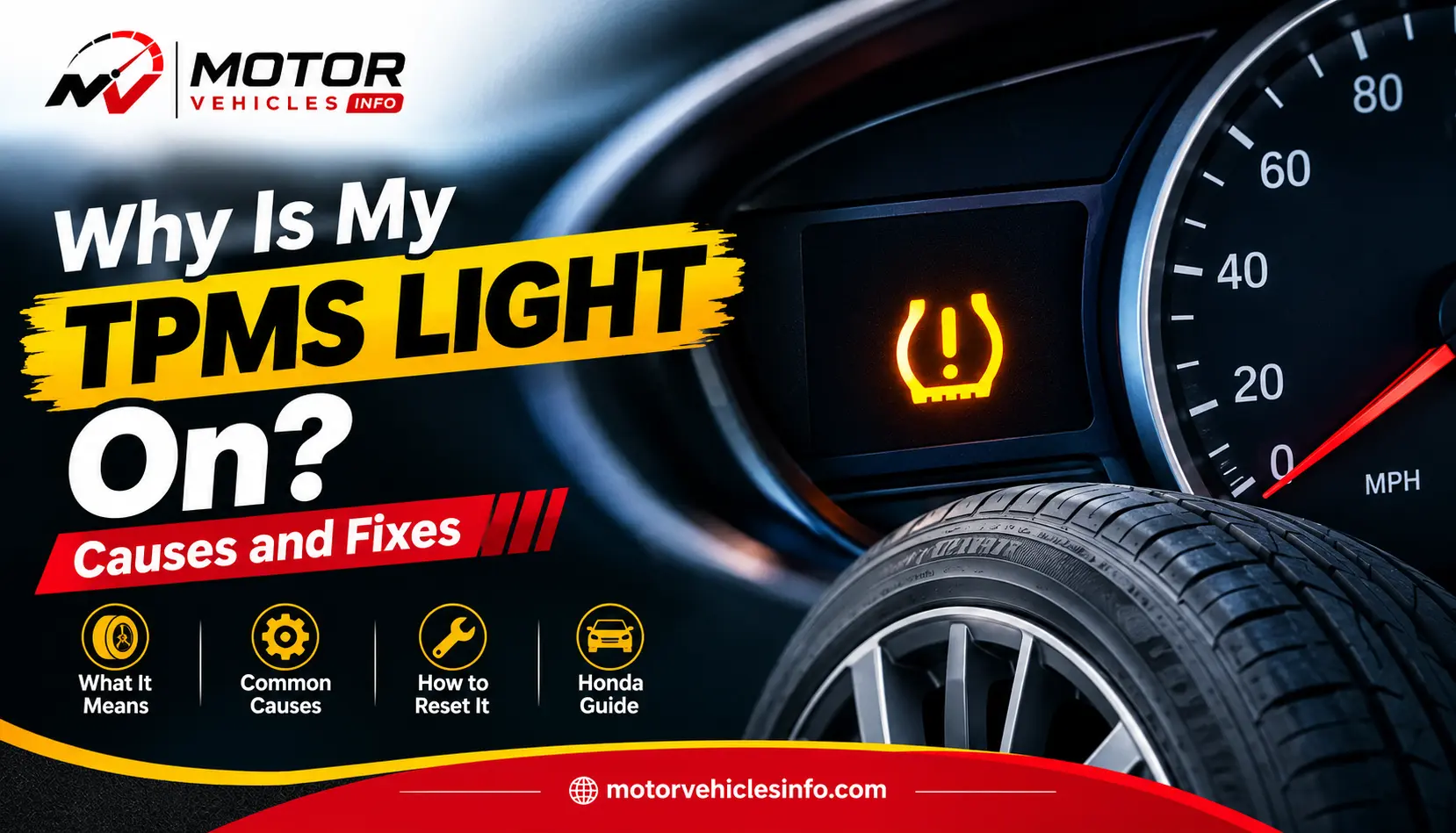
The tire pressure light looks like a flat horseshoe with an exclamation mark. It belongs to your tire pressure monitoring system (TPMS). Under a U.S. federal rule, new light vehicles must have a system that warns the driver when a tire is 25 percent or more below the recommended placard pressure.
If the placard says 35 psi, the low tire pressure light may stay dark until a tire drops near 26 psi. By then, you have been driving on a soft tire for a while.
If the light comes on:
- Find a safe place to stop and look over all four tires.
- Check each tire with your gauge.
- Inflate to the recommended tire pressure on the placard.
- Drive for about ten minutes. On many cars, the light then goes out. Some need a manual reset.
A light that flashes for about a minute and then stays on often points to a faulty sensor, not low air. Have a shop check it.
Low Tire Pressure Light vs. Other Dashboard Warnings
The tire light has nothing to do with the check engine light, which could signal something like an EVAP leak behind a P0455 code. It is also unrelated to the oil lamp, which we cover in why your car oil light stays on after an oil change.
Low vs High Tire Pressure: Warning Signs, Risks and Costs
| Too low | Too high | |
| Warning signs | Soft, sluggish steering; wear on both outer edges | Bouncy, harsh ride; wear down the center |
| Safety risk | Heat build-up and possible tire failure | Less grip, especially on wet roads |
| Cost | Higher fuel use, shorter tire life | Shorter tire life, poorer braking |
Fuel is the easiest cost to measure. According to fueleconomy.gov, underinflated tires can cut gas mileage by about 0.2% for every 1 psi drop in average pressure, and keeping tires at the recommended tire pressure can lift mileage by 0.6% on average. A tire that sits 5 psi low costs you roughly 1% in fuel, month after month. The bigger bill is usually a worn-out set of tires that needed replacing early.
7 Common Tire Pressure Mistakes (and Myths About Nitrogen, Spares and Sidewall PSI)
- Filling to the sidewall PSI. It is the maximum, not the recommended tire pressure for your car.
- Checking tires after a long drive. Heat inflates the reading and tempts you to release good air.
- Waiting for the warning light. The system reacts late. Your gauge reacts first.
- Forgetting the spare. A flat spare is useless. Many compact spares need far more pressure than your road tires, so read the spare’s own label.
- Believing nitrogen means no more checks. Regular air is already about 78% nitrogen. Nitrogen-filled tires may lose pressure a little more slowly, but they still respond to temperature and still need monthly checks.
- Using one number all year. Seasons and heavy loads pull your tire PSI away from the recommended tire pressure. Recheck when weather or cargo changes.
- Treating tire pressure as the only job. Tires are one part of a routine. Pair your monthly check with a look at fluids and belts. Our guides on transmission fluid change timing and serpentine belt squeal are good places to start.
FAQs About Recommended Tire Pressure
What is the recommended tire pressure for most cars?
Most passenger cars call for 30 to 35 psi, but the recommended tire pressure depends on your model. Your door placard or owner’s manual gives the exact figure, so always follow it over any general chart.
What is normal tire pressure for an SUV?
Normal tire pressure for an SUV typically falls between 32 and 38 psi. Heavier models and loaded vehicles may need more. Check the placard for the recommended tire pressure for your trim and tire size.
How often should I check tire PSI?
Check tire PSI at least once a month and before long trips, so you always stay on the recommended tire pressure.
Is the recommended tire pressure the same for front and rear tires?
Not always. Many cars list different front and rear numbers because weight is spread unevenly. The placard shows both, so set each axle to its own figure.
Can I use the PSI printed on the tire sidewall?
No. The sidewall figure is the tire’s maximum pressure, not the recommended tire pressure for your vehicle. Using it can cause a harsh ride, uneven wear and reduced grip.
Why is my low tire pressure light on when the tires look fine?
A tire can lose plenty of air before it looks flat. Cold weather also lowers pressure overnight. Measure each tire with a gauge, then inflate to the recommended tire pressure. If the light keeps flashing, a sensor may be at fault.
Should I change my tire pressure in winter and summer?
Keep the recommended tire pressure as your cold target all year. Cold weather lowers readings, so you may need to add air more often in winter. Don’t exceed the sidewall maximum.
Does recommended tire pressure change for electric cars?
EV makers often specify higher pressure because of battery weight. Follow the recommended tire pressure on your EV’s placard, and check it monthly, since the correct tire pressure protects both range and tire life.
Final Thoughts
Getting your tires right is one of the cheapest upgrades in motoring. Find the recommended tire pressure on your placard, check it cold with your own tire pressure gauge, and adjust for load and weather. Do that, and you’ll get better handling, longer tire life and smaller fuel bills.
Ready to Check Your Tires?
Grab your gauge, read the placard and set each tire to its recommended tire pressure today. Then keep learning with more practical car guides on Motor Vehicles Info.