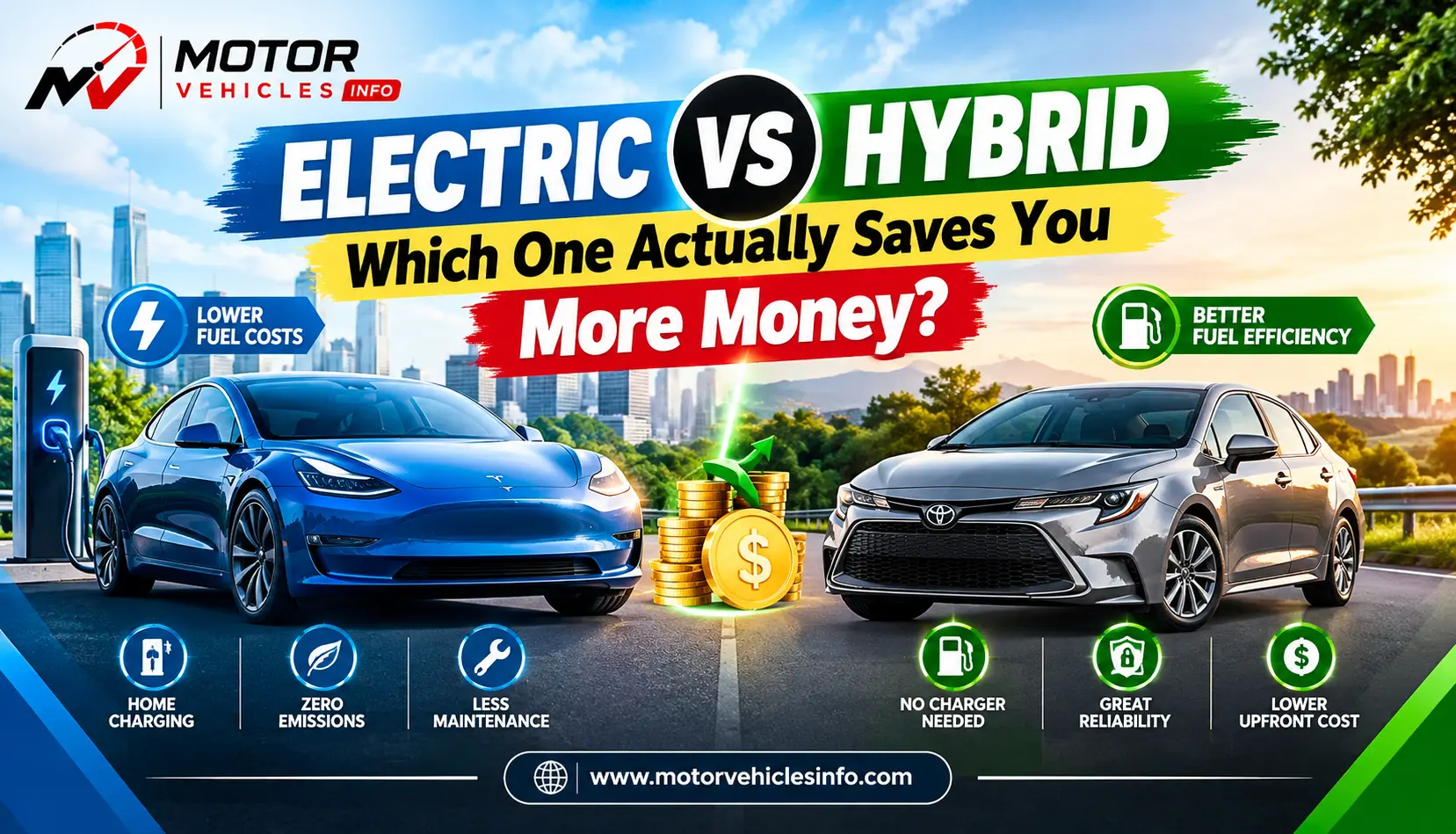
Gas is averaging $4.33 a gallon nationwide, and every ad says it’s time to go electric. So in the electric vs hybrid fight, which one really costs less? The honest answer depends on where you charge, how far you drive, and what you pay for insurance and depreciation.
This guide settles the electric vs hybrid question with current numbers from AAA, the Department of Energy, and Kelley Blue Book. You’ll get real math, the hidden costs, and a clear pick for your driving style. Whether you’re a first-time buyer, a used-car shopper, or a fleet manager, the hybrid vs electric decision comes down to the same few numbers.
Key Takeaways
- For most U.S. drivers, a hybrid wins the electric vs hybrid money race on price, resale value, and simplicity.
- An EV saves the most only with home charging. In the EV vs hybrid contest, public fast charging eats most of the savings.
- Federal EV tax credits ended September 30, 2025, so sticker price matters more than ever.
- A plug-in hybrid pays off only if you plug in nearly every day.
- Insurance, registration fees, and depreciation can swing your total by thousands.
Electric vs Hybrid vs Plug-In Hybrid: What’s the Real Difference?
A regular hybrid (HEV) pairs a gas engine with a small battery that recharges itself through braking. You never plug it in. A plug-in hybrid (PHEV) has a bigger battery you charge from an outlet. A battery-electric vehicle (EV) has no gas engine at all.
Hybrid vs Plug-In Hybrid: How They Differ
The difference between hybrid and plug-in hybrid comes down to battery size. The Department of Energy says a PHEV can cover roughly 15 to 60-plus miles on electricity alone before the gas engine joins in. A regular hybrid only uses electricity in short bursts. In the phev vs hybrid debate, the PHEV costs more upfront but can cut fuel use sharply if you plug in daily. Think of electric vs hybrid vs plug-in hybrid as a ladder: the more you plug in, the more you rely on cheap grid power and the less on gasoline.
Electric Cars vs Hybrid Cars at a Glance
| Hybrid (HEV) | Plug-in hybrid (PHEV) | Electric (EV) | |
| Needs a plug? | No | Yes, for best savings | Yes, always |
| Gas engine? | Yes | Yes | No |
| Electric-only driving | Brief bursts | About 15–60+ miles | All driving |
| Best for | Mixed driving, no home charger | Short commutes plus road trips | Home charging, predictable routes |
In short, the electric vs hybrid choice is really a question about your driveway, your commute, and your budget.
Electric Cars vs Hybrid Cars: Upfront Price and Monthly Payments
Price is where electric cars vs hybrid cars split first, and it shapes every other number in the electric vs hybrid comparison. Kelley Blue Book reports the average new EV sold for $55,879 in September 2026, while the average new vehicle of any type sold for about $50,600.
Hybrids sit much closer to gas-car prices. Edmunds lists the 2026 Honda Civic Hybrid sedan from about $30,590, versus about $25,790 for the base gas Civic, although the hybrid starts on a better-equipped trim. The Toyota Corolla Hybrid starts near $25,000.
Federal help is gone. The IRS confirms the new and used clean vehicle credits do not apply to vehicles acquired after September 30, 2025, and the home-charger credit closed for equipment placed in service after June 30, 2026. Some states and utilities still offer rebates, so check yours.
Payments follow price. An extra $8,000 financed at 7% over 60 months adds about $158 a month. That’s the monthly handicap an EV must overcome in any EV vs hybrid showdown before fuel savings even count.
Electric vs Hybrid Costs for First-Time Buyers
First-time buyers often have thin credit and tight budgets. In that case, the lower sticker price of a hybrid usually beats the electric vs hybrid fuel savings, because a lower loan amount means a smaller payment and less risk of owing more than the car is worth.
Expert tip: Compare out-the-door prices, not MSRP. Kelley Blue Book data shows EV incentives averaged about 11% of the sticker price in September, so always ask what discount applies to the exact car you want.
Gas Cars vs Electric Cars vs Hybrids: Yearly Fuel and Charging Costs
Let’s run the numbers on gas cars vs electric cars and hybrids for 15,000 miles a year. We used AAA’s October 16 average of $4.33 a gallon, the EIA’s 18.2-cent average home electricity price, and AAA’s early-October public charging average of 42 cents per kWh.
| Vehicle (illustrative) | Assumption | Yearly energy cost |
| Gas car | 30 mpg | $2,165 |
| Hybrid | 50 mpg | $1,299 |
| PHEV, plugged in daily | 60% electric miles, 40 mpg on gas | $1,223 |
| PHEV, never plugged in | 38 mpg | $1,709 |
| EV, home charging only | 0.30 kWh per mile | $819 |
| EV, 80% home / 20% public | Same efficiency | $1,033 |
| EV, public charging only | Same efficiency | $1,890 |
Assumptions: 15,000 miles a year; the PHEV uses 0.35 kWh per electric mile.
A hybrid saves about $866 a year over the gas car, so electric vs hybrid costs look much closer than the marketing suggests. The EV with mixed charging saves about $1,132. But in a straight electric vs hybrid comparison, the EV beats the hybrid by only $266 a year with mixed charging, or $480 with home charging only.
Home Charging vs Public Charging: The Electric vs Hybrid Swing Factor
Charging location is the biggest swing factor. An EV charged only at public stations costs more to run than the hybrid in our table, which flips the hybrid vs electric verdict entirely. Want your own numbers? FuelEconomy.gov lets you compare specific models side by side.
Hidden Ownership Costs: Insurance, Maintenance, Registration and Repairs
Sticker price and fuel are only part of the electric vs hybrid story. The smaller bills add up over five or ten years.
Insurance. Insurify data shows EV owners paying about $4,058 a year versus $2,732 for gas cars. Bankrate points to higher repair bills as the reason. Insurance shoppers should get quotes before choosing, and our insurance guides can help.
Maintenance. The Department of Energy says hybrids and plug-ins need maintenance similar to gas cars, while EVs need less thanks to fewer fluids and moving parts. Regenerative braking also helps pads last longer, so a brake pad replacement comes less often. Many hybrids still need transmission fluid changes.
Registration. Many states add fees for electrified cars. Ohio charges $200 a year for EVs, $150 for plug-in hybrids, and $100 for hybrids. Check your state’s registration rules before you buy.
DIY note: Hybrid and EV high-voltage systems are not a driveway project. Leave orange-cable work to trained technicians. Home mechanics comparing electric vs hybrid repair costs should remember that a hybrid still has a full gas engine to service, while an EV trades that for pricier electronics.
Depreciation, Resale Value and Battery Replacement: The Cost Nobody Budgets For
Depreciation is often the highest cost of all, and it’s where the electric vs hybrid gap is widest. iSeeCars found that five-year-old EVs lost 57.2% of their value, versus 35.4% for hybrids and 41.8% for all vehicles. In dollars, that’s about $28,435 for the average EV and $13,010 for the average hybrid.
Battery fear drives some of that gap. Hybrid and EV batteries typically carry at least eight years or 100,000 miles of warranty, per Kelley Blue Book. Out of warranty, a large EV pack replacement can mean a four- or five-figure bill.
Used car sellers and buyers should treat battery health as a pricing tool: in a used EV vs hybrid deal, a documented battery report can justify a higher price. Buying used? Ask for a battery health report. And remember, even hybrids and EVs carry a 12-volt battery that can strand you, so our alternator vs battery guide still applies.
The Plug-In Hybrid Trap: When a PHEV Saves Money and When It Doesn’t
A PHEV saves money when you charge nightly, your commute fits inside the electric range, and power is cheap. Our table shows it: $1,223 a year when plugged in versus $1,709 when never charged.
The trap is buying one and skipping the plug. The Department of Energy notes that a PHEV’s operating costs depend on how often it runs in all-electric mode. Without charging, you haul a heavy battery for little benefit and pay more upfront.
In the plug-in hybrid vs hybrid choice, the rule is simple. The same logic applies to PHEV vs electric: a plug-in hybrid only beats a full EV when range anxiety or charger access is your real obstacle. If you can’t plug in most days, buy a regular hybrid.
Break-Even Point: How Many Years Until an EV or Hybrid Pays Off?
These illustrative scenarios use the fuel savings above and assumed price premiums.
| Scenario | Extra upfront cost | Yearly savings | Break-even |
| Hybrid vs similar gas car | $3,000 | $866 | About 3.5 years |
| EV vs similar gas car | $8,000 | $1,132 | About 7 years |
| Same EV, insurance $500 higher | $8,000 | $632 | About 13 years |
| EV vs similar hybrid | $8,000 | $266–$480 | About 17–30 years |
The takeaway for electric vs hybrid buyers: hybrids pay back fast. An EV pays off against a gas car, but rarely against a hybrid on fuel alone. Higher mileage, cheap home power, or a steep discount on a used EV can change that. Fleet and small-business managers should run this electric vs hybrid math per vehicle, since high daily mileage shortens the EV break-even.
USA vs Canada vs Australia: Incentives, Fuel Prices and Electricity Rates
USA: Federal purchase credits are gone. Gas and power prices vary widely, so check AAA’s state gas averages and your utility’s rate.
Canada: Reports say the federal Electric Vehicle Affordability Program returned in February 2026, offering up to $5,000 for EVs and $2,500 for plug-ins. Confirm current rules with Transport Canada.
Australia: Incentives are mostly state-based and change often, so check your state government’s site.
Importing or exporting a used car? Rules, taxes, and battery regulations differ by country, so verify before you ship. The electric vs hybrid math changes sharply with local fuel prices, power rates, and incentives.
Real-World Range: Cold Weather, Road Trips, Towing and Charging Access
Range is where the electric vs hybrid debate gets practical. Cold hits EVs hardest. In AAA’s tests, range fell 41% on average at 20°F with the heater on and 17% at 95°F with the A/C running. Those were older models, and many newer EVs use more efficient heat pumps, but plan for a winter drop.
Hybrids and PHEVs have a gas backup, so road trips stay simple. EV road trips work well if fast chargers line your route, and the DOE station locator helps you check. Towing drains an EV’s range quickly, so heavy haulers should favor a hybrid.
No home charger? Apartment dwellers usually do better with a hybrid. In real-world electric vs hybrid driving, charging access matters more than any spec-sheet range number.
Which Should You Buy? Best Hybrid and Electric Cars by Budget and Driving Style
Use this table to build your electric vs hybrid shortlist. Starting prices shift, so confirm with a dealer. Edmunds named the Civic Hybrid, Tesla Model 3, Hyundai Ioniq 5, Hyundai Palisade Hybrid, and Ford Maverick its 2026 Top Rated winners.
| Your situation | Smart pick | Rough starting price |
| Budget commuter, no charger | Toyota Corolla Hybrid (affordable hybrid cars) | About $25,000 |
| Comfort-minded commuter | Honda Civic Hybrid or Camry | $30,000–$31,000 |
| Big family, long trips | Hyundai Palisade Hybrid | Above $41,000 |
| Budget truck | Ford Maverick | About $28,000 |
| Home charging, short daily miles | Nissan Leaf (one of the best electric cars for the money) | About $30,000 |
| Electric SUV | Hyundai Ioniq 5 | From about $35,000 |
For the best hybrid cars on a tight budget, start with the Corolla and Civic. For the best electric cars, start with the Leaf, Ioniq 5, and Model 3. Whichever you pick, run the electric vs hybrid numbers for your own mileage first.
Common Mistakes to Avoid
- Comparing sticker prices and ignoring resale value.
- Assuming you’ll charge 100% at home.
- Buying a PHEV and never plugging it in.
- Skipping insurance quotes before signing.
- Skipping the NHTSA recall check on used cars.
Frequently Asked Questions
Is electric vs hybrid cheaper over five years?
For most drivers, a hybrid is cheaper over five years once you add purchase price, insurance, and depreciation. That electric vs hybrid result holds unless you drive a lot and charge at home. An EV can win if you charge at home, drive high mileage, and find a good price.
What is the difference between hybrid and plug-in hybrid?
A hybrid charges itself and never plugs in. A plug-in hybrid has a larger battery you charge from an outlet, giving it real electric-only range before the gas engine starts.
PHEV vs hybrid: which is better if I can’t charge at home?
A regular hybrid. A PHEV costs more and loses most of its advantage without regular charging.
Are gas cars vs electric cars really cheaper to fuel in 2026?
Yes. With gas near $4.33, an EV charged mostly at home costs far less to fuel than a 30 mpg gas car. Public fast charging narrows the gap considerably.
Does a hybrid vs electric car cost less to maintain?
Usually not. In the hybrid vs electric maintenance comparison, EVs generally need less maintenance because they have fewer fluids and moving parts. Hybrids still need engine service, though they are typically cheap to keep running.
Which holds value better in the electric cars vs hybrid cars matchup?
Hybrids. iSeeCars data shows hybrids lose about 35% of their value in five years, while EVs lose more than 57%.
How long do hybrid and EV batteries last?
Warranties typically cover at least eight years or 100,000 miles. Many packs last longer, but out-of-warranty replacement on an EV can be costly.
Is there still a tax credit for hybrid or electric cars?
In the EV vs hybrid decision, incentives no longer tip the scale at the federal level. No federal purchase credit applies to vehicles acquired after September 30, 2025. Check your state, utility, and any local programs for rebates.
Final Thoughts
So, electric vs hybrid: which saves more? For most Americans in 2026, the hybrid wins the electric vs hybrid money test. It costs less upfront, holds its value, and needs no charger. The EV wins for home-charging, high-mileage drivers who find a fair price. The plug-in hybrid fits a narrow middle: short commutes, a reliable outlet, and the occasional road trip.
Settle your electric vs hybrid decision with numbers, not hype. Run your own figures on FuelEconomy.gov, get three insurance quotes, and read more in our electric vehicle guides before you sign anything.