To purchase a vehicle without examining its VIN is like entering into an agreement without having a look at the terms of that agreement. Despite being just a random combination of letters and numbers, it tells everything about the car, from the details of the manufacturing process to all the events that have taken place since then.
But if you have ever struggled to decode a VIN or understand the meaning behind the series of 17 digits that appear on your vehicle’s title plate or on the window sticker of your car, then you are certainly not the only one to experience such confusion, and our guide will definitely help you here.
What is a VIN Number of a Car?
A VIN, short for Vehicle Identification Number, is the 17-character code stamped onto pretty much every car, truck, or motorcycle built since 1981. No two vehicles share the same one – it’s as close to a fingerprint as a car gets.
Every chunk of that code means something. Part of it points to the manufacturer, part of it describes the model, and the rest works like a serial number that separates your car from the thousands of identical ones that rolled off the same line.
Dealers use it to confirm factory specs. Insurers use it to price a policy. Police use it to check whether a car’s been reported stolen. The VIN number of a car does a lot of quiet work behind the scenes.
Where to Find Your Car’s VIN?
There are a few main places where you can find the VIN on a car:
You do not have to look far because they are rarely seen by anyone who is looking for them. All you have to do is get out of the car and look through the lower right-hand corner of the windshield.
A few other places worth checking:
- The door jamb on the driver’s side, usually on a sticker near the hinge
- Stamped right into the engine block
- Printed on your title, registration, or insurance card
- Near the windshield washer fluid reservoir on some models
If you’re looking at a used car and something feels off, check two or three of these spots and compare them. If the numbers don’t match, walk away – that’s not a paperwork mix-up; that’s a warning sign.
Is a VIN Number the Same as a Chassis Number?
It’s almost exactly alike, but not really. There are actually many people who mistake the chassis number with the VIN number. It is noteworthy that the chassis number and VIN are identical in almost all modern vehicles.
The chassis number refers to the number marked on the original chassis frame. In modern cars, the chassis number and VIN are identical. For older cars, however, there will often be separate numbers for the chassis and engine that don’t correspond to anything in a modern VIN.
So if you come across a Chassis Number Decoder somewhere, it’s almost certainly doing the same job as a VIN decoder — just under a different name, depending on which part of the world you’re in.
Step-by-Step Guide to Vehicle ID Number Lookup
Running a vehicle ID number lookup sounds technical, but it’s really not much harder than typing an address into a maps app.
First, get the VIN written down exactly right. All 17 characters, no guessing. One thing that trips people up: VINs never use the letters I, O, or Q, so if you think you see one of those, look again — it’s probably a 1, a 0, or a misread character.
Next, pick a decoder you actually trust. Don’t go for websites that have lots of pop-ups. Instead, choose to use either the website of the car’s manufacturer or a reputable government website.
Enter your VIN and see what information is generated by it. A good decoder will give you information about the make, model, model year, engine type, and place of manufacture.
Then compare that to whatever the seller told you. If the listing says one engine and the VIN says another, that’s worth a conversation before you hand over any money.
And if the car’s used, don’t stop at decoding. Pull a history report too — decoding tells you what the car was supposed to be, not what’s happened to it since.
Best Tools to Decode a VIN and Websites in 2026
Some decoders barely scratch the surface. Others go deep enough to show you factory options and past recalls. It’s worth knowing the difference before you rely on one.
| # | Decoder | Free returns | Paid upgrade path | Best for | |||
| 1 | Carlytics free decode | Make, model, year, engine, fuel, body, factory, country, recalls | Mileage, accidents, theft, listings — EUR 8.90 one-time | European buyers wanting the most complete free decode, with a cheap paid upgrade | |||
| 2 | vPIC (US gov) | Make, model, year, engine, plant (US-authoritative) | Not offered — separate paid services needed for history | US-built vehicles, technical users, raw fields | |||
| 3 | Vindecoder.eu | Make, model, year, body, engine, transmission | Pay-per-report history available, no flat EU price | Developers needing API access, occasional global decoding | |||
| 4 | VinCheck.info | Basic specs, partial US history teaser | Upsell-heavy paid history (US-focused) | US vehicles only, free preview before paid history | |||
| 5 | VinAudit free decode | Basic specs (US-tuned) | US-only paid reports | Quick US-vehicle basic decode |
If you’re specifically trying to decode a Ford VIN, skip the generic tools first and go straight to Ford’s own portal — you’ll get more out of it.
Can you get a free car history report to check the VIN?
Yes, though don’t expect the full picture. There are a handful of free resources that let you check the VIN for the big red flags — salvage titles, open recalls, reported theft.
The NHTSA site flags active recalls at no charge. The National Insurance Crime Bureau offers a limited free search for theft and total-loss records too.
But the deeper stuff — full ownership history, service records, accident timelines — usually sits behind a paywall. If you’re about to spend several thousand dollars on a used car, paying twenty bucks for a proper report isn’t really optional. It’s just common sense.
VIN history
Vehicle identification numbers first appeared in 1954, but for decades after that, there was no real standard — each automaker used its own format. If you’re trying to decode a VIN from the ’50s through 1980, modern decoding tools won’t help you; your best bet is contacting the DMV or the manufacturer directly. Before 1954, cars were identified by engine numbers instead, but that created its own headaches, since engines were swapped out often enough to make tracking a specific vehicle unreliable.
Everything changed in 1981, when the National Highway Traffic Safety Administration required all vehicles to carry a standardized 17-digit VIN — the format still in use today.
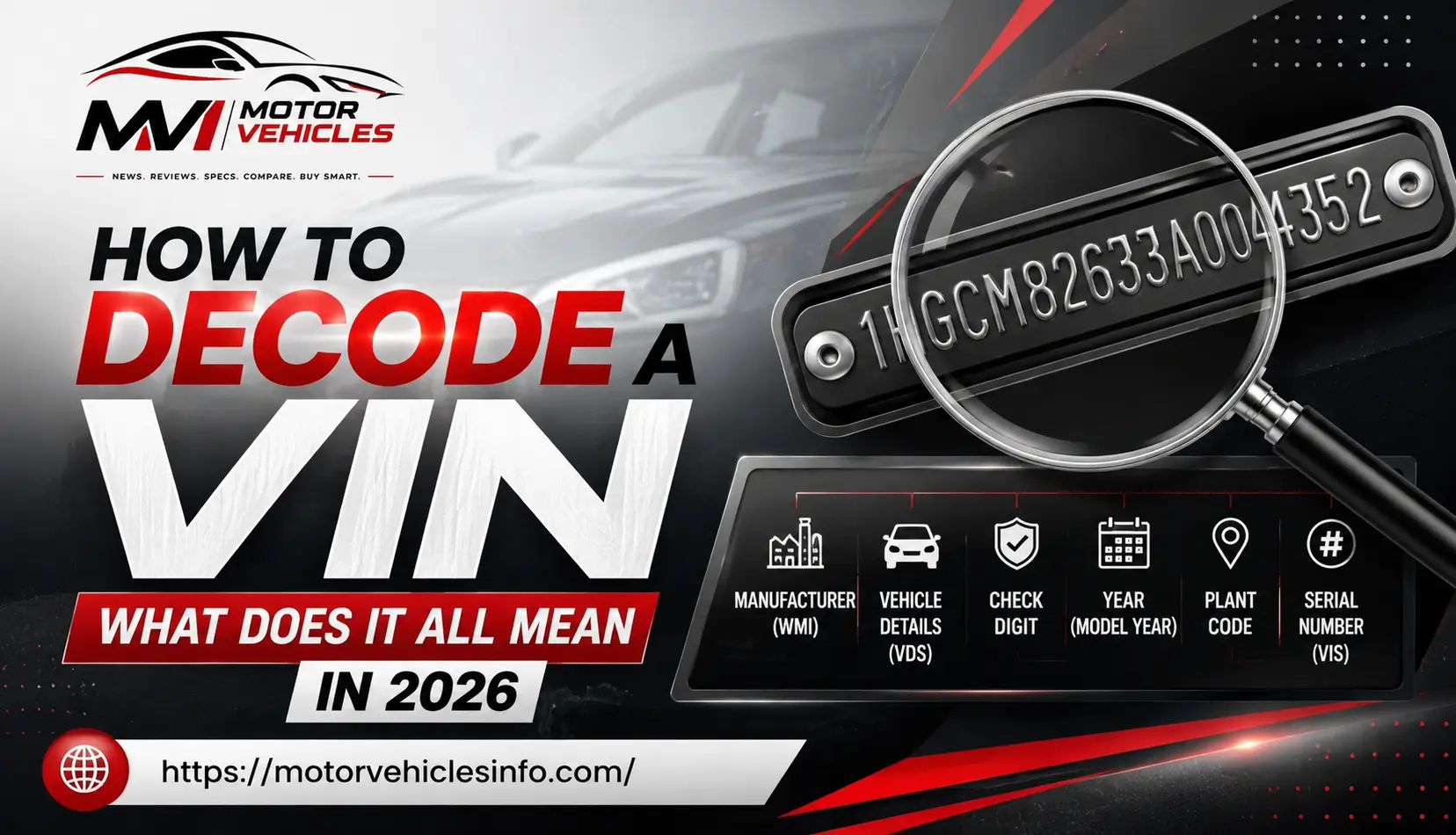
The Structure of a VIN: WMI, VDS, VIS
Once you know how a VIN is put together, decoding one stops feeling like guesswork. There are three main sections, and each does a different job.
| Position | Section | What It Represents | Example |
| 1–3 | WMI (World Manufacturer Identifier) | Manufacturer and country of origin | 1FA = Ford, USA |
| 4–8 | VDS (Vehicle Descriptor Section) | Model, body type, engine, restraint system | Varies by manufacturer |
| 9 | Check Digit | Mathematically validates the VIN is authentic | 0–9 or X |
| 10 | Model Year | Encoded letter or number for the year | L = 2020, M = 2021 |
| 11 | Plant Code | Factory where the vehicle was assembled | Manufacturer-specific |
| 12–17 | VIS (Vehicle Identifier Section) | Unique serial/production number | Sequential |
World Manufacturer Identifier (WMI)
Look at the very first character of a VIN, and you already know roughly where that car was built. A 1, 4, or 5 usually means North America. A W points to Germany, J to Japan, K to Korea. From there, the next two characters get more specific — narrowing things down to the exact manufacturer, and sometimes even the type of vehicle it is.
This is worth checking early when you decode a VIN. Say someone’s trying to sell you a “European-built” Audi, but the WMI shows it was actually assembled in North America — that mismatch alone is reason enough to ask more questions before you hand over any money.
Vehicle Descriptor Section (VDS)
Positions 4 through 8 are where manufacturers get the most creative freedom, and honestly, it’s the trickiest part of any vehicle ID number lookup. These characters usually cover body style, engine type, transmission, and sometimes restraint system info — but every automaker codes this section a little differently. That’s why a generic VIN decoder can fall flat on the details, especially once you get outside the mainstream models. Try to decode a Ford VIN and then run a Korean import through the same tool — you’ll often notice one comes back a lot more complete than the other.
Check Digit
Position 9 looks like just another character in the sequence, but it’s actually a built-in math check. It’s calculated from a weighted formula applied to the other 16 characters in the VIN. If that math doesn’t add up to what’s printed on the vehicle, you’ve got a problem — either someone made a typo somewhere, or you might be dealing with a VIN that’s been altered on purpose. Checking this digit is one of the quickest ways to spot VIN cloning — a scam where someone lifts a legit VIN off one car and slaps it onto a stolen one to hide what it really is. It’s a detail a lot of buyers skip right past, but catching it early can save you from a mistake that costs a lot more than a little extra time.
Model Year and Plant Code
So what is the VIN number telling you about age and origin? Position 10 answers the “when” — it uses a letter-based cycle for the VIN number model year that repeats every 30 years, skipping letters like I, O, Q, U, and Z so they’re never confused with numbers. Position 11 answers the “where,” identifying the exact assembly plant. This matters more than people expect — buyers researching build quality often find real differences between plants producing the same model, and it’s also a handy way to confirm a car’s documented origin actually matches reality.
Vehicle Identifier Section (VIS)
The last six characters make up the production sequence — basically, the car’s spot in line on the assembly floor for that specific model year and plant. Think of it as a mini chassis number decoder built into the VIN itself: two vehicles can share the exact same trim, engine, and specs, and their VIS characters will still be different, because no manufacturer reuses the same VIN number on a car within a 30-year stretch.
So whether you’re doing a full vehicle ID number lookup before handing over a deposit, or you just want to search a VIN number out of curiosity, knowing what these five sections mean turns that random-looking string of letters and numbers into a pretty detailed snapshot of the car’s history.
Why You Need to Decode a VIN Before Buying a Car
Most buyers skip this step because they’re already daydreaming about driving the car home. That’s exactly when you need to decode a VIN.
Kicking tires and popping the hood won’t tell you if the car’s been totaled, has a branded title, or is even the trim the ad claims. A vehicle ID number lookup pulls from manufacturer records, not the seller’s word.
A VIN decoder gives you the basics: make, model, VIN number, model year, engine, and where it was built. Trying to decode a Ford VIN? Ford’s system is pretty clear, so most decoders breeze through it. Some folks call this a chassis number decoder since it’s stamped into the frame, but same 17 characters, same job.
What is the VIN number, really? The car’s fingerprint. No two alike. Search a VIN number before you buy, and you’re not guessing anymore.
Insurers want it, lenders want it, and future buyers will expect you to have checked it. Check the VIN now, save yourself a headache later.
Common Mistakes to Avoid When You Decode VIN Information
Even with a solid decoder, it’s easy to trip yourself up. A few things worth watching for:
- Mixing up similar-looking characters. Remember, I, O, and Q never appear in a real VIN — if you spot one, you’ve misread something.
- Trusting only one source. If a report looks off compared to the listing, run the VIN through a second tool before assuming the worst.
- Glossing over the check digit. Character nine exists specifically to catch fraud and typos, so a mismatch there deserves a closer look, not a shrug.
- Assuming decoded specs describe the car’s condition. A decoder tells you what the car was built with, not how it’s been treated since.
- Skipping the history report because the decode looked clean. Decoding and history checking answer two different questions — you really need both.
Make it a point to spend the additional ten minutes deciphering your VIN properly before purchasing. This is one simple task that has helped many people avoid getting into a car that they would immediately regret once they took delivery.
FAQs
What does a VIN actually tell you?
Manufacturer, country of origin, model, body style, engine, model year, assembly plant, and a unique production number — basically a build sheet compressed into 17 characters.
Is decoding a VIN really free?
Basic decoding usually is, through government or manufacturer sites. Full history reports — accidents, titles, ownership — almost always cost money, since that data comes from paid sources.
Is the chassis number the same thing as the VIN?
On modern cars, yes, just a different name for the same number. Older vehicles are where the two can differ.
How can I tell if a VIN has been tampered with?
A check digit (position 9) not adding up is the biggest red flag. Also watch for the letters I, O, or Q — they never appear in a real VIN, so seeing one means a misread.
Why do decoders behave differently depending on the brand?
Positions 4–8 aren’t standardized across manufacturers, so coverage varies by brand. For specific makes like Ford, the manufacturer’s own portal often fills gaps a generic decoder misses.
Does decoding a VIN replace a vehicle history report?
No. Decoding shows what the car was built as; a history report shows what’s happened to it since. Skipping the report because the decode looked clean is a common mistake.
Can VIN decoding help with older cars, say from the 1960s?
Not really — the 17-character standard only started in 1981. Older cars need a direct check with the manufacturer or DMV instead.
Ready to check a VIN before you buy? Don’t let a clean-looking listing fool you — decode the VIN, pull a history report, and check for salvage titles, branded titles, and odometer rollback red flags before you hand over a single dollar. A few minutes of checking now can save you thousands later.