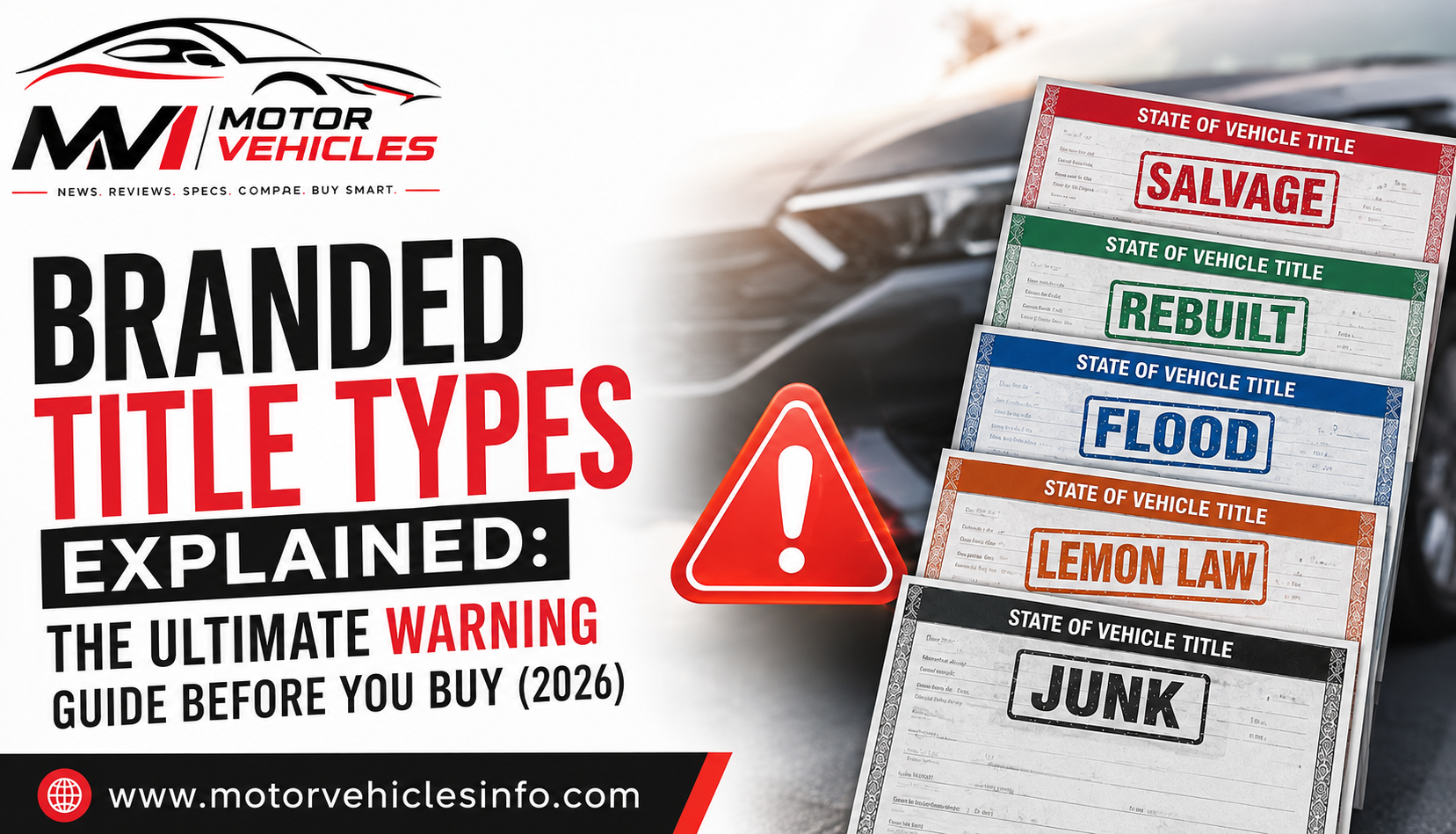
A clean-looking title is one of the easiest things to fake in a used-car deal — and one branded title type’s entry buried in a state record can wipe out 20–40% of a car’s value overnight. If you don’t know how to read the difference between “salvage,” “rebuilt,” “flood,” and “junk,” you’re one signature away from paying full retail price for a car that’s worth a fraction of that.
This guide breaks down every branded title type you’ll actually encounter in the U.S., what each one legally means, how much it hurts resale value, and which brands are dealbreakers versus which ones are quiet bargains if you know what you’re doing.
What Is a Branded Title?
A branded title is a permanent notation added to a vehicle’s legal title by a state’s Department of Motor Vehicles (DMV) after the car has been declared a total loss, stolen and recovered, flooded, or bought back under a state lemon law. Once a brand is applied, it’s meant to follow the vehicle for life — every future title issued in any state is supposed to carry that same brand forward.
The keyword is “supposed to.” Brands don’t always transfer cleanly across state lines, which is exactly how a scam called title washing happens — but that’s a separate problem covered in our full title washing guide. For now, focus on knowing what each brand actually means, because “branded title” isn’t one thing — it’s a category with very different risk levels underneath it.
Branded Title Types at a Glance
| Title Brand | What Triggers It | Typical Value Hit | Driveable? |
|---|---|---|---|
| Salvage | Insurer declared total loss, not yet repaired | 40–60% below market | No, until rebuilt & inspected |
| Rebuilt / Reconstructed | Salvage vehicle repaired and passed state inspection | 20–40% below market | Yes |
| Flood | Water damage to the point of total loss | 30–50% below market | Case-by-case |
| Lemon Law Buyback | Manufacturer repurchased under state lemon law | 10–25% below market | Yes |
| Junk / Non-Repairable | Damage too severe to ever legally re-title | 0% — cannot be driven or sold as a vehicle | No, parts only |
| Bonded / Certificate of Title Bond | No proof of prior ownership, title reconstructed | 10–20% below market | Yes |
Salvage Title
A salvage title is issued when an insurance company pays out a total-loss claim on a vehicle — usually because the estimated repair cost exceeds 70–90% of the car’s actual cash value (the exact threshold varies by state). At that point, the insurer takes ownership, and the state marks the title “salvage” before the car is auctioned off, typically to a rebuilder or a parts yard.
A car with a salvage title cannot legally be driven or registered for road use in almost every state. It exists in a kind of legal limbo until someone repairs it, passes a state salvage inspection, and applies for the next brand on this list.
What to watch for: Salvage titles get sold at auction sites like Copart and IAA, and some sellers list a salvage-title car without disclosing it clearly, hoping the buyer won’t check. Always confirm the title status before you negotiate price, not after.
Rebuilt / Reconstructed Title
A rebuilt title (also called “reconstructed” in several states) is what a salvage title becomes once the vehicle has been repaired and passed a state-mandated inspection confirming it’s safe to drive. This is the brand you’re most likely to encounter on a used car that’s actually for sale and on the road.
Rebuilt titles are legal to drive and register, but they carry real risks that inspections don’t always catch:
- Airbags that were never properly replaced or reset
- Frame damage that was straightened rather than replaced
- Electrical or sensor issues from water or impact damage
- A resale value that stays permanently 20–40% below a clean-title equivalent, no matter how good the repair was
The math that matters: A rebuilt title can be a legitimate bargain if the repair was done professionally and the discount reflects the real risk — but it should never be priced close to a clean-title car. If a seller is asking within 10–15% of clean-title value for a rebuilt car, that’s a red flag on its own.
Flood Title
A flood title is applied when a vehicle was submerged in water to the point an insurer declared it a total loss. Flood damage is uniquely dangerous because it can look completely fine on the surface while corrosion quietly destroys wiring harnesses, control modules, and structural components over the following 6–18 months.
Unlike collision damage, flood damage doesn’t always show up on a pre-purchase inspection unless the mechanic specifically checks for it — musty odor under the carpet, water lines inside the fuse box, silt in the seat-track bolts, or fogging inside interior light housings.
Some states issue a separate “flood” brand; others fold flood damage into the general “salvage” or “junk” category depending on severity. Because of this inconsistency, a flood history can sometimes travel with a car without a dedicated brand showing up at all — which is exactly why a full vehicle history pull matters more here than almost any other brand on this list.
Lemon Law Buyback Title
A lemon law buyback title is issued when a manufacturer repurchases a new vehicle from its original owner because it had a defect the dealer couldn’t fix after a reasonable number of attempts, under that state’s lemon law. This is fundamentally different from every other brand here — it’s not about crash or water damage; it’s about an unresolved manufacturing defect.
That said, lemon buybacks carry a real value hit (typically 10–25%) because:
- The underlying defect may recur, especially with electrical or drivetrain issues
- Some states allow the manufacturer to resell the car after “repairing” it, without a guarantee the fix fully worked
- Buyers correctly price in the uncertainty, even when the specific defect was resolved
Worth knowing: A lemon buyback is sometimes the least risky brand on this list if you can get service records showing exactly what the defect was and confirmation it was fixed under warranty. It’s a paperwork problem, not always a mechanical one.
Junk / Parts-Only Title
A junk title (also called “non-repairable” in some states) means the vehicle has been legally determined to be beyond economical or safe repair for road use, ever. A junk-titled vehicle cannot be re-registered or driven — it can only be sold for parts or scrap metal.
If you see a “junk” or “non-repairable” brand on a car being sold as a running, driving vehicle, that’s not a discount opportunity — it’s a seller trying to move a car that has no legal path back onto the road. Walk away.
Other Branded Title Types You’ll See Less Often
- Bonded Title / Certificate of Title Bond: Issued when the owner can’t produce a valid prior title (common with inherited cars, storage-unit purchases, or out-of-state imports). The state requires a surety bond instead of the original paperwork. Legal and drivable, but it can complicate resale.
- Manufacturer Buyback (non-lemon): Similar to a lemon buyback but repurchased for reasons outside the state’s lemon law process — recall-related repurchases, for example.
- Theft Recovery: Applied when a stolen vehicle is recovered after the insurer already paid out the claim. Often combined with another brand depending on the condition it was found in.
- Odometer Rollback / Not Actual Mileage: Technically a separate flag rather than a title “brand” in most states, but it’s frequently discovered alongside a branded title during a full history check — see our full odometer rollback detection guide for how to catch this specifically.
How Much Does a Branded Title Lower Resale Value?
Every branded title type costs you money at resale, but the size of the hit depends entirely on which brand it is and how the damage was documented:
- Salvage (undriveable): Not resold as a road vehicle — value is scrap/parts only
- Rebuilt/Reconstructed: 20–40% below a comparable clean-title car
- Flood: 30–50% below market, sometimes more once buyers see “flood” specifically
- Lemon buyback: 10–25% below market
- Junk/non-repairable: No resale value as a vehicle
These are directional ranges, not guarantees — the actual discount a specific car should command depends on the make, the severity of the original damage, and how well the repair was documented. Appraisal tools and a qualified mechanic’s inspection are the only way to get a real number for a specific VIN.
Can You Insure or Finance a Branded-Title Car?
Insurance: Most major insurers will only offer liability coverage on a rebuilt-title vehicle, not full comprehensive/collision — and some decline to write a policy at all. A handful of insurers specialize in branded-title coverage, but expect a smaller pool of options and closer inspection requirements before they’ll issue a policy.
Financing: Traditional auto lenders are often reluctant to finance salvage or rebuilt-title vehicles because the car’s collateral value is harder to pin down. Buyers with branded-title cars frequently end up paying cash, using a specialty lender, or accepting a higher interest rate than they’d get on a clean-title purchase.
Neither of these facts should be a surprise after reading this guide — a branded title changes what a car is worth to everyone in the transaction, not just you.
How to Check for a Branded Title Before You Buy
Never take a seller’s word — or a printed title — at face value. A physical title can be washed, altered, or simply out of date if the brand was applied in a different state. Before you hand over money:
- Pull the VIN from the dashboard (driver’s side, visible through the windshield) or the driver’s door jamb — never rely on a number the seller texts you.
- Run a free preliminary check through the National Insurance Crime Bureau’s VINCheck tool to see if the VIN has been reported stolen or declared a total loss by a participating insurer.
- Check for open safety recalls tied to the VIN at NHTSA.gov/recalls — a recall isn’t a title brand, but an unresolved one is a separate red flag worth knowing before you buy.
- Pull a full NMVTIS-backed title history report through an approved data provider — this is the only check that reliably surfaces every state’s title brand history on the VIN, since all 50 states are federally required to report into it.
- For the fastest, most complete picture in one pass, run the VIN through our complete guide to checking a used car’s history before you buy — it walks through free and paid options side by side so you’re not paying for more report than you need.
If you specifically want a report built for a lower-budget used-car purchase, our breakdown of the best VIN check services for buying a used car under $10,000 compares the providers that catch title brands accurately without the $40+ price tag some sites charge.
When a Branded Title Is Actually a Smart Buy
Not every branded title type is a trap. A rebuilt-title car can be one of the smartest used-car purchases available if three things line up:
- The original damage was cosmetic or non-structural (hail damage totaling an older car is a classic example)
- You can get itemized repair records and photos from the rebuild, not just a passed inspection sticker
- The asking price already reflects the 20–40% discount buyers expect — not close to clean-title pricing
Buyers who specifically shop for well-documented rebuilt titles can save thousands on a mechanically sound car — the catch is you have to do the verification work a typical buyer skips.
FAQ: Branded Title Types
Does a branded title mean the car is unsafe to drive?
Not automatically. A rebuilt or lemon-buyback title can be perfectly safe if it was properly repaired or the defect was resolved. Salvage and junk titles are the ones that mean the car isn’t legally drivable at all.
Can a branded title be removed from a vehicle’s history?
No — legally, a title brand is meant to be permanent and follow the vehicle across every future title issued in any state. When a brand appears to disappear, it’s almost always a sign of title washing, not a legitimate removal.
Is it illegal to sell a car with a branded title without disclosing it?
Yes, in every state. Sellers are legally required to disclose known title brands. That legal requirement doesn’t stop it from happening — which is exactly why buyers need to verify the title independently rather than relying on seller disclosure alone.
Do all states use the same branded title types?
No. Every state has some version of salvage, rebuilt, and junk brands, but the exact terminology, thresholds, and additional brands (like flood or bonded) vary. This inconsistency is part of what makes title washing possible across state lines.
What’s the difference between salvage and junk titles?
A salvage title means the car can potentially be repaired, inspected, and re-titled as rebuilt. A junk title means the state has determined the vehicle can never legally return to the road — it exists only to be sold for parts or scrap.
The Bottom Line
Branded title types aren’t automatically dealbreakers, but they’re never something to discover after you’ve already paid. Salvage and junk brands should stop a purchase outright unless you’re specifically buying for parts. Rebuilt, flood, and lemon buyback titles can be legitimate deals — but only at the right price, with the right documentation, and only after you’ve independently verified the title yourself instead of trusting what’s printed on the paper in front of you.