You turn the dial to max cold, point every vent at your face, and… nothing. Warm air, weak airflow, or a compressor that won’t even click on. A car AC not cold is one of the most common complaints shops hear once the weather warms up, and it almost never means you need a whole new system.
This guide walks through why your car AC is not cold, how to tell the difference between a weak system and a dead one, which fixes you can try in your own driveway, and when a car ac not cooling properly means it’s time to call a professional. We’ll also cover car AC recharge cost in 2026, whether a DIY can from AutoZone auto parts or Advance Auto is worth it, and how refrigerant type changes the whole equation.
Car AC Not Cold: How to Diagnose the Problem (Quick Self-Test)
Before you spend a dime, run this two-minute self-test. It’s the fastest way to figure out why your car AC is not cold and whether the fix is simple or something bigger.
- Start the engine and turn the AC to max cold, recirculate on, fan on high. Let it run for five minutes.
- Feel the vents. Air that’s merely cool but not icy points to one set of problems; air that’s the same temperature as outside air points to another.
- Listen for the compressor. You should hear or feel a faint click and a slight change in engine idle when the AC compressor engages. If you hear nothing, the compressor clutch likely isn’t engaging at all.
- Check the cabin air filter. A clogged filter won’t cause warm air, but it will make a working AC system feel underpowered.
- Look under the hood. With the AC on, check whether the two lines running to the compressor feel different temperatures — one should be noticeably colder than the other. If both lines feel the same, refrigerant is likely low or the compressor isn’t cycling.
This quick test won’t replace a proper gauge reading, but it tells you whether your car AC not cold issue is likely a simple refrigerant top-off or a deeper mechanical or electrical fault. For anyone weighing whether a repair is worth doing versus trading in, it also helps to know your overall repair budget — something we cover in more depth in our guide to extended car warranty coverage for older vehicles.
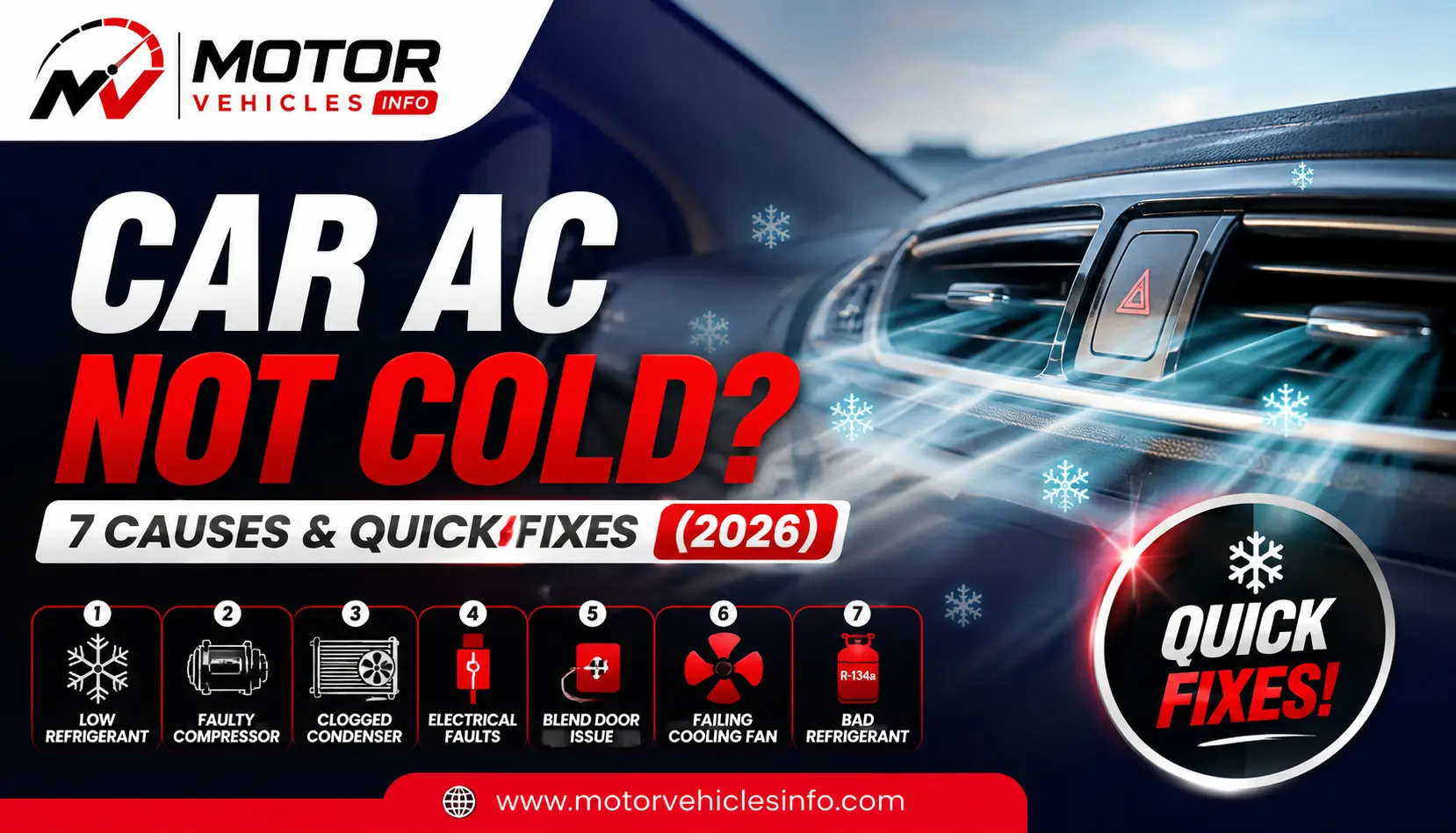
7 Common Causes of Car AC Not Blowing Cold Air
Here are the seven most common reasons behind an air conditioner not blowing cold air in car cabins, ranked roughly from most to least common.
1. Low or Leaking Refrigerant
This is the number one reason a car AC not cold complaint shows up. Refrigerant doesn’t get “used up” the way gasoline does — if the level is low, refrigerant has leaked out through a worn hose, a failing O-ring, or a small crack in the condenser. Even a tiny leak, invisible to the eye, will slowly turn ice-cold air into lukewarm air over weeks or months.
2. A Failing AC Compressor
The compressor is the heart of the system. If its clutch won’t engage, its internal parts have worn out, or its drive belt has failed, the whole system stops working. A failing compressor is often the priciest cause of a car AC not cold complaint, and it’s usually accompanied by a loud grinding or squealing noise.
3. A Clogged or Damaged Condenser
The condenser sits at the front of the car, right behind the grille, where it’s exposed to road debris, bugs, and dirt. When it’s caked in grime or bent from a minor front-end impact, it can’t release heat properly, so the refrigerant never gets cold enough — even if the level is fine.
4. Electrical Faults: Fuses, Relays, and Sensors
A blown fuse, a failed relay, or a faulty pressure sensor can shut the compressor clutch down completely, leaving you with air but no cold air at all. This is one of the more overlooked causes of a car AC not cold problem, because everything else in the system can be perfectly healthy.
5. A Stuck or Broken Blend Door
The blend door controls how much air passes over the heater core versus the AC evaporator. If the actuator that moves it fails, you can get a mix of hot and cold air, or air that’s stuck on “warm” no matter what you set the dial to. You’ll often hear a clicking noise from behind the dashboard when this happens.
6. A Failing Cooling Fan
Your AC condenser needs airflow to shed heat, especially at idle or in stop-and-go traffic. If the electric cooling fan isn’t spinning, the system may blow cold at highway speed but turn warm the moment you’re stuck at a red light.
7. Contaminated or Mismatched Refrigerant
If a previous top-off used the wrong type of refrigerant, or if moisture and air got into the system, the AC can run poorly or not cool at all, even with the “correct” pressure reading on a gauge. This is one reason using the right recharge kit for your specific car matters more than people expect.
Car AC Cool But Not Ice Cold vs. No Cold Air At All: What’s the Difference?
Not every car AC not cold complaint is the same problem, and the distinction matters for diagnosis.
Cool but not ice cold usually means the system is working, just underperforming. Common culprits include a partial refrigerant leak, a dirty cabin air filter restricting airflow, a partially clogged condenser, or high humidity and outside heat simply overwhelming a system that’s otherwise fine. This version of the problem is often fixable with a simple recharge.
No cold air at all is a more serious signal. It usually points to an electrical failure (blown fuse, dead relay, failed pressure switch), a seized or disengaged compressor clutch, or a refrigerant level so low the system’s safety switch won’t even let the compressor turn on — which, ironically, protects the compressor from running dry and destroying itself. If your car AC stops working outright rather than just weakening, treat it as a “get it checked soon” situation rather than a DIY top-off job.
| Symptom | Likely Cause | DIY-Friendly? |
| Air is cool but not icy | Low refrigerant, dirty filter, mild condenser blockage | Often yes |
| Air is same temp as outside | Electrical fault, dead compressor, empty system | Usually no |
| Cold at highway speed, warm at idle | Failing cooling fan | No |
| Cold, then suddenly warm | Refrigerant leak reaching critical low point | Sometimes |
| Musty smell with weak cold air | Clogged cabin filter or evaporator drain | Often yes |
Quick Fixes You Can Try at Home (No Tools Required)
Before assuming your car AC not cold problem needs a shop visit, try these free or near-free steps first.
- Replace the cabin air filter. It’s usually behind the glovebox and takes five minutes with no tools. A clogged filter can make a functioning AC system feel weak.
- Run the AC on recirculate, not fresh air. Recirculate mode cools the already-cool cabin air instead of pulling in hot outside air, and it noticeably improves performance on hot days.
- Check for a tripped fuse. Pop the fuse box cover (the owner’s manual will show you which fuse) and visually inspect the AC-related fuses for a broken filament.
- Clean the condenser fins. If you can see the condenser through the front grille, a gentle rinse with a garden hose (engine off, cool) can clear leaves, bugs, and dust that block airflow.
- Idle the engine and rev slightly. At idle, some compressors move less refrigerant. A slightly higher idle can sometimes confirm whether weak airflow at idle is a fan issue.
- Give it a real test window. Cold air can take a few minutes to fully develop, especially in a car that’s been baking in the sun. Don’t judge the system in the first 30 seconds.
If none of these steps change anything and your car AC not cold symptom persists, the issue is likely refrigerant level, a mechanical part, or an electrical fault — all of which call for a gauge check rather than guesswork.
R-134a vs. R-1234yf: Why Your Refrigerant Type Changes Everything
Not all car air conditioners use the same refrigerant, and mixing them up is a common — and expensive — DIY mistake.
R-134a was the industry standard for most vehicles built between the mid-1990s and roughly 2013–2016, depending on the automaker. R-1234yf has replaced it in the vast majority of vehicles produced since then. The switch wasn’t cosmetic: it was driven by federal environmental policy. Under the American Innovation and Manufacturing (AIM) Act, the EPA is phasing down the production and import of high-global-warming-potential HFCs like R-134a by 85 percent over roughly a decade and a half, which is steadily pushing up the price and shrinking the supply of R-134a while R-1234yf becomes the default.
Here’s why this matters for a car AC not cold repair:
- The two refrigerants are not interchangeable. R-134a and R-1234yf use different fittings specifically so they can’t be cross-contaminated, but low-quality universal kits and improperly adapted fittings can still cause damage if forced.
- Your car’s underhood sticker tells you which one it uses. Look for a label near the radiator support or under the hood listing refrigerant type and capacity — this is the single most reliable way to know what your specific car needs before buying a can.
- R-1234yf recharge kits typically cost more than R-134a kits, both in the shop and off the shelf, because the refrigerant itself is pricier to manufacture.
- Servicing either refrigerant for pay requires certification. Under Section 609 of the Clean Air Act, anyone who repairs or services a motor vehicle air conditioning system for payment must be trained and certified by an EPA-approved program, which is one reason a professional car ac recharge costs more than a DIY can — you’re paying for licensed handling, not just refrigerant.
Getting the refrigerant type wrong doesn’t just fail to fix your car AC not cold problem — it can damage seals, hoses, and the compressor, turning a cheap fix into an expensive one.
DIY Recharge Kit vs. Professional Recharge: Which Should You Choose?
Once you’ve confirmed low refrigerant is the likely cause of your car AC not cold issue, you have two real options.
DIY recharge kits are best when:
- Your car is cooling weakly rather than not at all
- You’ve confirmed your refrigerant type (R-134a vs. R-1234yf) from the underhood sticker
- The system isn’t making grinding, squealing, or clicking noises
- You just want a temporary top-off to get through a hot week
Professional recharge is the better choice when:
- Your car AC stops working entirely rather than just weakening
- You’ve already tried a DIY can and the cold air didn’t last
- You hear unusual noises from the compressor or under the dash
- You want the leak actually located and repaired, not just masked
- Your vehicle uses R-1234yf, which is harder to find in consumer-sized cans and pricier to service
A DIY kit essentially treats a symptom. A professional car AC recharge — done with a recovery machine that pulls a vacuum, checks for leaks, and weighs in the exact refrigerant charge — treats the actual problem. If your car AC not cold issue keeps coming back every few months, that’s a strong signal you have a real leak that a can of refrigerant can only temporarily mask.
AutoZone, Advance Auto & Other Retail Options for DIY AC Recharge
If you’ve decided to try a DIY fix, AutoZone auto parts stores and Advance Auto locations are two of the most common places U.S. drivers turn to first.
Both retailers typically stock:
- Pre-mixed R-134a recharge cans with a built-in pressure gauge
- R-1234yf cans and adapters for newer vehicles
- Stop-leak and system conditioner additives
- Basic AC gauge sets for drivers who want more precise readings
Many locations also offer a free visual inspection or loaner tools program, which is worth asking about before you buy anything — a quick look under the hood can sometimes reveal an obvious leak, a disconnected hose, or a shredded belt that no amount of refrigerant will fix. Staff at these counters can usually point you to the right can once you tell them your make, model, and year, since the correct car AC recharge kit depends entirely on your refrigerant type and system capacity.
A word of caution: pressure gauges on consumer-grade cans are a rough guide, not a precise diagnostic tool. If your gauge reads “full” but your car AC not cold symptom hasn’t improved, stop adding refrigerant — overcharging a system is just as harmful as undercharging it and can damage the compressor.
Car AC Recharge Cost: What You’ll Actually Pay in 2026
Here’s what a realistic car AC recharge cost looks like across the most common options in 2026.
| Option | Typical Cost (USD) | What’s Included |
| DIY R-134a can (AutoZone/Advance Auto) | $40 – $60 | Refrigerant only, gauge included, no leak check |
| DIY R-1234yf can | $60 – $100 | Refrigerant only, gauge included, no leak check |
| Basic shop recharge | $150 – $250 | Refrigerant, evacuation, basic pressure test |
| Shop recharge with dye leak test | $200 – $350 | Recharge plus UV dye leak detection |
| Compressor replacement | $500 – $1,200+ | Parts, labor, full system evacuation/recharge |
| Condenser replacement | $400 – $900 | Parts, labor, recharge |
| Full AC system diagnostic | $100 – $200 | Diagnosis only, applied to repair if you proceed |
Independent repair-cost data backs this up: the average cost for a professional AC recharge nationally runs between roughly $260 and $340, with labor typically making up $171 to $251 of that total and parts around $89. Costs vary by region, vehicle make, and whether your system uses R-134a or the pricier R-1234yf.
A few things that change your car AC recharge cost:
- Vehicle type: Luxury and European vehicles often need more refrigerant and specialized fittings, pushing costs higher.
- Refrigerant type: R-1234yf costs more per pound than R-134a, sometimes significantly more.
- Leak location: A recharge alone is cheap; finding and fixing the actual leak (a hose, seal, or condenser) adds parts and labor.
- Where you go: dealerships typically charge more than independent shops for the identical air conditioning service for cars, though dealership techs may have model-specific diagnostic tools.
If your budget is a concern and your vehicle is out of factory coverage, it’s worth understanding how a warranty plan might offset a major AC repair bill before you commit to compressor or condenser replacement.
When to See a Professional for Car AC Repair
Some situations call for a certified technician instead of another can of refrigerant. See a professional if:
- Your car AC not cold issue returns within weeks of a DIY recharge (a sign of an active leak)
- You hear grinding, squealing, or clunking from the compressor area
- You see oily residue around AC lines or fittings (refrigerant carries oil, and a stain usually marks a leak point)
- Your car AC stops working entirely with no click from the compressor clutch
- You’re not sure whether your vehicle uses R-134a or R-1234yf
- A DIY gauge reading shows unusually high or unusually low pressure
- The AC blows cold, then warm, then cold again unpredictably
A certified technician has access to a recovery machine, a vacuum pump, and precise gauges — tools that catch problems a consumer-grade can and gauge simply can’t. They’re also the only legal option for anyone performing AC work for payment, since technicians must be trained and certified under Section 609 of the Clean Air Act and must use EPA-certified refrigerant handling equipment regardless of which refrigerant the vehicle uses. Before booking a repair, it’s also worth a quick VIN-based recall check — some climate-control and compressor issues have been the subject of manufacturer recalls, and a covered repair can save you the entire bill.
Expert Tips for Keeping Your Car AC Cold Longer
- Run the AC for ten minutes every week, even in winter. This keeps seals lubricated and can prevent a car AC not cold surprise in the first hot week of spring.
- Park in shade or use a windshield sunshade. Less heat soak means your AC reaches cold temperatures faster and works less hard overall.
- Replace the cabin air filter every 12,000–15,000 miles. A clean filter keeps airflow — and cooling performance — where it should be.
- Get an annual AC inspection before summer. According to the nonprofit Car Care Council, a vehicle’s heating, ventilation, and air conditioning system should be checked to make sure it’s working properly as the weather turns warmer, since small leaks and worn belts are easiest to catch before they cause a full breakdown.
- Don’t ignore a slowly weakening system. A car AC not cooling as well as it used to is almost always cheaper to diagnose early than after it fails completely.
Common Mistakes to Avoid
- Overcharging the system. More refrigerant is not always better — too much reduces cooling efficiency and can damage the compressor.
- Mixing refrigerant types. Adding R-134a to an R-1234yf system (or the reverse) can cause serious, expensive damage.
- Relying on stop-leak additives as a permanent fix. They can temporarily seal small leaks but often clog components long-term.
- Ignoring strange noises. A squealing belt or grinding compressor rarely fixes itself, and driving on it longer usually raises the repair bill.
- Assuming a car AC not cold problem is always the compressor. Compressors fail, but low refrigerant, electrical faults, and dirty condensers are just as common and much cheaper to fix.
FAQs:
Why is my car AC not cold even after I recharged it?
If your car AC not cold symptom returns after a recharge, you almost certainly have a leak somewhere in the system. A recharge adds refrigerant but doesn’t fix the hole it’s escaping from, so the cold air will fade again over days or weeks. A dye leak test at a shop can usually pinpoint the exact source.
How much does it cost to fix a car AC that’s not cold?
It depends on the cause. A simple recharge runs roughly $150 to $350 at a shop, or $40 to $100 for a DIY can from a retailer like AutoZone or Advance Auto. If a part has failed, compressor replacement typically runs $500 to $1,200 or more, while a condenser replacement is usually $400 to $900.
Can I drive with a car AC that’s not cold?
Yes, it’s safe to drive with a car AC not cold, since it’s a comfort issue rather than a mechanical safety issue. That said, don’t ignore warning signs like grinding noises or a burning smell, and be cautious about long drives in extreme heat without functioning air conditioning, particularly with children, older adults, or pets in the vehicle.
How do I know if my car uses R-134a or R-1234yf?
Check the underhood sticker near the radiator support, front of the engine bay, or inside the hood itself. It lists the refrigerant type and the exact amount (in ounces or grams) your system needs. Most vehicles built before 2013–2016 use R-134a, and most built after use R-1234yf, though this varies by automaker.
Is a DIY AC recharge kit from AutoZone or Advance Auto worth it?
A DIY kit from autozone auto parts or Advance Auto is worth trying if your AC is cooling weakly rather than not at all, you’ve confirmed the correct refrigerant type, and the system isn’t making unusual noises. It’s a reasonable $40–$100 gamble. If cold air doesn’t return or fades again quickly, a professional diagnosis is the next step.
Why is my car AC blowing cold air at highway speed but warm at idle?
This pattern points to a failing electric cooling fan. At highway speed, airflow through the grille cools the condenser passively, but at idle or in stop-and-go traffic, the system depends on the fan to keep the condenser cool. If the fan isn’t spinning, cold air fades whenever the car slows down.
What does it mean if my car AC stops working suddenly?
A car AC stops working suddenly is usually electrical — a blown fuse, a failed relay, or a low-refrigerant safety switch that shuts the compressor off to protect it from running dry. It can also mean the compressor clutch itself has seized or failed. Either way, it’s worth a professional diagnosis rather than repeated DIY attempts.
How often should I get my car’s AC serviced?
Most technicians recommend an annual AC inspection, ideally in spring before peak summer heat. This catches small leaks, worn belts, and weak refrigerant levels before they turn into a full car AC not cold breakdown on the hottest day of the year.
Can low refrigerant damage my car’s AC compressor?
Yes. Refrigerant carries the lubricating oil that keeps the compressor’s internal parts moving smoothly. Running the system for extended periods with low refrigerant can starve the compressor of lubrication, leading to premature wear or complete failure — one more reason to address a car AC not cold symptom early rather than waiting.
Does a clogged cabin air filter cause a car AC not cold problem?
A clogged cabin air filter won’t make cold air turn warm, but it will make a properly cooling system feel weak by restricting airflow through the vents. If your car ac not cooling as strongly as it should but the air itself still feels cold at the vent, check the filter first — it’s a five-minute, low-cost fix.
Final Thoughts
A car AC not cold complaint is annoying, but it’s rarely a mystery once you know where to look. Start with the free checks — cabin filter, fuses, recirculate mode — then move to a DIY recharge kit if the air is merely weak rather than absent. If your car AC stops working completely, makes noise, or the cold air disappears again within weeks of a top-off, it’s time to let a certified technician find and fix the actual leak instead of masking it can after can. Whether you handle it yourself with a kit from AutoZone or Advance Auto, or book a proper air conditioning service for cars at a shop, knowing the real cause means you fix it once instead of every few months.
Ready to get your cabin cold again? Run through the self-test above, check your refrigerant type on the underhood sticker, and choose the fix that matches what you find — your car AC recharge cost and your patience will both thank you. For more practical, no-nonsense car maintenance guides, browse our full library of car guides and maintenance tips.