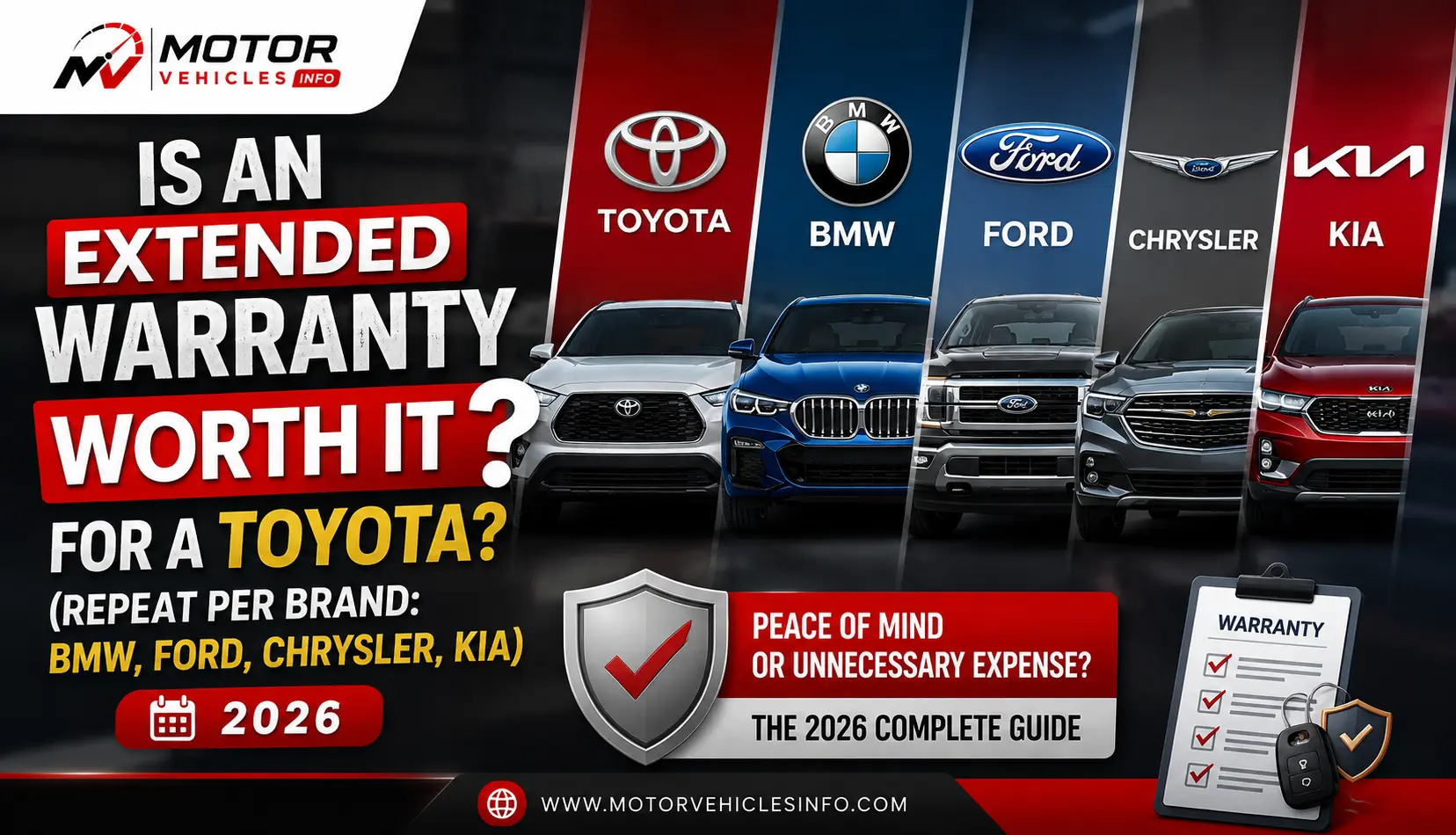
The check engine light comes on eighteen months after your factory warranty ends, the shop quote reads $2,800, and you’re suddenly doing math you never wanted to do. That’s the exact moment most people wish they’d made a decision about an extended warranty before they needed one, not during a stressful phone call from a service bay.
This guide will explain to you what an extended warranty means, what a Toyota extended warranty covers, what a BMW extended warranty covers, the price for both warranties in 2026, and how you can calculate a breakeven analysis yourself before signing up. We will also help you negotiate, transfer, or cancel your extended car warranty.
What is an Extended Warranty?
An extended warranty provides coverage on mechanical failure after the expiration of your vehicle’s factory warranty. In spite of its title, it should be clear that this is not a warranty at all but an auto service contract as defined by the Federal Trade Commission. This means that the “extended warranty” that most consumers refer to is actually an auto service contract which is sold either by the manufacturer, the dealer, or even an outside company.
That distinction matters more than it sounds. A real warranty is included in the price of the car. An extended warranty is a separate purchase, priced separately, and sold by a separate business — sometimes the automaker, sometimes a warranty company for cars that has nothing to do with the brand on your hood.
The reason extended warranties exist is simple: manufacturer coverage runs out, and repair bills on a modern car — full of electronics, turbochargers, and driver-assist sensors — rarely stay cheap. An extended warranty is essentially a bet that you’ll spend more on repairs than you spend on premiums. Sometimes that bet pays off. Often, especially on a Toyota, it doesn’t.
Types of Extended Car Warranties
Not every plan covers the same ground, and the pricing gap between tiers can be significant. Before comparing quotes, it’s worth knowing which type you’re actually being sold.
- Exclusionary (bumper-to-bumper style): Covers everything except a short, named list of exclusions. This is the most comprehensive — and most expensive — type of extended warranty.
- Stated component (named-component) coverage: Only the parts specifically listed in the contract are covered. Cheaper, but you need to read the list closely.
- Powertrain-only plans: Cover the engine, transmission, and drive axle — the parts most likely to cause a car to stop running, but a small slice of what can actually break.
- Manufacturer-backed vehicle service agreements: Sold through the automaker’s own dealer network (Toyota’s VSA, BMW’s Ultimate Protection VSC). These use factory parts and factory-trained technicians.
- Third-party extended warranty companies: Independent providers like Endurance or CarShield that sell nationwide plans, often with more flexible payment terms than a dealer-sold contract.
For a broader rundown of how independent providers stack up against each other, our guide to the best extended car warranty companies for high-mileage vehicles breaks down pricing tiers and claim experiences in more detail.
What Does a Toyota Extended Warranty Actually Cover?
Toyota’s extended warranty is marketed by Toyota Financial Services under the Toyota Vehicle Service Agreement (VSA) brand, also known as “Toyota Extra Care” in dealerships. There are three levels of the program:
| Plan | What It Covers | Best For |
| Platinum | Nearly every mechanical and electrical component, most similar to the original factory warranty | Buyers who want bumper-to-bumper peace of mind |
| Gold | Powertrain plus air conditioning, brakes, steering, and electrical systems | Buyers who want solid coverage without paying for everything |
| Powertrain | Engine, transmission/transaxle, drive axle, and related components | Buyers who mainly worry about a major mechanical failure |
Toyota warranties also do not cover services like oil changes, brake pad replacement, tire replacement, or wiper blade replacement, nor do they cover damage resulting from accidents or owner negligence. Another thing is that a Toyota extended warranty comes with certain added benefits, like towing and rental car assistance, which transform the warranty into insurance.
Toyota’s Factory Warranty vs. Extended Coverage: Where’s the Gap?
All new Toyotas come with the manufacturer’s 3-year/36,000 mile basic warranty and 5-year/60,000 mile powertrain warranty. This is excellent coverage, and this is precisely why Toyota extended warranties’ sales pitches may seem redundant in the first year of ownership.
The difference occurs beyond the 36-month mark when the bumper-to-bumper coverage expires, and you’ll have to deal with all costs associated with problems with the infotainment system, air conditioner, power windows, and scores of sensors while the powertrain warranty is quietly still in effect until 60,000 miles. A Toyota extended warranty bought while the original coverage is still in effect closes this hole, thus eliminating any gaps in the warranty coverage.
It is also at this point when the reliability of your vehicle should be a stronger consideration than any marketing. Toyota is ranked among the highest in all surveys carried out to gauge dependability, and this is precisely the reason why all financial advisors suggest that there is no need for an extended warranty and self-insurance, as we will see later in the break-even analysis.
How Much Does a Toyota Extended Warranty Cost in 2026?
Pricing on a Toyota extended warranty varies by model, mileage at purchase, term length, deductible, and which of the three tiers you choose. As a general range in 2026:
- Powertrain plan: roughly $1,000–$1,800
- Gold plan: roughly $1,800–$2,800
- Platinum plan: roughly $2,500–$4,000
Buying earlier — ideally before the factory warranty expires — tends to lower the price, since the vehicle carries less risk on paper. Rolling the cost into your auto loan also inflates the real price, because you’ll pay interest on the warranty premium for years. Paying separately, in cash or on a card you can pay off quickly, keeps a Toyota extended warranty closer to its sticker price.
If you’re weighing a Toyota-brand plan against an independent provider, our breakdown of Endurance vs. CarShield claim payouts is a useful side-by-side before you commit to either route.
Is It Worth It? A Simple Break-Even Formula You Can Run Yourself
Skip the sales pitch and run the numbers instead. This formula works whether you’re pricing a Toyota extended warranty, a Ford extended warranty, a BMW extended warranty, or coverage on any other brand:
- Estimate your repair fund. Set aside what the extended warranty would have cost — say $2,500 — in a separate savings account instead of paying a warranty company.
- Estimate likely repairs. Look up common repair costs for your model at the mileage range the extended warranty would cover. Use resources like RepairPal or your own dealership’s service history.
- Compare the two totals. If your realistic repair estimate over the coverage period is lower than the extended warranty price, self-insuring wins. If it’s higher — or if a single repair could wipe out your savings before you’ve rebuilt the fund — the extended warranty wins.
- Weight for reliability. A Toyota’s above-average reliability record pushes the math toward self-insuring. A BMW’s higher repair costs and lower dependability scores push the math toward buying coverage.
This ratio leans towards not purchasing the extended warranty, keeping the money aside rather than spending it, for most Toyotas that are in good condition, provided that you do not plan to use the car beyond 100,000 miles, have a turbocharged or hybrid car whose parts will cost more to replace, or just need certainty over uncertainty.
BMW’s 4-Year/50,000-Mile Factory Warranty vs. Ultimate Protection VSC
The manufacturer’s warranty period on BMW vehicles is shorter compared to that of Toyota, which covers either 3 or 5 years, depending on the particular model. The extended warranty for BMW vehicles, which is offered through dealers, is referred to as the BMW Ultimate Protection Vehicle Service Contract (VSC). There are two types of warranties, namely the Powertrain and Platinum, with terms reaching up to 7 years or 100,000 miles.
The calculations are quite different when it comes to a BMW.
Because BMW’s parts and labor rates run higher, and the factory warranty ends a year sooner, an extended warranty tends to close a bigger, more expensive gap. That’s part of why owners searching for an extended warranty for my BMW end up cross-shopping the official BMW Ultimate Protection VSC against third-party extended warranty companies before renewing coverage.
Real Complaint Data: BMW Ultimate Protection vs. Top-Rated Warranty Companies
Price isn’t the only variable — how a company handles claims matters just as much. Before buying any extended warranty, whether it’s the factory-backed BMW Ultimate Protection VSC or a third-party plan, check the Better Business Bureau’s profile for the specific company and read the complaint narratives, not just the letter grade. Complaint volume and resolution rate tend to tell you more than a star rating alone.
It is highly advised that you spend an additional ten minutes reading about the Endurance warranty reviews or even Carshield complaints before signing up. Some of the most common customer complains when it comes to the car warranty industry are those related to claims denials due to waiting periods, claims of parts failing which were not even mentioned in the contract, and delays in reimbursement for rental cars and towing fees. This applies not only to dealers’ extended warranties but also to independent extended warranty providers.
If you’re cross-shopping providers, the NHTSA complaint and recall database is also useful — not for warranty complaints specifically, but for understanding how often a given model has recurring mechanical issues in the first place, which tells you how much an extended warranty is likely to actually get used.
The One Thing Most BMW Warranties Don’t Cover (and Why It Matters)
Wear-and-tear components. Brake pads, rotors, tires, wipers, batteries, and clutch parts are not included in any BMW extended warranty or Toyota extended warranty program – they are considered maintenance, not mechanical issues. For a BMW, in particular, this is even more aggravating because the vehicle’s suspension and brake components will wear out sooner and be more expensive to replace than on an average Toyota.
Check the sample of the contract before signing it, not afterwards, when your claim has been rejected. Specifically ask whether electrical parts, such as the iDrive entertainment system, adaptive suspension system, and turbocharger, are covered by the program – these are the very parts for which BMW extended warranty deserves its price.
Practical Tips Before You Buy Any Extended Warranty
- Get the sample contract, not just a sales sheet, and read the exclusions section first.
- Ask about the waiting period — most extended warranty companies require 30 days and 1,000 miles before claims are eligible.
- Confirm the deductible structure — per-visit deductibles are usually cheaper over time than per-repair deductibles if you have multiple issues fixed in one shop visit.
- Check whether coverage is nationwide or limited to dealer networks, especially if you travel or plan to move.
- Keep every maintenance receipt. A missing oil-change record can void a claim under either a factory extended warranty or a third-party service contract.
Common Mistakes to Avoid
- Buying under pressure in the finance office. You can typically purchase a toyota extended warranty or a ford extended warranty any time before the factory coverage expires, not only at the moment of sale.
- Rolling the cost into your loan without comparing the total interest paid over the loan term.
- Assuming all extended warranty companies are equal. BBB ratings, complaint volume, and claims-payment speed vary widely between providers — an endurance auto warranty plan and a competitor’s plan can look similar on paper and behave very differently at claim time.
- Skipping the cancellation window. Most contracts include a 30-day full-refund period — use it if you change your mind.
- Not comparing a factory plan against independent extended warranty companies before renewing, since pricing and coverage differ more than most buyers expect.
How to Negotiate, Transfer, or Cancel Any Car Extended Warranty
You have more leverage than the finance office lets on. A few things worth knowing:
- Negotiate the price. Extended warranty pricing at a dealership often has real markup built in — ask for the invoice cost or get a competing quote from a third-party provider before agreeing to a number.
- Buy later, not just at delivery. You can usually purchase a manufacturer-backed extended warranty any time before your factory coverage expires, which gives you time to shop competing quotes without losing eligibility.
- Transfer it if you sell the car. Most Toyota and BMW extended warranty contracts are transferable to a new owner, which can support resale value — ask the provider about their transfer process and fee.
- Cancel within the refund window. Nearly every extended warranty contract allows a full refund within the first 30 days, and a prorated refund after that. Cancel in writing and keep a copy.
- Watch for phone and mail solicitations. The FTC specifically warns that mail and phone pitches using urgent phrasing like “Final Warranty Notice” often come from businesses with no real connection to your dealer or manufacturer. Treat unsolicited “your warranty is expiring” calls with skepticism.
If you’re weighing whether to keep a used vehicle covered before or after a private sale, our private-seller pre-purchase checklist walks through what to verify — including remaining factory and extended warranty coverage — before money changes hands.
Frequently Asked Questions
Is an Extended Warranty worth it for a Toyota?
The extended warranty may not be worth it for many Toyota customers who maintain their cars and trade them in before reaching 100,000 miles due to the reliable nature of the manufacturer that leads to low costs. However, the extended warranty starts becoming more valuable when the customer intends to own the car beyond 100,000 miles, or owns the hybrid or turbo engine.
How much does a Toyota extended warranty cost?
The cost of a Toyota extended warranty depends on the coverage level, which is either Powertrain, Gold, or Platinum, the duration of the warranty, the deductible, and the number of miles on the car.
Is a BMW extended warranty worth it?
It is advisable to go for an extended warranty on a BMW rather than a Toyota, due to the shorter factory warranty period and higher costs associated with repairs on a BMW. The decision of whether to buy or not will always be based on your break-even analysis.
What’s the difference between a warranty and an Extended Warranty?
There is a warranty that comes as part of the price of your new vehicle and which is defined by federal laws. The Extended Warranty, or service contract as it is sometimes called, is a different purchase that you make from the manufacturer or any other source, and it is not a warranty by any legal definition.
Can I buy an extended warranty after the factory warranty expires?
It depends on the provider. Manufacturer-backed plans like Toyota’s VSA and BMW’s Ultimate Protection VSC generally must be purchased while the factory warranty is still active. Many independent extended warranty companies, including Endurance and Carshield, will sell coverage on higher-mileage vehicles after factory coverage has already lapsed.
Are Endurance and Carshield good extended warranty companies?
Both are established names in the industry, but their reputations shift by year and by region — complaint volume and BBB standing have moved over time for each company. Pull the current Better Business Bureau profile and read recent Endurance warranty reviews before choosing between an Endurance auto warranty plan, Carshield, or any other warranty company for cars.
Can I transfer my extended warranty if I sell my car?
Most Toyota and BMW extended warranty contracts, along with most third-party plans, are transferable to a new owner for a small fee. A transferable extended warranty can also make your car more attractive to buyers at resale.
What does a Toyota extended warranty not cover?
The Toyota Extended Warranty will not cover normal wear and tear components such as oil changes, brake pads, tires, and windshield wiper blades, nor will it cover any damages from an accident.
How long can I cancel an extended warranty for a refund?
Most extended warranty contracts, whether from Toyota, BMW, or a third-party provider, allow a full refund if canceled within the first 30 days. After that window, refunds are typically prorated based on time or mileage used.
Is it cheaper to buy an extended warranty from the dealer or a third party?
Third-party extended warranty companies are often, though not always, cheaper than a manufacturer-backed plan, and some offer more flexible payment terms. The tradeoff is that dealer-backed plans use factory parts and technicians, while third-party plans may require approved independent repair shops instead.
Final Thoughts
Extended the Warranty isn’t automatically a waste of money, and it isn’t automatically a smart purchase either — it’s a bet you can actually price out ahead of time. Toyota’s strong reliability record tilts the math toward skipping extended coverage for a lot of owners, while BMW’s shorter factory warranty and higher repair costs tilt it the other way. Run the break-even formula above with real numbers for your specific model before you decide, and take the company’s complaint history as seriously as the price on the quote.