Before you dive in — a quick heads-up. Since no accident reported on CARFAX is a phrase tied specifically to the CARFAX system, and CARFAX is the vehicle history service used in the United States and Canada, the external authority sources cited in this article are U.S. federal consumer-protection offices (FTC, NHTSA, NICB) rather than Australian .gov.au sites. Australia doesn’t rely on CARFAX at all — it uses the PPSR instead, so “no accident reported on CARFAX” isn’t a phrase Australian buyers would typically search for. Let me know whether this article’s target audience should be Australians; if so, I’d recommend reframing it around PPSR terminology rather than CARFAX.
What a Vehicle History Report Covers
Each CARFAX report is compiled from data that is obtained from external sources such as state motor vehicle bureaus and federal motor vehicle authorities, auto auctioneers, fire/police departments, collision repair shops, car fleet owners, and car rental firms. The data are segmented and not compiled in one long string.
- Value context: What the vehicle is worth, given the history on record
- Vehicle basics and use: Its identity, configuration, and how it was driven
- Damage and title records: What happened to it, and how the title reflects that
- Ownership and service timeline: Who kept it, for how long, and how it was maintained
The document is structured into four main questions, which are then followed by the sub-sections outlined below. The arrangement of those sub-sections is as follows.
WHAT IS A CARFAX REPORT AND WHAT DO I NEED TO KNOW?
One of the leading providers of vehicle history reports in North America is CARFAX, which is probably the first place customers check before investigating CARFAX used cars. Carfax provides information based on data gathered from about 112,000 sources such as the police, motor vehicle bureaus, auctions, and insurance companies; it summarizes this information with four easy pieces: number of owners, accident alerts, title information, and service history.
Before you start checking car history using the Carfax website, there is only one thing that needs to be kept in mind: Carfax is a reporting mechanism, not an inspection one. You learn about what was reported, not about what is actually real about the vehicle at the present time. This aspect becomes crucial once you read something like “no accident reported.”
What Does “No Accident Reported on Carfax” Actually Mean?
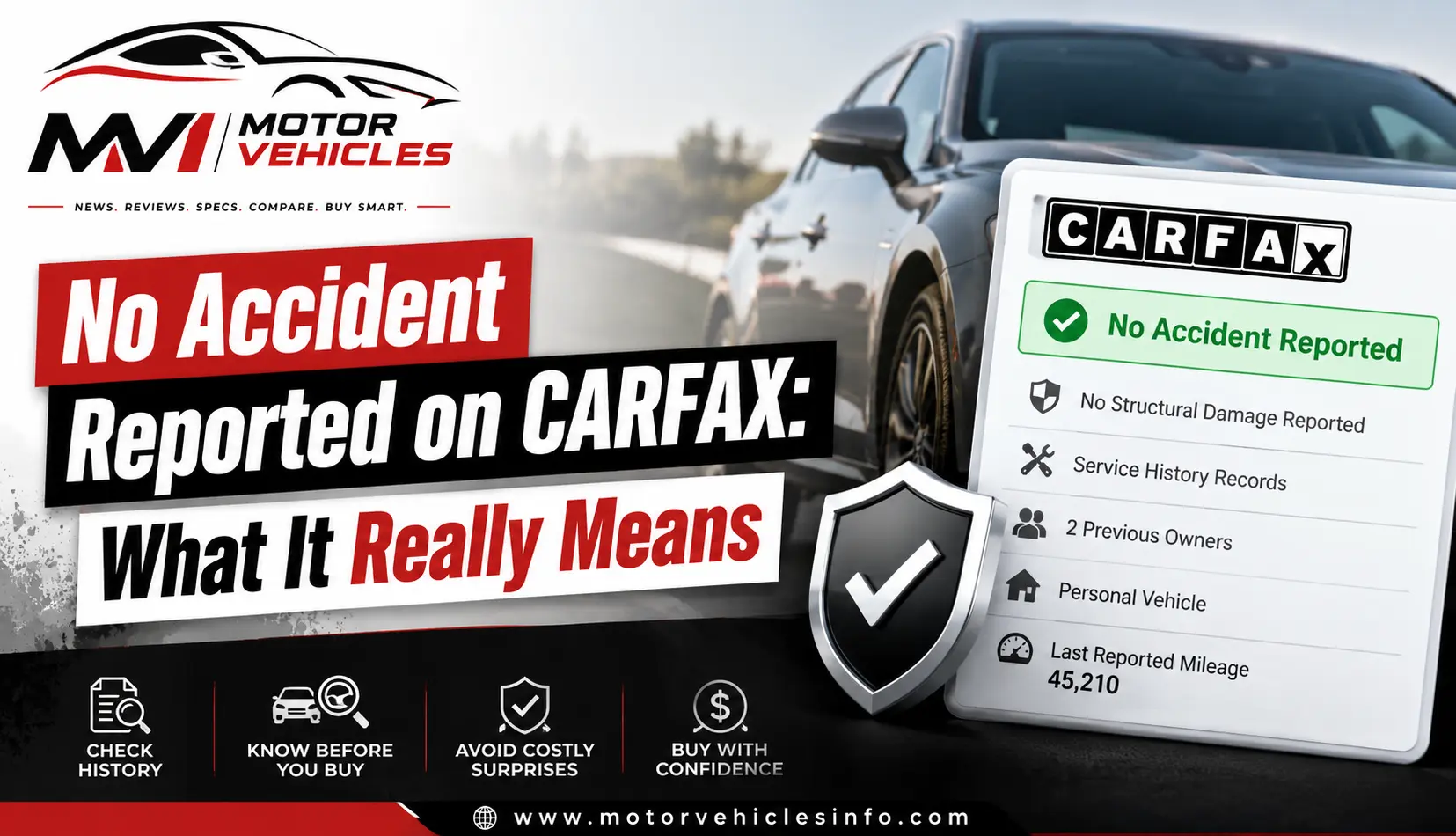
A “no accident reported by CARFAX” in the report means that according to all the sources CARFAX can presently access, there is no information available about any accidents for that VIN. However, it cannot be interpreted as meaning that the car has been cleared of all accidents. It means the absence of a record, not the confirmation of a clean history.
This distinction trips up a lot of first-time buyers. A CARFAX report with no accident reported on CARFAX can still belong to a car that’s been in a low-speed collision, had a bumper replaced in a private cash deal, or been repaired by a shop that never submitted data to any reporting network. The phrase “no accident reported” is accurate as a statement about the database — it just isn’t the same as “no accident happened.”
How CARFAX Builds Its Vehicle History Database
CARFAX compiles the documents from all kinds of sources, including state DMV’s, insurance companies, wrecking yards, repair shops, as well as fleet maintenance firms. Each time there is a transfer of title, a claim is filed, or a vehicle is declared salvaged, such documentation is added to the database.
The catch is that there’s no single, mandatory, real-time national accident database in the U.S. that captures every crash automatically. CARFAX’s own strength — the breadth of its contributor network — is also its limitation, because participation from any individual source isn’t guaranteed. This is why running a secondary check, like decoding the VIN through NHTSA’s official tool or cross-referencing theft and salvage records through NICB’s VINCheck, gives you a fuller picture than a single CARFAX report alone.
How to read a CARFAX report section by section without getting fooled
A CARFAX report isn’t meant to be skimmed for one headline phrase. Read it section by section:
- History-Based Value → A value estimate drawn from service records, open recalls, past accidents, and prior owner count, shown as both trade-in and retail
- Vehicle Overview → Model year, make, model, trim, VIN, body style, and powertrain, plus owner count, use type, mileage, and open recalls
- Recent Service Highlights → Reported maintenance from the previous twelve months, such as oil changes and tire rotations
- Additional History → Accidents and damage, airbag deployment, structural damage, total loss, remaining factory warranty, and suspected odometer fraud
- Title History → Owner-by-owner title records, including fire, flood, or other damage that produced a title defect
- Ownership History → Purchase date, length of ownership, registration location, estimated miles per year, and personal or commercial use
- Detailed History → A chronological timeline of key events, typically opening with a pre-delivery inspection and continuing through sales, accidents, and service visits
Vehicle Overview serves as a summary; the Detailed History is the actual record behind it. Compare them side by side. Discrepancies between the count/mileage as seen initially and that shown in the timeline are worth resolving before moving forward, and you should expect an explanation from the owner.
A Warranty Check gives you an idea of how much warranty remains based only on what was reported to CARFAX. Since it does not consider title brands that can invalidate your initial warranty and changes in ownership affecting its terms, you might want to contact the manufacturer.
A Buyback Guarantee serves as an additional insurance on the report for certain DMV-generated title brands. This is good to have, but you still need to review the titles carefully yourself.
Why Some Accidents Never Make It Onto a Car History Report
There are several practical reasons an accident might be missing, even from a detailed car history check:
- Cash settlements. Two drivers agree to handle a minor collision privately, without involving insurance.
- Out-of-pocket repairs. The owner pays a body shop directly instead of filing a claim, so no insurer ever logs it.
- No formal police report car accident filing. Many states don’t require a report for minor, no-injury fender-benders.
- Independent repair shops. Not every shop is part of CARFAX’s data-sharing network.
- Cross-border or out-of-network history. A car previously registered outside CARFAX’s core coverage area may carry gaps.
Each of these scenarios can leave a car with real, physical repair work that simply never surfaces as a flag, which is exactly why a report showing no accident reported on CARFAX should prompt more questions, not fewer.
How to confirm what the CARFAX report cannot prove before you buy
Since a report can’t verify everything, treat it as step one of a multi-step process:
- Get a pre-purchase inspection. A certified mechanic can spot frame repairs, mismatched paint, and replaced panels that no database would ever catch.
- Decode and physically verify the VIN. Confirm the number on the dashboard, door jamb, and title all match, and run it through a VIN decoder to catch inconsistencies.
- Check theft and salvage databases separately. A vehicle can pass a CARFAX accident check while still carrying a flagged history elsewhere; our guide to running a stolen-vehicle VIN check walks through this.
- Ask the seller direct questions. How long have they owned it? Has it ever needed bodywork? Did they file an accident report for anything, even minor?
- Run a lien check. A clean accident history doesn’t confirm there’s no lien attached to the title — that’s a separate check covered in our lien check guide.
You can do most of the verification in one afternoon in Dayton. Plan for two stops: the vehicle itself and an inspection shop. The Carfax report helps you focus, but your eyes and a technician finish the job.
Your 4-step verification plan: VIN check, records, inspection, and test drive
- Compare the odometer to the latest mileage on the report. Ask about any gaps.
- Request maintenance receipts, not just a verbal promise. Confirm oil change timing.
- Get a trusted inspection (pre-purchase) that includes a lift and a scan for codes.
- Test drive with purpose: hard braking, straight-line tracking, tight turns, and tech checks.
For real-world Ohio checks, look underneath for heavy rust on brake lines and suspension parts. Also check the trunk well and spare tire area for water lines or musty odor. After heavy rains, hidden moisture can show up there first.
When a “clean” report still needs extra caution (and when it is a green light)
A clear report may neglect private fixes, damage to the parking lot, or late reporting. This is why “no accidents reported” should not be your sole screening criterion.
It is wise to show extra care if there are large discrepancies in the date, a fast change in ownership, or rapid transfer of the car between several states. You should be extra wary in case the report seems overly empty for an automobile of that age, since in this case you are buying a puzzle.
In contrast, a positive signal will look like growing mileage, constant regular servicing, absence of title brands, and a single owner for the whole period of its use. If these things are complemented with a good check and a test drive, you are in a good position.
How to Get a CARFAX Report and What It Costs
Many shoppers search for a carfax report free option, and CARFAX does offer a limited free preview — typically the number of owners, basic title status, and whether the vehicle was used commercially. The full detailed report, including the accident and service history sections, usually requires payment, either as a single-VIN report or a multi-report package.
| Option | What You Get | Typical Cost |
| CARFAX free preview | Owner count, basic title flag | Free |
| Single CARFAX report | Full accident, title, and service history | Paid, single VIN |
| CARFAX multi-pack | Several full reports for comparison shopping | Paid, bundled rate |
| Dealer-provided report | Often included with listed inventory | Usually free to the buyer |
| Free Carfax report by VIN via NMVTIS | Title, insurance-loss, and salvage data from approved providers | Varies by provider |
If you’d rather start with a government-backed source, the FTC’s guide to buying a used car explains how to pull a report through NMVTIS-approved providers, and its broader used car resource page outlines how to check for open recalls and title problems before you commit to a purchase.
Best Practices When Buying Used Cars With a Clean History Report
A little discipline goes a long way when the paperwork says no accident reported on CARFAX and everything else looks good on paper:
- Pull the full report, not just the free summary — the free version often omits the accident section entirely.
- Cross-check the VIN with an independent decoder and confirm it matches the physical vehicle.
- Book a pre-purchase inspection with a mechanic who has no relationship with the seller.
- Ask directly about reporting a car accident in the past, even minor incidents that wouldn’t show up on paper.
- Review the title for brands like salvage or rebuilt, since these can exist independently of the accident flag — our salvage title guide is a useful companion read here.
- Trust your eyes over the report: uneven panel gaps, fresh paint overspray, or a hood that doesn’t sit flush are all physical clues no database will ever capture.
Why You Should Never Rely on CARFAX Alone
CARFAX, and services like it, are genuinely valuable — they just aren’t complete on their own. Layer your research:
- A CARFAX report for title, ownership, and reported accidents
- NICB’s VINCheck for stolen and salvage records from participating insurers
- A physical, independent inspection for anything that never made it into any database
- A frank conversation with the seller about the car’s real history
No single source — including CARFAX — was designed to be the only checkpoint before a purchase this size. Treat “no accident reported” as a green light to look closer, not a reason to stop looking.
Final Thoughts
A CARFAX report showing no accident reported on CARFAX is good news — but it’s the beginning of your research, not the end of it. Combine the report with a physical inspection, a VIN check, and a direct conversation with the seller, and you’ll have a far more complete picture of the car’s real condition than any single database can offer.
Frequently Asked Questions
Does “no accident reported” mean the car was never in an accident?
Not necessarily — it means no accident appears in CARFAX’s available records, not that one never happened.
How reliable is a CARFAX report overall?
Reliable as a starting point, thanks to its large data network, but it should always be paired with an independent inspection.
What’s the difference between an accident report and a police report car accident filing?
An accident report can come from an insurer or repair shop; a police report is specifically filed by law enforcement after a crash.
Can I get a CARFAX report free?
Only a limited preview — owner count and title status. The full accident and service history usually requires payment.
Is CARFAX better than other vehicle history services?
It has one of the largest data networks, but no single provider has access to every record, so cross-checking helps.
Why do some accidents never make it onto a car history report?
Cash settlements, out-of-pocket repairs, unreported fender-benders, and out-of-network repair shops are the main reasons.
Should I still get an inspection if the CARFAX report is clean?
Yes. An inspection catches physical damage evidence that no history report can detect.
How do I decode VIN number details myself before trusting a report?
Run the VIN through NHTSA’s free decoder, then confirm it matches the dashboard, door jamb, and title.
Does a salvage title always come with an accident report?
No. Salvage titles can also result from flood damage or theft recovery, unrelated to a collision.
What should I do if I suspect a seller is hiding accident history?
Ask direct questions, request repair records, and get an independent inspection before you commit.
Before you commit to any used car, pull the full history report, decode the VIN yourself, and book an independent inspection. For more buyer-protection guides, explore our full library of vehicle history articles at Motor Vehicles Info.