Your check engine light is now on, and it is displaying the code P0455; what will you do next?
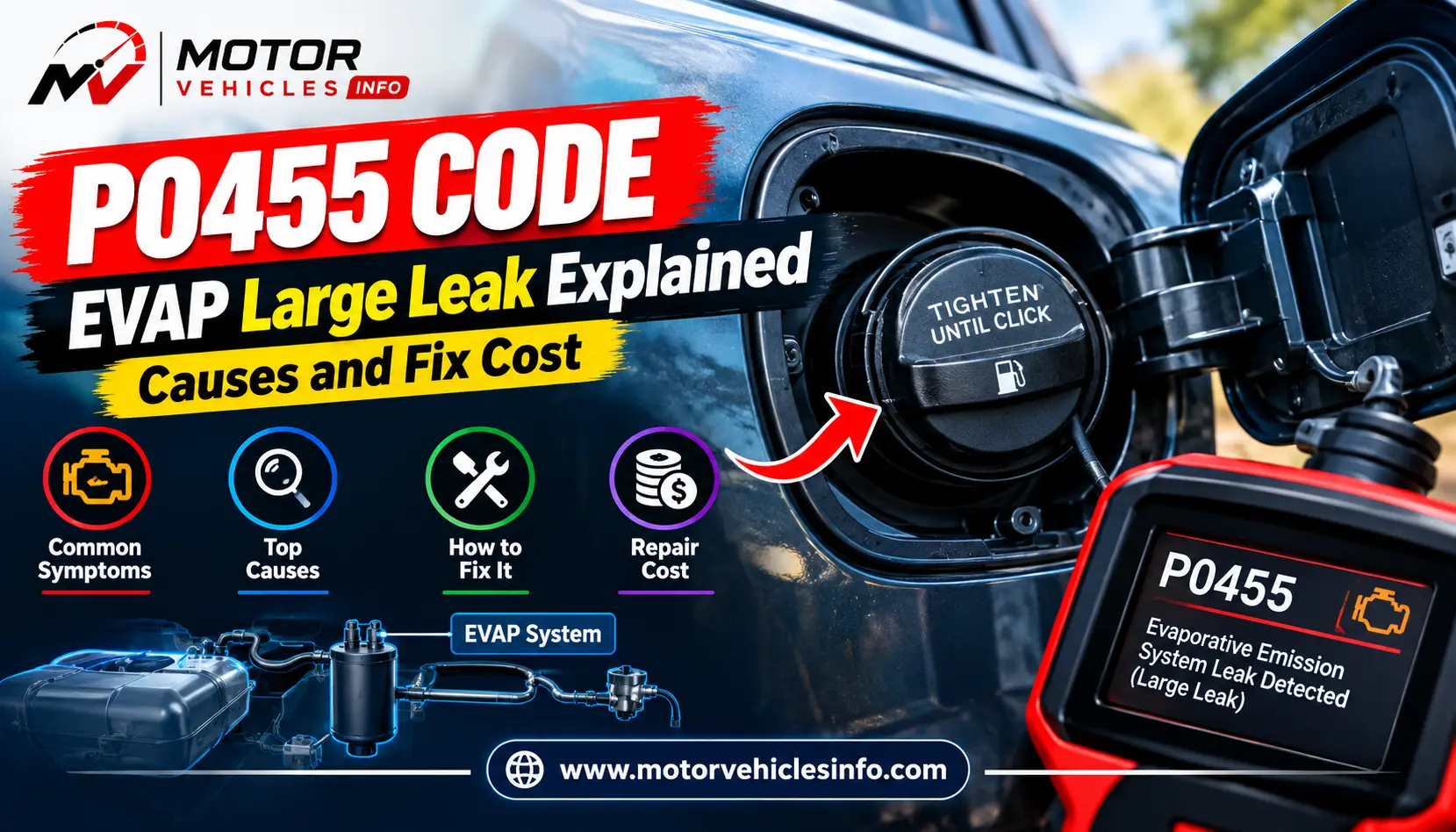
The P0455 code indicates that the EVAP system in your car’s fuel vapor system detected a huge leak. This usually results from a loose gas cap. It may also be a damaged hose or a stuck valve. It is worth noting that the engine code P0455 is not usually an emergency and can be fixed at an affordable price, less than $50.
In this article, we shall look at P0455 symptoms, causes, how to fix it, and the cost of repairing the P0455 code in the USA.
Key Takeaways
- The P0455 code trouble indicates that there is a high level of fuel vapor leakage through the EVAP system, which is caused by a loose, damaged, or missing gas cap.
- Try simple and inexpensive solutions first; tightening the cap or purchasing a new one costs approximately 15-40.
- Symptoms of P0455 are very mild; usually, you only see the check engine light turn on.
- The cost of fixing P0455 may range between 15-900.
- Driving is possible in the short term, but your car will not pass emissions tests.
What Is the P0455 Code?
P0455 code is an OBD-II diagnostic trouble code known as “Evaporative Emissions Control System Leaks (Large Leak).” The code is applicable to almost all cars, trucks, and SUVs powered by gasoline that were manufactured for the American market starting from 1996 onwards. The use of evaporative emission systems is usually not employed in diesel engines.
The problem is identified by your ECM upon failure of the leak detection test conducted by the ECM.
The EPA’s OBD fact sheet for drivers notes that on-board diagnostics can flag a loose or missing gas cap, which wastes fuel and adds to smog. That’s why a simple cap problem can set code P0455.
P0455 Code Meaning in Plain English
Think of the EVAP system as a sealed bottle. Gasoline gives off vapor, and your car traps it instead of letting it drift into the air. When P0455 sets, the bottle has a large hole.
How the EVAP System Works and When Your Car Runs the Leak Test
The parts of this system include the gas cap, filler neck, fuel tank, charcoal canister where the vapor is stored, purge valve, vent valve, hoses to connect the components, and fuel tank pressure sensor. The purge valve opens once the engine starts, and the vapor is burnt by the engine.
How the Leak Test Triggers a P0455 Code
The ECM seals the system and pulls a light vacuum, or builds slight pressure. Then it watches the pressure sensor. If the reading falls too fast, the ECM stores P0455.
The test doesn’t run constantly. Most cars run it once per trip at most, and only when conditions are right: a cold engine, mild weather, and a fuel level between roughly a quarter and three-quarters of a tank. Rules vary by manufacturer. That’s why a code can show up days after the real problem started.
P0455 Symptoms: What You’ll Notice (and Why the Check Engine Light Is Often the Only Sign)
Most drivers notice nothing else. The EVAP system sits apart from the parts that make your car move, so the engine runs normally.
Here are the P0455 symptoms you may see:
- Check engine light: the most frequent symptom and usually the only symptom.
- Gasoline scent: slight smell of fuel around the rear end of the vehicle.
- Mild reduction in fuel efficiency: usually slight, since the vapors escape rather than ignite.
- Fuel cap notification: some cars alert with “Check Fuel Cap.”
- Failing emissions test: how many times it was first detected.
P0455 Symptoms That Signal a Bigger Problem
A strong gasoline smell in the cabin, a wet spot under the car, or rough running with other codes suggests a real fuel leak. Have it checked quickly.
Top Causes of P0455, Ranked from Most to Least Likely
Shops usually start with the cheap, easy items. This order works for most vehicles:
- Loose, worn, or missing gas cap. By far the most common cause. The seal hardens and cracks with age.
- Cracked or disconnected EVAP hoses. Rubber and plastic lines age, especially near the tank.
- Purge valve stuck open. It lets air into the system and ruins the leak test.
- Faulty vent valve. If it sticks open, the system can’t seal.
- Damaged charcoal canister. Age, rust, or overfilling the tank can crack it.
- Corroded filler neck or tank. More common on older cars where roads are salted.
- Bad fuel tank pressure sensor. It may report a leak that isn’t there.
Less Common Causes of Engine Code P0455
Rodents sometimes chew EVAP lines. A recent collision repair can leave a hose unplugged. A poorly fitting aftermarket cap can also set the P0455 code.
Is It Safe to Drive With P0455? Emissions, Fuel Economy and Fire Risk
Usually yes, for a short time. The engine and brakes aren’t affected. Still, don’t ignore it for months.
Emissions, Fuel Economy and Fire Risk
A large leak lets raw fuel vapor escape, which adds to smog, and you lose a little fuel to evaporation. The fire risk is low with a loose cap. But gasoline vapor is flammable, so treat a strong fuel smell or a visible drip as a fuel leak. Keep sparks away and get it inspected right away.
Will a P0455 Code Fail an Emissions Test?
Yes. A lit check engine light is an automatic failure in states that use OBD-based inspections. According to the EPA’s list of state and local OBD inspection programs, most of the 33 areas that require emissions testing check the OBD system. That list is archived, so confirm current rules with your state DMV.
Fleet managers should treat P0455 as a compliance item, since one failed inspection can sideline a vehicle.
P0455 Code: How to Fix It, Step by Step (Gas Cap to Smoke Test)
Work from cheapest to most expensive. Most people never get past step two.
- Confirm the code. Read it with an OBD-II scanner and note any other codes, such as P0457 or P0446.
- Check the gas cap. Inspect the rubber seal for cracks and tighten it until it clicks. Replace it if it looks worn.
- Inspect the filler neck and visible hoses for cracks, rust, or loose connections.
- Test the purge and vent valves. A scan tool with bidirectional controls can command them open and closed.
- Run a smoke test. It’s the most reliable way to find hidden leaks.
- Repair, clear the code, and drive normally so the ECM can rerun the test.
Use your VIN to buy the right parts. Our guide on how to decode a VIN explains what all 17 characters mean.
P0455 Code How to Fix: The Gas Cap Test
Replace a worn cap with a quality one made for your vehicle. Clear the code and drive for a few days. If the light stays off, you’re done.
What Is a Smoke Test?
A smoke machine pushes harmless, low-pressure vapor into the EVAP system. Wherever smoke escapes, you’ve found the leak. Shops commonly charge roughly $100 to $200. Never pressurize the system with shop air, because too much pressure can damage sensors.
Check for Recalls Before You Pay
Manufacturers occasionally issue recalls or service bulletins for fuel vapor parts. Before a big repair, run your VIN through NHTSA’s recall lookup. It’s free. Our guide to checking recalls by VIN walks you through it.
P0455 Code Repair Cost: Real Price Ranges by Cause (DIY vs. Shop)
The P0455 code repair cost depends on what’s leaking. A cap costs less than lunch. A canister or filler neck can run into hundreds. These are rough planning ranges, not quotes. Prices vary by vehicle, region, and shop labor rates, which often run $100 to $200 per hour.
| Repair | Parts Cost | DIY Difficulty | Typical Shop Total |
| Gas cap | 15–40 | Very easy | 20–60 |
| EVAP hose or line | 10–100 | Easy to moderate | 100–350 |
| Purge valve | 30–150 | Easy to moderate | 120–350 |
| Vent valve | 50–200 | Moderate | 150–450 |
| Tank pressure sensor | 30–150 | Easy to moderate | 100–300 |
| Charcoal canister | 150–600 | Moderate to hard | 350–900 |
| Fuel filler neck | 100–400 | Moderate to hard | 300–800 |
| Smoke test | N/A | Shop only | 100–200 |
Cap, hose, and purge valve jobs suit home mechanics. Canister and filler neck work often means dropping the tank, so that’s where a shop earns its fee.
Does a Warranty Cover the P0455 Code?
Maybe. Under federal emissions warranty rules (40 CFR Part 85, Subpart V), light-duty vehicles get a 24-month or 24,000-mile emissions warranty, with 8 years or 80,000 miles for specified major components. EVAP parts typically fall under the shorter period, so check your warranty booklet.
Older cars may need another option. Some service contracts cover EVAP parts, and others exclude them. Our guide to the best extended car warranty companies for cars over 100,000 miles shows what to look for in the fine print.
P0455 vs. P0440, P0442, P0456 and P0457: How the EVAP Codes Differ (and Why It’s Not P0420)
Several EVAP codes look alike. The difference is mostly leak size.
| Code | Meaning | What It Usually Points To |
| P0455 | Large leak detected | Loose or missing cap, cracked hose, bad valve |
| P0440 | General EVAP malfunction | Broad system fault, needs diagnosis |
| P0442 | Small leak detected | Aging seals, tiny hose crack |
| P0456 | Very small leak detected | Pinhole leaks, hard to find |
| P0457 | Loose or missing fuel cap | Cap not sealed (used by some makes) |
| P0420 | Catalyst system efficiency below threshold | Exhaust and catalytic converter, not EVAP |
Why P0455 Is Not the Same as P0420
Drivers confuse them because both are emissions codes. They aren’t related. P0420 means catalyst system efficiency below threshold, which points to the exhaust. P0455 lives on the fuel vapor side.
The bills differ, too. A P0455 code often costs under $200 to fix. A P0420 repair can reach four figures if the catalytic converter needs replacing.
Why P0455 Comes Back After a Repair: Common Mistakes, Drive Cycles and Passing Emissions
When P0455 returns a week after the fix, one of these mistakes is usually the reason:
- Not tightening the cap fully. It should click.
- Clearing the code without fixing anything. The light just returns.
- Fixing only one leak. Some systems have two or three.
- Buying a bargain cap that doesn’t seal.
- Topping off the tank. Squeezing in fuel after the pump clicks can flood and damage the canister.
- Skipping the drive cycle.
How a Drive Cycle Confirms Your P0455 Repair
After a repair, the ECM must rerun its EVAP test. A common approach is to keep the fuel level between roughly a quarter and three-quarters of a tank, let the car sit overnight, then drive a mix of city and highway for 20 to 30 minutes over a few days. Your service manual has the exact steps.
How to Pass Emissions After a P0455 Repair
Don’t drive straight to the inspection station. Clearing codes resets the car’s “readiness monitors” to “not ready,” and many inspections reject a car in that state. Drive until the monitors finish. A basic scanner shows their status.
What P0455 Means for Used Car Buyers and Sellers
Some sellers clear codes right before listing a car. The light disappears, but the monitors usually show “not ready,” and a cheap scanner reveals it. Our private seller pre-purchase checklist covers what else to check, and it helps to know what no accident reported on CARFAX really means.
A car with a P0455 code isn’t necessarily a bad buy. If it’s a cap or hose, it’s a cheap fix and a good negotiating point. If a smoke test finds a corroded tank, think again.
P0455 Code FAQs
What does the P0455 code mean?
The P0455 code means your car’s EVAP system found a large leak in the fuel vapor network. The ECM runs a pressure or vacuum test, and the system failed by a wide margin. The usual causes are a loose gas cap, a cracked hose, or a bad valve.
Can I drive with the P0455 code?
Usually yes, for a short time. The engine and brakes aren’t affected. But the car releases fuel vapor and will fail an emissions test. If you smell strong gasoline or see a drip, stop driving and have it inspected.
Can a loose gas cap cause the P0455 code?
Yes. A loose, cracked, or missing cap is the top cause of the P0455 code. Tighten it until it clicks, or replace it if the seal looks worn. Then clear the code and drive for a few days.
How do I fix the P0455 code?
For the P0455 code the fix process, start with the gas cap, then inspect the filler neck and hoses. Test the purge and vent valves next. If you still can’t find the leak, a smoke test will show it. Then clear the code and complete a drive cycle.
How much does P0455 code repair cost?
P0455 code repair cost ranges from about $15 for a gas cap to $900 for a canister replacement. Hose and valve repairs usually land between $100 and $450 at a shop. A smoke test adds roughly $100 to $200.
Will the P0455 code clear itself?
Sometimes. If a loose cap was the cause and you tighten it, the light often turns off after several drive cycles. If a real leak remains, the P0455 code will keep coming back.
What is the difference between P0455 and P0420?
P0455 is an EVAP code for a large fuel vapor leak. P0420 means the catalyst system efficiency is below the threshold, which relates to the catalytic converter. They’re unrelated, and P0420 repairs usually cost much more.
Should I buy a used car with a P0455 code?
It depends on the cause. A gas cap or cracked hose is a cheap fix and a useful negotiating point. Ask for a smoke test before you buy. A corroded tank or canister means a much larger bill.
Final Thoughts
The P0455 code sounds serious, but it usually isn’t. Most of the time the culprit is a worn gas cap or a cracked hose. Start with the simple checks, use a smoke test when needed, and finish with a proper drive cycle.
Don’t ignore engine code P0455 for months. Fix it early, keep your receipts, and check your warranty before paying out of pocket.
Seeing P0455 on your dash? Start with your gas cap today, then work through the steps above. For more plain-English repair and buying guides, browse all our car articles and bookmark this P0455 code guide for next time.