Your truck starts up on a cold morning, but the check engine light is already illuminated. A quick diagnosis reveals that the P0128 code was detected. Temperature readings appear normal, your heater will blow warm air, and everything seems to work as expected. But then, what is wrong?
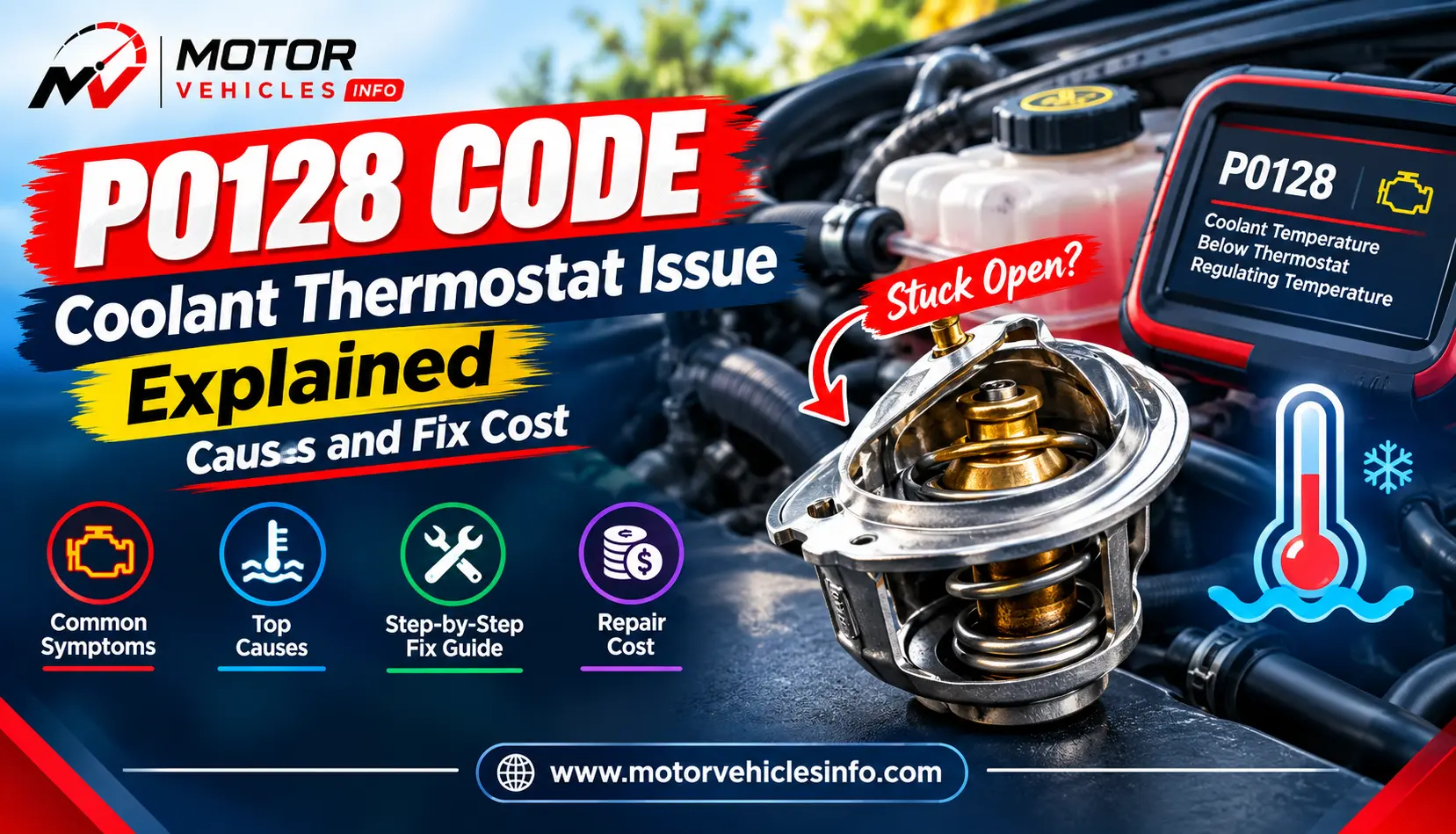
The P0128 code trouble code indicates that your engine is heating up very slowly, or that it does not heat up enough. Typically, an issue with the thermostat being stuck in its open position causes this condition. This manual provides information on the P0128 trouble code in clear language, reveals the causes, and lets you save money by avoiding unnecessary replacement of parts.
Key Takeaways
- P0128 is known as “Coolant Temperature Below Thermostat Regulating Temperature.”
- “Stuck-open thermostat” is usually the reason behind most P0128 codes, but other issues such as “bad coolant temperature sensor,” “low coolant level,” or “stuck fan” will trigger the same problem.
- You might have a good gauge reading while your OBD-II system stores P0128.
- Though the P0128 code is not an urgent one, you will end up with poor fuel consumption and an engine failing emission testing.
- Diagnosis before repair. Test the thermostat and temperature sensor. Don’t replace any component without proper testing.
- Average P0128 code repair cost is 150-450.
What Is the P0128 Code?
P0128 is a generic OBD-II diagnostic trouble code that stands for “Coolant Temperature Below Thermostat Regulating Temperature.” In simple language, the car’s engine control module (ECM or PCM) thinks that your coolant is not warming up properly.
Every gasoline car and light truck built for the U.S. since 1996 carries an on-board diagnostics system. The EPA’s consumer fact sheet on OBD explains that this system watches the engine and emissions equipment, then lights the dashboard warning when it detects a problem. The code works the same way on nearly every brand, and it appears just as often in the UK and Australia.
How a Thermostat Works (and Why the Computer Cares)
The thermostat is a valve filled with wax found in the cooling system of your vehicle. The thermostat remains closed when the engine is cold to allow circulation of the coolant in the engine alone, allowing it to heat up quickly. When the coolant reaches the temperature range of the thermostat, which is typically from 180°F to 200°F, the valve opens to allow circulation of the coolant into the radiator.
The ECM monitors this through a coolant temperature sensor against an inbuilt algorithm taking into account external temperature, airflow, and runtime. If the coolant fails to reach its target within the expected timeframe, the computer generates a P0128 error code and illuminates the check engine light.
A cold engine requires a rich fuel mixture, which means fuel wastage and increased emissions. P0128 simply means that the engine is not heating up properly.
P0128 Symptoms: What You’ll Notice (and Why Your Temp Gauge May Look Normal)
Many drivers find P0128 only because the light comes on, since the car often feels fine. A few clues usually appear, though.
Common P0128 Symptoms
- Check engine light: Usually the only guaranteed sign.
- Weak cabin heat: The heater blows lukewarm air in winter.
- Lower fuel economy: A cold-running engine uses extra fuel. The U.S. Department of Energy’s fueleconomy.gov notes that engines take longer to reach their most efficient temperature in cold weather, and a stuck-open thermostat makes that worse all year.
- Long warm-up times: The gauge needle crawls upward or stalls below the middle mark.
Why Your Temp Gauge May Look Normal With P0128
However, most dashboard gauges are “dampened,” which means that they will show a value in the middle regardless of the large temperature changes. Your coolant can be 20-30 degrees cooler, but you will still see the gauge in the middle.
You can use a scanner to find out the actual value. If you have a value of 150°F on the scanner, then there is a P0128 fault for sure.
What Causes P0128? Ranked by Likelihood (Including Short Trips and Cold Weather)
Here are the usual suspects, listed from most to least common.
- Thermostat stuck open. Waxes degrade, and the valve does not close completely. This is the primary reason for the P0128 code.
- Improper or low-quality thermostat. Some inexpensive replacement units open prematurely or at a lower temperature than the OEM part.
- Defective coolant temperature sensor or faulty wiring. A temperature sensor giving a falsely low reading may generate the code even when the engine is hot.
- Low coolant or trapped air. Inadequate circulation causes erroneous data in the coolant temperature sensor, especially after the coolant was changed.
- Cooling fan running excessively. A faulty fan relay or malfunctioning fan signal takes away heat from the engine.
- Software problems. Some manufacturers provide ECM updates or service bulletins regarding the P0128 error code.
- Cold ambient temperature and frequent short journeys. Not a defect, but certainly a reason.
Short Trips and Cold Weather: When P0128 Is Partly Environmental
Sometimes there isn’t anything wrong with the thermostat at all. Five minutes of driving in extremely cold weather might result in the engine failing to get to the right temperature before the trip ends, and your car will have a P0128 trouble code.
The engine heats up faster during driving than while idling, which is mentioned on the fueleconomy.gov site. In case your P0128 code appears only during winter trips, drive for 20 to 30 minutes and then scan for trouble codes. If everything goes well and you don’t have any codes, it might be a borderline case.
Is P0128 Serious? Can You Keep Driving With It?
AAA’s guidance on the check engine light says a steady light means you should schedule a diagnosis soon, while a flashing light calls for pulling over and stopping the engine. P0128 normally triggers a steady light.
Still, a long-term P0128 problem can cause trouble:
- Higher fuel costs from constant rich running.
- A failed emissions inspection, since an active check engine light usually means an automatic fail.
Plan on fixing it within a few weeks. If the gauge climbs toward hot or a red temperature warning appears, stop driving, because overheating is a different and more urgent problem.
P0128 Jeep, Dodge, and Chevy: Model-Specific Causes and Common Trouble Spots
The P0128 code appears on almost every brand, but owners of certain platforms report it more often. Treat the table below as a starting point rather than a verdict, because results vary by year and engine.
| Brand | Models Often Affected | Frequent Culprits | Quick Tip |
| Jeep | Grand Cherokee, Wrangler, Cherokee, Liberty | Thermostat or thermostat housing, coolant sensor | Match the factory temperature rating exactly |
| Dodge / Ram | Ram 1500, Charger, Challenger, Durango | Thermostat, plastic housing leaks, fan control | Inspect the housing for seepage while you are there |
| Chevrolet / Chevy | Silverado, Tahoe, Cruze, Equinox | Thermostat, coolant sensor, air in the system | Burp the system after every coolant job |
P0128 Jeep: What to Check First
Owners searching “p0128 jeep” often find a worn thermostat, particularly on higher-mileage Grand Cherokees and Wranglers. If your jeep P0128 shows up right after a coolant change, suspect trapped air before blaming the new part.
P0128 Dodge: Common Trouble Spots
A P0128 Dodge case frequently starts with a tired thermostat, but some Dodge and Ram engines use plastic housings that can crack or weep. Look for dried coolant crust around the housing, and confirm the fan is not running constantly.
P0128 Chevrolet and P0128 Chevy Cases
Searches for “p0128 chevrolet” and “p0128 chevy” tend to involve higher-mileage trucks and SUVs, plus compact cars with plastic thermostat housings. The cure is usually a quality thermostat and a proper coolant bleed.
Before buying parts for any brand, check for open recalls and technical service bulletins. You can run your VIN for free on NHTSA’s recall lookup, which also helps used-car shoppers and VIN history checkers spot trouble before they buy.
How to Fix Code P0128: Step-by-Step Diagnosis Before You Replace Anything
If you are wondering how to fix code P0128, the best method is a short, orderly test. Follow these steps in order.
- Scan and save the data. Write down the code, freeze-frame data, and any other stored codes. Many U.S. parts stores, including AutoZone, will read codes for free, though policies vary by location.
- Check the coolant level. Do this only when the engine is cold. Never open the radiator cap on a hot engine, because scalding coolant can cause serious burns.
- Look for bulletins and recalls. Search your model for known P0128 service bulletins.
- Watch live data. With an OBD-II scanner, track coolant temperature from a cold start. A healthy engine usually climbs steadily to the thermostat’s rating, often within 5 to 15 minutes of driving, then holds steady.
- Compare with a second reading. Point an infrared thermometer at the thermostat housing or upper radiator hose. If the scanner reads 150°F but the hose is 195°F, suspect the sensor.
- Feel the upper hose. If it gets hot almost immediately, the thermostat is probably stuck open.
- Check the fan. It should not run constantly on a cold engine.
- Replace the thermostat if it fails the tests. Use the exact temperature rating from the manufacturer.
- Bleed the system. Air pockets cause false readings and trigger the P0128 code again.
- Clear the code and run a drive cycle. Drive normally for several days and confirm the code stays gone.
Expert Tips for a Clean P0128 Repair
- Buy an OEM or high-quality thermostat, since cheap parts are a common reason P0128 returns.
- Replace the gasket or O-ring and use the coolant type your owner’s manual specifies.
- Check the belt while you are working at the front of the engine. A worn drive belt is a common nearby problem, and our guide on serpentine belt squeal and replacement cost explains what to look for.
Common Mistakes to Avoid
- Replacing the sensor without testing it.
- Skipping the coolant bleed.
- Installing a thermostat with the wrong temperature rating.
P0128 Repair Cost: DIY vs. Shop Pricing (and Where to Get a Free Scan at AutoZone)
These are typical U.S. ranges, so treat them as estimates and ask for a written quote.
| Repair | DIY Cost | Shop Cost |
| Thermostat only | $15 – $75 | $150 – $350 |
| Thermostat with housing | $40 – $250 | $250 – $500 |
| Coolant temperature sensor | $15 – $60 | $100 – $250 |
| Coolant flush or refill | $20 – $50 | $100 – $200 |
| Diagnostic scan | Free at many stores | $90 – $180 |
Labor typically runs one to two hours. Many AutoZone locations scan codes for free, so start there. Other chains, such as Advance Auto Parts and O’Reilly, often offer a similar service. If you ignore P0128 and fail an emissions test, you may also pay for a retest and delay your renewal, and our vehicle registration guides explain how inspections can affect it.
P0128 Came Back After Replacing the Thermostat? Troubleshooting Repeat Codes
It is frustrating to replace a thermostat and still see the P0128 code. Work through these possibilities.
Why P0128 Returns After a Repair
- Wrong thermostat: A lower temperature rating, or a cheap part that opens early.
- Air in the system: Trapped air near the sensor gives false low readings.
- Bad coolant sensor: The thermostat was fine, and the sensor was the real problem.
- Fan problem: A fan that never stops cools the engine too much.
- Thermostat installed wrong: Backward installation or a missing seal can cause trouble.
- Software: Some models need an updated ECM program.
- Electrical trouble: Weak voltage can distort sensor readings, so learn how to tell an alternator problem from a battery problem.
If the new part does not fix the issue within a drive cycle or two, stop buying parts and retest the sensor and fan.
P0128 vs. P0125, P0126, P0116, and P0117: How Related Codes Differ
Several coolant temperature codes look alike. The table shows how each one differs from the P0128 code.
| Code | Meaning | Typical Cause |
| P0128 | Coolant below thermostat regulating temperature | Stuck-open thermostat, fan, sensor |
| P0125 | Insufficient coolant temperature for closed-loop fuel control | Slow warm-up, thermostat, sensor |
| P0126 | Insufficient coolant temperature for stable operation | Thermostat or cooling system issue |
| P0116 | Coolant sensor circuit range/performance | Sensor or wiring problem |
| P0117 | Coolant sensor circuit low input | Shorted sensor or wiring |
P0125 and P0126 often appear alongside P0128 on a failing thermostat, while P0116 and P0117 point toward the sensor circuit. Fix any sensor or wiring codes first, then recheck for P0128.
Not every code shares one cause. An evaporative code like the one in our P0455 code guide points to a very different system.
P0128 FAQs
What does the P0128 code mean?
The P0128 code means the engine coolant is not reaching the temperature the computer expects within a set time. The most common cause is a thermostat stuck in the open position, though the coolant sensor, fan, or low coolant level can also be responsible.
Can I drive with a P0128 code?
Yes, you can usually drive with a P0128 code, because it does not normally cause immediate engine damage. Still, plan to repair it soon to protect fuel economy and your emissions test result.
How do I fix code P0128 myself?
To fix code P0128 yourself, scan the car, check the coolant level, watch live coolant temperature, then replace the thermostat if it fails the tests. Always bleed the cooling system afterward and clear the code before a test drive.
How much does it cost to fix a P0128 code?
Most P0128 repairs cost between $150 and $450 at a shop, depending on the vehicle and labor rates. DIY thermostat jobs often cost under $100 for parts.
Is P0128 common on Jeep, Dodge, and Chevy vehicles?
Yes, the P0128 Jeep, P0128 Dodge, and P0128 Chevy searches are very common because these brands sell many trucks and SUVs with age-related thermostat wear. The code is generic, though, so it appears on almost every make.
Can low coolant cause a P0128 engine code?
Yes, low coolant or trapped air can give the temperature sensor a false reading. Top off the coolant when the engine is cold, bleed the system, and rescan to see if the P0128 engine code returns.
Will P0128 clear itself?
Sometimes P0128 clears on its own if cold weather or a short trip caused it. If the check engine light returns after a normal drive, the cause is probably a real fault.
Will P0128 make me fail an emissions test?
In most places, an active check engine light means an automatic emissions test failure. Fix the P0128 problem and complete a full drive cycle before you retest.
Final Thoughts
The P0128 code sounds scary, but it is usually a simple cooling system problem. Start with a scan, check the coolant, test the thermostat and sensor, and fix the real cause rather than guessing. A little patience saves money and prevents a repeat code.
Catch a P0128 code early, and you protect your engine, your fuel budget, and your next emissions test.
Scan your car this week and share what you find in the comments. For more repair guides, cost breakdowns, and buyer tips, browse our latest articles at Motor Vehicles Info and keep your vehicle running right.