Most of the time, a used car has been in an Accident, and not every seller tells it straight. A meaningful share of used vehicles carry some kind of accident, damage, or title problem in their background that a quick test drive won’t reveal, according to Carfax’s own buyer education material. Knowing how to tell if a used car has been in an accident is one of the few used-car skills you can actually learn in an afternoon — and it pays for itself the first time it catches something. The good news: you don’t need a mechanic’s certification to catch most of it. You need fifteen minutes, good lighting, and a checklist.
This guide walks through the six physical checks that reveal signs a used car was in an accident, in the order you should actually do them during a walkaround. If you want the full pre-purchase process — free lookups, paid reports, and what to do with what you find — start with our complete guide to checking a used car’s history before you buy.
Why a Clean-Looking Car Can Still Have a Hidden Accident
Body shops are good at their job. A competent repair can look flawless from three feet away in a dealership showroom. The damage usually isn’t hidden in what you can see — it’s hidden in what doesn’t quite match: gaps that aren’t identical, paint that’s a shade off in direct sun, a texture your fingertips can feel but your eyes can’t. That’s why every check below relies on comparison (one side of the car against the other) rather than judging a single panel in isolation. This is also the foundation of how to check if a car has been repaired without paying for a professional inspection up front — and it’s the same walkaround method used-car flippers and independent inspectors rely on before they’ll put money down.
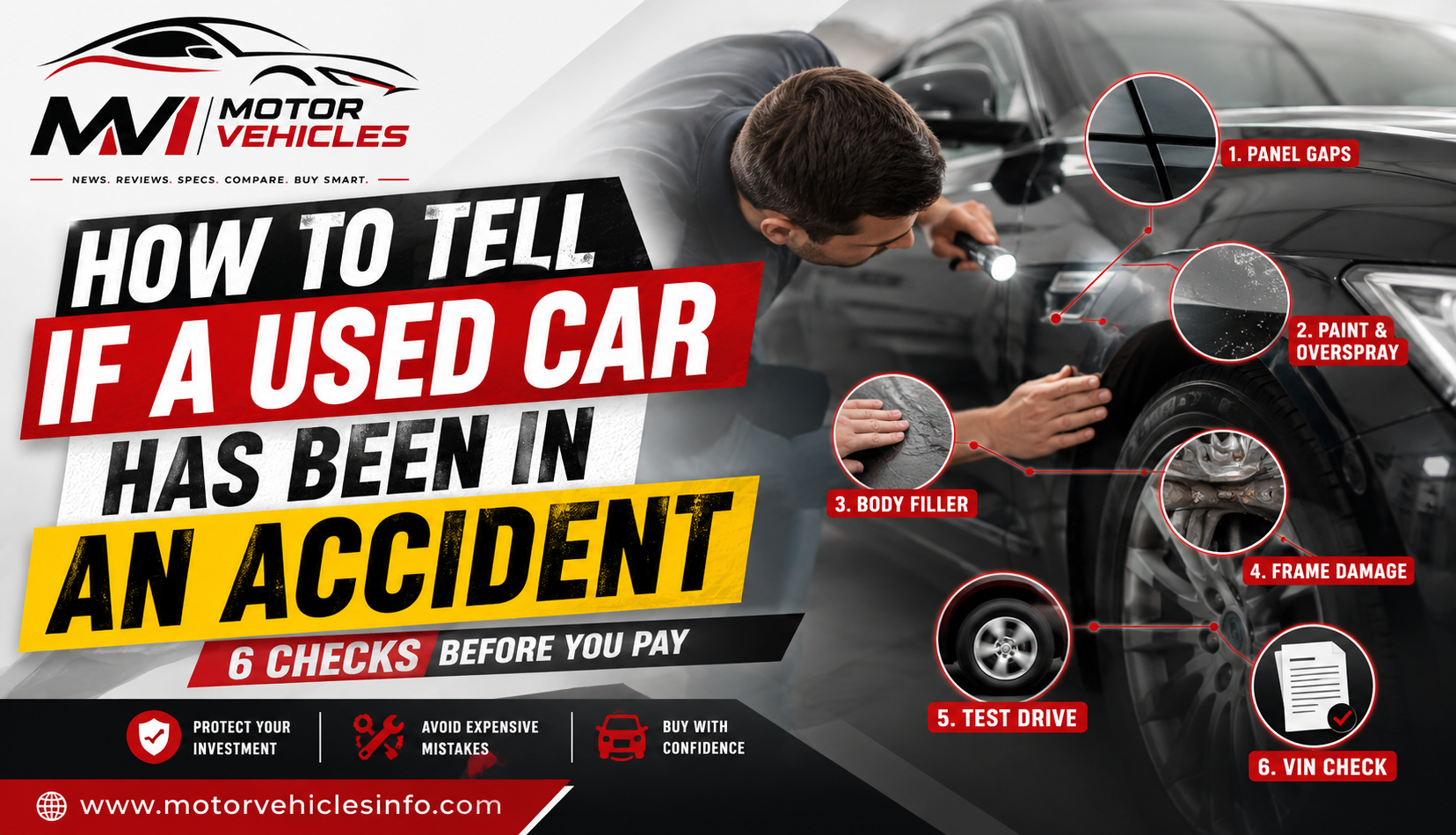
Check 1: Panel Gaps and Door Alignment
Start here — it’s the fastest tell and the hardest for a repair shop to fully correct. This kind of panel gap used car inspection takes under two minutes and needs no tools.
Walk around the car and run a finger along the seams between the hood and fenders, the doors and the body, and the trunk or liftgate and the rear quarter panels. Factory gaps are consistent in width from top to bottom and identical from the left side of the car to the right. Gaps that differ side to side, or a door that doesn’t sit flush with the fender next to it, are a classic sign the panel was removed and reinstalled after a repair.
Then open and close every door, the hood, and the trunk a few times. A door that rubs, needs extra force to latch, or doesn’t line up with the striker cleanly can mean the frame around it was bent and reassembled slightly out of true. This is the single most reliable free test you can do standing in a parking lot, and it’s the first thing any real panel gaps used car inspection should cover before you move on to paint.
Check 2: Paint Mismatches and Overspray
Stand a few feet back in direct sunlight and look down the length of each side of the car, the way a detailer would check for swirl marks. Consistent, glossy paint is normal even on an older car; discoloration, dullness, or an odd texture on one panel usually means a touch-up was done to hide something.
Then get close. Check under the hood, behind the front bumper cover, in the trunk, and inside the doorjambs for overspray on a car — fine flecks of paint that landed where they shouldn’t have during a repaint. Run your fingers along the doorjambs; overspray often feels slightly rough even when it’s hard to see. Also watch for a paint surface that looks unnaturally shiny, as if it’s brand new on an otherwise worn car — that’s often a sign of a recent repaint rather than the factory finish. Paint mismatch and overspray on a car are two of the most common signs a used car was in an accident, precisely because sellers rarely think to check the jambs and hinges before listing it.
Check 3: Body Filler and Paint Thickness
Body filler is used to smooth out dents before a repaint, and it leaves clues you can feel even when you can’t see them. Learning how to detect body filler on a car is one of the more overlooked skills in a private-party inspection.
Run your open palm flat across each door and fender rather than just looking. A rough texture, a wavy surface, or a slight dip under your hand can indicate filler was used underneath the paint. If you want to get more precise, a cheap magnetic paint-thickness gauge (under $20 online) does the job a body shop uses professionally — factory paint typically runs in the 90–105 micron range on many Japanese-brand vehicles and roughly 110–150 microns on many European-brand vehicles, so a panel that reads noticeably above its expected factory range has likely been repainted or filled. Treat these as general reference ranges, not a precise pass/fail line — thickness varies by model, color, and even which panel you measure. Between the hand test and a gauge reading, checking for body filler on a car is one of the few steps here that can catch damage even a very good paint match can’t hide.
Check 4: Frame, Subframe, and Weld Marks
This is the frame damage used car check that separates “cosmetic repair” from “structural repair,” and it’s worth doing even on a car that passed the first three checks with flying colors.
Get down and look underneath the car, along the subframe rails and around the strut towers under the hood. The frame is what determines whether a car can be restored to its original safety and structural integrity, so damage here matters more than anything cosmetic. Factory welds are uniform, machine-made spot welds in consistent rows. A row of uneven, hand-done welds, fresh undercoating in just one area, or paint overspray on frame rails that should never have been painted are all signs of a structural repair. If you see any of this, stop and get a pre-purchase inspection checklist run by an independent mechanic before you go any further — this isn’t a check to skip on a car you’re seriously considering. A proper frame damage used car check is the single check most likely to separate a car that’s fine to buy from one that isn’t, no matter how good the rest of the walkaround looked.
Check 5: The Test Drive Tells
Everything so far happens with the car parked. The last physical check happens at speed.
A steering wheel that tugs to one side is a classic symptom of a used car that has been in an accident, even when nothing about the panel or paint gave it away. Brakes that pull, or odd sounds from the wheels on a straight, flat road can point to collision damage that never made it into a listing photo. While you’re at it, check tire wear and tire age: mismatched tread depth across an axle, or a tire that looks newer than the car’s mileage suggests, isn’t proof of an accident on its own, but it’s worth asking about — especially paired with anything from Checks 1–4.
Check 6: Confirm It With a VIN Check
Everything above tells you what a repair looks like, but a walkaround alone can’t fully answer how to tell if a used car has been in an accident with certainty. It won’t tell you what actually happened, how severe it was, or whether it was reported and repaired properly. That’s what a VIN check for accident history is for — services like Carfax or AutoCheck can show whether a car was in a crash, and often include repair records or title issues that no walkaround will surface.
Before you pay for a report, it’s also worth running the VIN through the National Insurance Crime Bureau’s free VINCheck tool. It won’t show accident history, but it takes ten seconds and flags anything more serious: a vehicle reported stolen and never recovered, or one an insurer already declared a salvage total loss. You can also cross-check the VIN against the federally mandated NMVTIS vehicle history database for title-brand information. If it comes back clean, move on to a full paid report to see the accident and repair details — and if you’re deciding which report to actually buy, our side-by-side test of Carfax vs. AutoCheck shows which one actually catches more problems on the same VIN.
What to Do If You Find Something
Finding one sign that a used car has been in an accident doesn’t automatically mean walk away — but finding two or three together changes the math. None of these six checks are automatic dealbreakers on their own — even factory quality control leaves the occasional uneven gap, and a single scuffed bumper repaint doesn’t mean the car was totaled. What matters is how many checks come back positive, and how severe the sign is. One mismatched panel gap: ask about it. Panel gaps plus overspray plus a rough-feeling door: walk it through a pre-purchase inspection before you negotiate further. Any hint of frame or subframe repair: get a mechanic’s opinion before you get emotionally attached to the car. Treat this six-check routine as a standing part of your used car buying checklist, not a one-off you only run when something already feels off.
The combination of a hands-on inspection and a vehicle history report accident check is what actually protects you — neither one catches everything alone. For the complete step-by-step process, including which free and paid reports are worth the money, see our full used car buying checklist and history guide.
FAQ: Telling If a Used Car Has Been in an Accident
Can a car pass these checks and still have been in an accident?
Yes. A high-quality repair on a minor accident — a bumper replacement after a low-speed tap, for example — can be nearly invisible to the eye and hand. That’s why, even after you’ve learned how to tell if a used car has been in an accident by hand, a VIN check is still worth running on a car that looks clean.
Do uneven panel gaps always mean an accident?
Not always. Some vehicles leave the factory with minor inconsistencies, and older cars can develop slight misalignment from normal wear. Uneven gaps are a signal to look closer, not a verdict on their own.
Is a vehicle history report enough on its own, without a physical inspection?
No. Reports rely on what’s been reported to them — insurance claims, state title records, service records. An accident that was paid for in cash and never reported to an insurer won’t show up on any report, which is exactly why the physical checks above still matter.
What’s the single fastest check to do at a dealership or a private seller’s driveway?
Panel gaps and door alignment (Check 1). It takes under two minutes, needs no tools, and catches more repaired accidents than any other single check on this list.
Does a vehicle history report always show accident damage?
No. Reports only include incidents that were reported to an insurer or a participating repair shop. A car can have real accident history and still show a clean report, which is exactly why the physical checks in this guide matter even when a report comes back clean.
Can a body shop repair make a car impossible to tell it was in an accident?
A high-quality, factory-standard repair can come very close, especially on purely cosmetic damage. That’s part of why frame and structural checks matter more than paint alone — panel and paint work can be nearly invisible, but frame geometry is much harder to fully disguise.
Want the complete process of confirming whether a used car has been in an accident, including which free and paid history reports to trust? Read the full guide to checking a used car’s history before you buy.