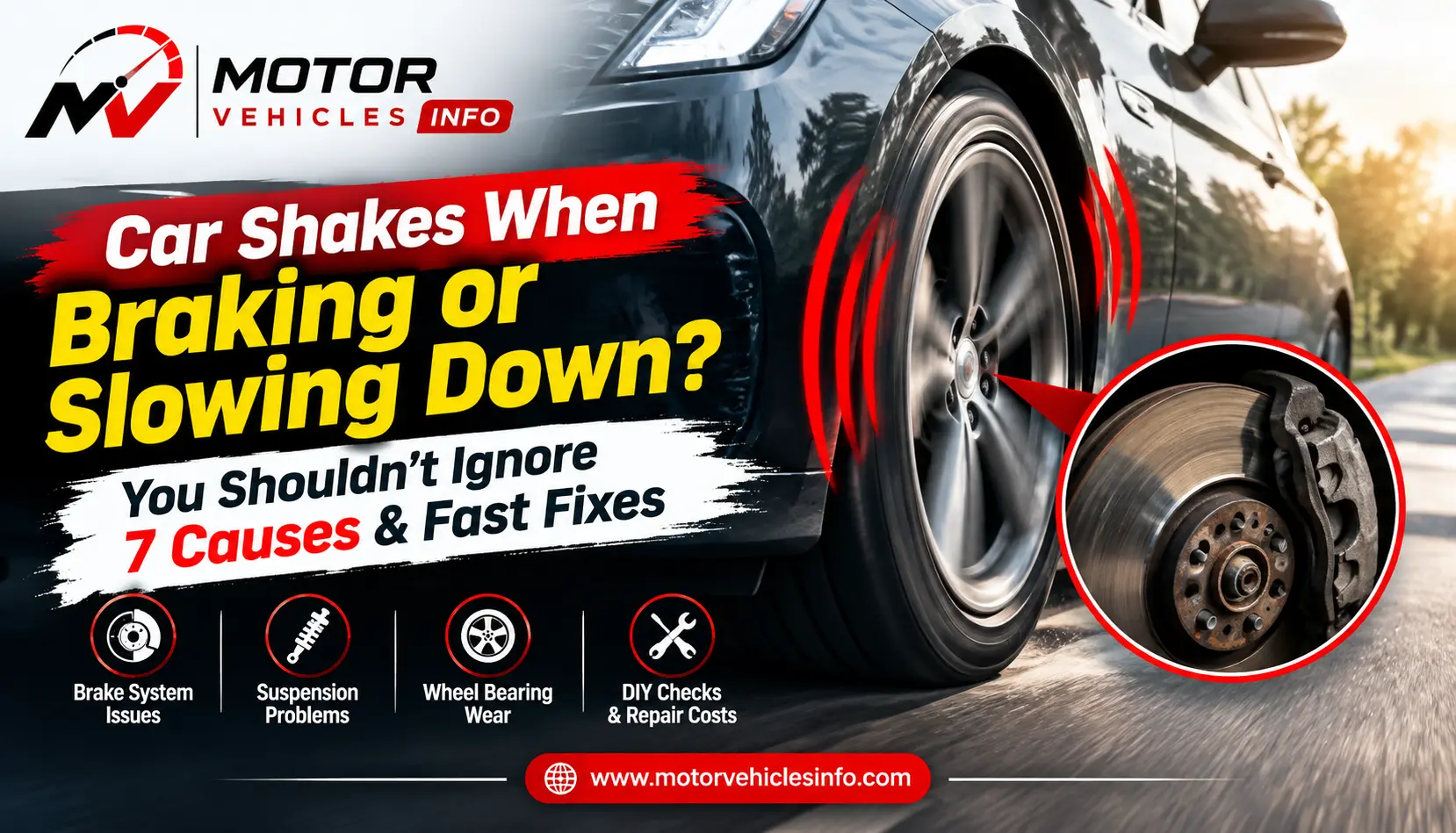
You drive to the red light, apply the brake pedal, and all of a sudden you feel the steering wheel vibrating. Or maybe your vehicle starts shaking like you’re driving over rumble strips while on a completely smooth road surface. A vibrating car on braking is the most common yet poorly understood issue at repair shops. The problem is you can’t ignore a vibration that occurs during braking because a car that shakes on braking needs professional attention and maintenance due to possible brake system degradation.
This guide reveals the reasons a car shakes when applying brakes, how to distinguish between the issues of the brake system and the suspension, the cost of the repairs, and a list of the parts to replace yourself if you consider it. No matter if you found this article by looking for “car shakes when braking,” “when I brake car shakes,” or “car vibrates when braking,” you will find the same seven causes of the problem listed below. We have written this article based on ASE mechanics’ best practices and shop experience.
What Does It Mean When Your Car Shakes When Braking?
Car shakes on braking is a signal that tells you that one of the components in the braking and suspension systems has ceased to function as it should. The majority of the time, when my car shakes on braking, this is caused by the fact that the surface of the brake rotor is no longer flat and consistent, which, in technical terms, is called disc thickness variation (DTV). As the brake pad engages an irregular surface of the rotor thousands of times per minute, this vibration is passed through directly to the pedal, to the steering wheel, or even to the entire chassis.
In this context, it should be stated quite clearly that car shaking on braking is not something one can ignore easily. The vibration is a symptom of the malfunction that causes problems with braking. According to the National Highway Traffic Safety Administration (NHTSA), brakes are one of the most safety-critical systems on any vehicle, and the agency runs a free VIN recall lookup that includes brake-related safety recalls — worth a quick check any time you notice new shaking or vibration. That’s a strong reminder that any car shake when braking complaint deserves a real diagnosis, not a guess.
Steering Wheel vs. Brake Pedal vs. Whole Car: How to Pinpoint the Cause
Where you feel the shake is one of the best free diagnostic clues you have. Mechanics use this exact logic before they even put the car on a lift.
Steering Wheel Shakes When Braking
If the steering wheel shakes during braking, then there is definitely an issue with the front brakes. The fact is that the front rotors experience a greater amount of heat compared to rear rotors and also perform most of the job of stopping the vehicle. Excessive play in the front wheel bearing may also result in shaking of the steering wheel.
Brake Pedal Pulses When Braking
A pulsing brake pedal — one that pushes back rhythmically against your foot — is the classic sign of disc thickness variation. This can happen on front or rear rotors, since the pedal is connected to the entire hydraulic brake system, not just one wheel.
Whole Car Shakes or Shudders When Braking
If the entire car is shaking upon braking, particularly if it is more a feeling of vibration through the seat than in the hands, check the rear brakes and rotors, worn-out bushings on the suspension system, or the rear wheel bearings. However, if the shaking worsens as the speed increases and stops once the car has completely stopped, then it probably has something to do with the rotors.
7 Common Causes of Car Shaking When Braking
1. Warped or Uneven Rotors (Disc Thickness Variation)
This is the most prevalent cause of car shuddering during braking. The rotor becomes rough because of high and low points developed by the heating and cooling process as the pads rub against it during braking.
2. Worn or Unevenly Worn Brake Pads
An old brake pad will not press evenly on the rotor. When your brake pads have been worn down to the point where there is nothing left between the wear indicators, you will notice the car vibrating during braking.
3. Loose or Worn Wheel Bearing
Failing wheel bearings allow the wheel hub to rotate about its axis a little bit. This rotation increases when braking torque comes into play. That is the reason why failing wheel bearings manifest themselves in car vibrations when braking, as well as in humming noises which vary depending on the speed.
4. Stuck or Sticking Brake Caliper
If the piston in the caliper does not retract completely, the caliper holds one brake pad against the rotor at all times, resulting in extra heat buildup that leads to a warped rotor. This is another cause of car vibration while braking after installing new brake pads.
5. Loose Lug Nuts or Wheel Hardware
This is a quick, dangerous, and surprisingly common cause of a car shaking when braking. If lug nuts are under-torqued, the wheel can shift slightly on the hub every time you brake hard, producing a sudden and often frightening vibration.
6. Suspension or Steering Component Wear
Worn tie rod ends, ball joints, or control arm bushings can amplify braking vibration even when the rotors themselves are fine. This is a common misdiagnosis: owners replace brakes and rotors, but the car still shakes when braking because the real culprit is a loose suspension component.
7. Tire and Wheel Issues Made Worse by Braking
An out-of-balance tire, tire cupping, or a bent wheel might only be noticeable at speed — and braking can make an existing vibration feel more pronounced as weight shifts forward onto the front wheels, which is exactly why so many drivers report “car vibrates when braking” but rarely at a steady cruise.
Why Rotor Thickness Variation Actually Causes Shaking (The Mechanic’s Explanation)
What most drivers refer to as “warped rotors” is actually very uncommon. The truth is that the vast majority of the time, drivers are experiencing disc thickness variation, also known as DTV. When thousands of brake actions are taken, the brake pads deposit uneven material on the disc surfaces, creating thickness differences in the process that are extremely thin – sometimes only a few thousandths of an inch.
This is the mechanical phenomenon in a nutshell: while rotating between the brake pads, the thickness differences cause the caliper piston to repeatedly retract and advance many times a second at high speeds. This mechanical vibration propagates from the caliper to the steering knuckle and all the way up through the suspension and the steering linkage – which explains the shaking of cars when braking at high speeds and the shaking of the steering wheel when braking in front-wheel drive cars. The major factor causing the disc thickness variation is heat – the harder braking going down the hill, riding the brakes in stop-and-go driving, and even when towing. Once DTV starts, it tends to get progressively worse, which is why so many owners describe the problem building over a few weeks rather than appearing overnight.
Car Shakes When Idle vs. When Braking: What’s the Difference?
It can be quite tempting to think of every form of vibration as a single thing, but car shakes when idle is a very different scenario from car shakes when braking. If your vehicle shakes when idle – by which means that the shaking occurs while the vehicle is at rest with your foot off the brake pedal and the engine running – then the source of the problem lies with the engine rather than the braking system. This can be because of problems with a faulty motor mount, a dirty or vacuum leak in the idle air control valve, spark plugs, or a plugged fuel injector.
On the other hand, car shaking when braking occurs only when the process of decelerating takes place, and involves wheel rotation and the friction system. You can test this on your own: if the car shudders with the engine running and in park gear, you’ve got an idle problem. However, if it only shivers while rolling and braking, it’s a braking system issue, probably stemming from problems with the rotor, brake pads, or wheel bearing. If it turns out your issue is a completely different symptom, like weak airflow or warm air from the vents, it’s worth checking a separate guide such as our car AC not cold troubleshooting guide so you don’t chase the wrong repair.
Is It Safe to Keep Driving If Your Car Shakes When Braking?
Short answer: not for long. A car that shakes when braking is usually still stoppable in an emergency, but the underlying issue — whether it’s a worn brake pad, an uneven rotor, or a failing wheel bearing — tends to get worse with every mile, not better. As disc thickness variation increases, stopping distances can lengthen and pedal feel becomes less predictable, which matters most in the moment you need your brakes to work perfectly.
A loose wheel bearing is the scenario that deserves the most urgency. Left unaddressed, a wheel bearing can fail completely, which in rare but serious cases can cause a wheel to separate from the vehicle. If your car vibrates when braking and you also hear a grinding, growling, or clicking noise, treat that as a same-week appointment, not a someday task. For everyday DTV or worn brake pad situations, it’s reasonable to drive cautiously to a shop within a week or two, avoiding hard braking and highway speeds when possible in the meantime.
DIY Checks You Can Do Before Visiting a Mechanic
Before you spend money on a diagnosis, a few checks can help you and your mechanic narrow down why your car shakes when braking — and rule out whether it’s really an idle problem instead:
- Check brake pad thickness through the wheel spokes; less than 3mm of visible pad material means replacement is due soon.
- Look at the rotor surface for grooves, blue heat spots, or an uneven, wavy edge — all signs consistent with disc thickness variation.
- Grab the top and bottom of each tire (car off, parking brake on) and rock it; noticeable play often signals a worn wheel bearing.
- Check lug nut tightness with a torque wrench against your owner’s manual spec — never guess or overtighten.
- Note exactly when the shake happens: only under braking, only at speed, only when cold, or all the time. This detail alone can save a mechanic significant diagnostic time.
- Inspect tires for uneven or cupped wear patterns, which can mimic or worsen brake-related vibration.
If you’re inspecting a car you’re about to buy rather than one you already own, roll these same checks into a proper pre-purchase inspection — our 20-point private seller checklist covers brakes alongside the rest of the vehicle.
How Much Does It Cost to Fix a Car That Shakes When Braking?
| Repair Type | Typical Cost Range (Parts + Labor, per axle) |
| Rotor resurfacing (machining) | $30 to $60 per rotor |
| Brake pad replacement | $100 to $300 per axle |
| Brakes and rotors replacement (pads + new rotors) | $250 to $600 per axle |
| Wheel bearing replacement | $250 to $550 per wheel |
| Caliper replacement | $150 to $400 per caliper |
| Tire balancing | $15 to $75 total |
Prices vary by region, vehicle make, and whether you use OEM or aftermarket parts, but this range reflects typical shop quotes across the US, UK, and Australia when a car shakes when braking due to rotor, brake pad, or wheel bearing wear. Rear brakes and rotors are sometimes slightly cheaper than front due to smaller rotor size, though this varies by model. If your car vibrates when braking and a shop quotes far above these ranges, ask for a breakdown of parts versus labor before you approve the work — a car shakes when braking repair should never require guesswork pricing. If you’re driving a higher-mileage vehicle and want to plan ahead for repairs like this, it’s worth comparing an extended car warranty for cars over 100,000 miles, though note most plans treat brake pads and rotors as wear items and may not cover them.
Where to Buy Replacement Rotors, Pads, and Bearings (AutoZone & Parts Guide)
If you’re planning a DIY brake job, AutoZone is one of the most widely used sources for rotors, brake pads, and wheel bearing kits in the US, and its guide on signs of warped brake rotors is a useful sanity check alongside this article. AutoZone auto parts listings typically let you filter by your exact make, model, and year, which matters because rotor diameter and brake pad shape are not universal even across trims of the same car.
When shopping for parts to fix a car shakes when braking issue, match rotor type (vented vs. solid), pad friction material (ceramic, semi-metallic, or organic), and torque specs to your specific vehicle. A mismatched brake pad compound is itself a common cause of new brake vibration, so don’t just grab the cheapest option on the shelf. If you’re not confident doing the job yourself, most parts retailers, including AutoZone, can point you toward local installers who deal with a car shakes when braking diagnosis every day.
Common Mistakes
- Assuming a car shakes when braking is always a rotor problem and skipping a wheel bearing or lug nut check first.
- Replacing rotors without replacing worn brake pads, which just repeats the same uneven wear cycle within a few thousand miles.
- Ignoring a car shakes when idle symptom by writing it off as “normal,” when it may indicate a separate engine issue.
- Overtightening or under-torquing lug nuts after a tire rotation or brake job, which itself can trigger vibration.
- Driving for months on a known worn brake pad or failing wheel bearing because the car “still stops fine.”
- Confusing car shakes when idle with car shakes when braking and paying for the wrong repair entirely.
Brake Safety Standards in the US, UK, and Australia
Brake inspection requirements differ slightly by country, but the underlying safety logic is the same everywhere. In the United States, the NHTSA sets Federal Motor Vehicle Safety Standards covering brake systems and brake fluid. In the United Kingdom, the annual MOT test checks brake performance, including the anti-lock braking system and brake warning lights, as part of the vehicle’s roadworthiness. In Australia, state transport authorities such as Transport Victoria’s roadworthy certification process require brakes to meet a minimum standard before a vehicle can be registered or resold. Wherever you drive, a car shakes when braking complaint is worth treating as seriously as these official inspection standards treat brakes generally.
Final Thoughts
A car that shakes when braking is your vehicle’s way of flagging a real, fixable mechanical issue — usually an uneven rotor, a worn brake pad, a stuck caliper, or a failing wheel bearing. None of these are exotic repairs, and most shops can diagnose the exact cause in under an hour. The real risk isn’t the vibration itself; it’s letting a car shake-when-braking symptom go unaddressed until stopping distance and control are compromised. If you’ve noticed your car vibrates when braking, book a brake inspection this week rather than waiting for the shake to get worse.
Notice your car shakes when braking? Don’t wait for a bigger repair bill or a safety scare. Book a brake inspection with a trusted local mechanic this week, and while you’re checking under the hood, it’s also worth running a quick recall check by VIN in case a brake-related recall applies to your vehicle, or browse AutoZone auto parts to compare rotors, brake pads, and wheel bearing kits if you’re planning to tackle the fix yourself.
FAQs:
Why does my car shake only when I brake at high speed?
Even small variations in disc thickness will cause a pulse to be produced by the caliper piston several times a second when the vehicle is being driven at highway speeds; this is the reason why the car shakes while braking at speeds higher than 50 mph.
Is it safe to drive if my car vibrates when braking?
You will still generally be able to brake safely for a while, although the vehicle that vibrates when braking must be checked out soon, within one or two weeks, as the problem will get worse.
Can a wheel bearing really cause my car to shake when braking?
Yes. When the wheel bearing is worn out, it causes a slight movement of the wheel hub. This movement becomes very obvious when braking due to extra pressure applied to it and makes a growling sound.
What’s the difference between car shakes when idle and car shakes when braking?
Shakes when idling happen while the car is at rest with the engine still running, and this problem is typically caused by a malfunctioning engine/motor mount. Shakes when braking, on the other hand, occur only while decelerating and indicate problems with the brake rotors or wheel bearings.
How much does it typically cost to fix a car that shakes when braking?
Most brake repairs are priced from $150 to $600 per axle, ranging from brake pad replacements to full brake and rotor repair or wheel bearing replacement, which is usually more expensive than other services.
Can I fix a car that shakes when braking myself?
With the help of simple tools, many DIY people can change their brake pads and rotors, and places such as AutoZone have options for searching for parts according to their vehicles, as well as loaner specialty tools; however, changing of wheel bearings should be left to professionals.
Do new brake pads always fix a car that shakes when braking?
Not necessarily. In cases where the rotor has experienced disc thickness variation, the installation of new brake pads on an undressed or untouched rotor will soon produce the vibration all over again.
Why does the steering wheel shake when braking but not the whole car?
A shaking of the steering wheel often means that there is a problem with either the front rotors or the front wheel bearings, as the steering mechanism connects directly to the front wheels.
Should I replace both rotors on an axle at the same time?
Yes, since the majority of mechanics recommend replacing the rotors and pads in pairs to ensure balanced braking action and avoid pulling and vibrations in the future, your concern is not groundless.
Can bad tires cause a car to shake when braking even if the brakes are fine?
Yes. Uneven tires or tire wear may cause vibrations which become more pronounced with an increase in weight when the vehicle slows down, which is why it is essential to do a complete checkup on the tires too.