That small light in the form of a tire on your dashboard can easily spoil an ordinary drive by bringing in unnecessary trouble. While driving perfectly fine, all of a sudden you find yourself wondering whether your car will get stuck to the side of the road. Wondering why your TPMS light comes on? That is one of the most searched dashboard-related questions, and in most cases there is a really simple solution.
A TPMS light means that the tire pressure monitoring system wants to warn you of any potential problems in order to avoid blowouts — either due to real leaks, because it was too cold in the morning, or because the batteries in the sensors became too old to work. In this guide, we will talk about what the TPMS light means, why the TPMS light comes on, the difference between a solid and blinking TPMS light, how it is different from the ABS light, and how to reset it — including for Honda owners.
Key Takeaways
- This means that one or more tires are underinflated by 25% or more than the recommended level.
- Meaning of TPMS: Tire Pressure Monitoring System – a mandatory safety feature for almost all US cars produced after 2008.
- A solid TPMS light means the pressure is low, while a blinking TPMS light is indicative of a sensor or system error.
- TPMS light and ABS light can be confused as their design looks similar, but the fact is that the former monitors tire pressure, while the latter monitors brake functioning.
- Typically, the procedure for TPMS light resetting lasts no more than five minutes once you inflate the tires, while most cars have a special TPMS reset button.
- Resetting the Honda TPMS light does not require using an OBD-II scanner; the process consists of pushing some buttons on the wheel or dashboard.
- A professional check of TPMS sensors usually costs 30 to 100.
What Is the TPMS Light? (TPMS Meaning Explained)
The definition of TPMS, when spelled out, stands for Tire Pressure Monitoring System. This is the tiny electronic system installed in your vehicle that monitors tire pressure to avoid any untimely surprises, such as discovering a slow leak at the most inconvenient moment, say, on the highway. If the TPMS light is on, it means that at least one of your tires has deflated and now has less pressure than the manufacturer thinks is acceptable, which would be about 25% lower than the recommended cold pressure.
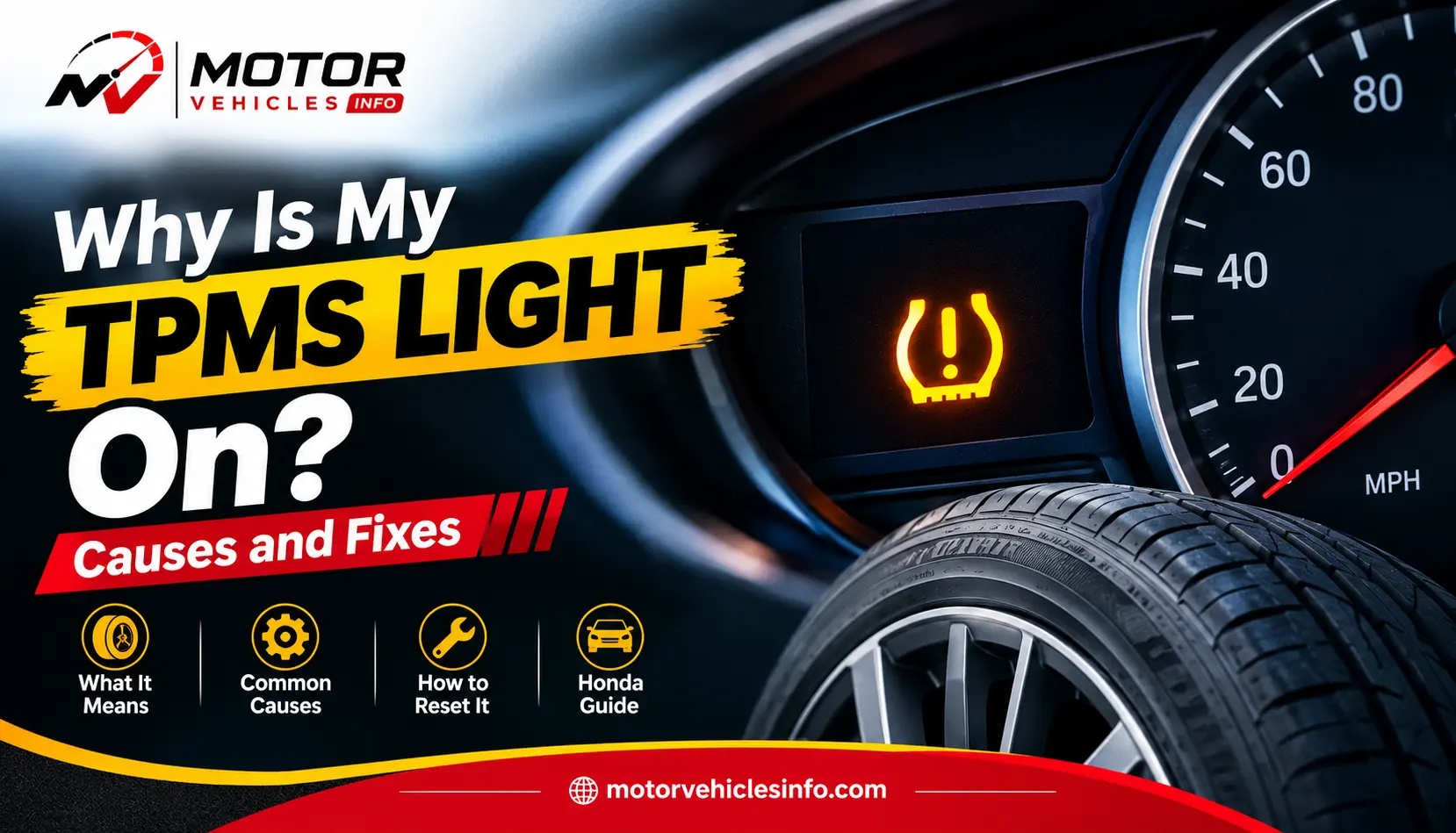
The symbol of the TPMS light consists of a cross-section of a tire with an exclamation mark inside it; its color can be amber or yellow, but it can easily be confused with some other warning lights on your dashboard.
The tire pressure monitoring system must be working on any passenger car made available for sale in America since the 2008 model year, and this was a direct result of the National Highway Traffic Safety Administration’s action following a spate of tire-related rollover accidents that occurred in the early years of the decade. Further details of the regulation and the underlying safety rationale can be obtained from the official tire safety website of the NHTSA. Underinflated tire accidents have been on the decline since the implementation of the regulation, as the regulators expected them to. For instance, in certain states, the functioning of the TPMS light is actually included in regular vehicle safety tests conducted as part of the registration renewal process.
How the TPMS Sensor Works (Direct vs. Indirect Systems)
Not every TPMS sensor works the same way, which helps explain why your TPMS light sometimes behaves oddly.
Direct TPMS uses an actual pressure sensor — a small battery-powered module mounted inside each wheel, usually on the valve stem — to measure real air pressure and send that reading to your car’s computer. It’s the more common, more accurate sensor TPMS setup on modern vehicles, and it’s why many newer cars can display the exact PSI for all four corners instead of just a warning light.
Indirect TPMS skips the pressure sensor TPMS module entirely and borrows data from your ABS wheel-speed sensors instead. An underinflated tire has a slightly smaller rolling diameter, so it spins a bit faster than the other three; the system notices the mismatch and lights up the TPMS light as a proxy for low pressure. It’s clever but less precise, and it typically needs recalibrating after every tire rotation or pressure adjustment so it can relearn what “normal” looks like.
Whichever type your vehicle uses, the tire pressure sensor’s job is the same: catch a dangerous pressure drop before it becomes a dangerous tire failure.
Common Causes of a TPMS Warning Light Turning On
There’s rarely just one reason the TPMS light decides to make an appearance. Here are the usual suspects:
- A genuine slow leak: A nail, a screw, or a small puncture in the tread can bleed air out gradually over days or weeks.
- Seasonal temperature drops: Tire pressure falls by roughly 1 PSI for every 10°F drop in outside temperature, which is the single most common trigger for a TPMS light in fall and winter.
- A damaged or corroded valve stem: Rubber valve stems age and crack over time, and a slow air leak at the stem is easy to miss.
- A dying TPMS sensor battery: Direct TPMS sensors run on small internal batteries that typically last 5–10 years before they need replacement.
- A recent tire rotation or new tire installation that wasn’t followed by a TPMS relearn procedure.
- A tire pressure sensor knocked loose during a pothole hit, curb strike, or amateur tire change.
- A software glitch or low 12-volt battery, which can occasionally cause the TPMS warning light to flicker on without any actual pressure problem.
If you’re shopping for a used vehicle and want to rule out a history of tire or sensor issues before you buy, running a vehicle history check is worth the few minutes it takes — our guide to Carfax alternatives covers a few budget-friendly options for pulling that information.
TPMS warning Light On but Tires Look Fine? Here’s Why
This is one of the most frustrating versions of the problem: the TPMS light is on, you’ve walked around the car, and every tire looks perfectly round and normal. That’s actually expected, and here’s why.
Tires can lose several PSI without any visible change in shape, especially on vehicles with stiffer sidewalls or larger wheels. A tire that’s 6–8 PSI low can look completely normal to the eye while still being enough of a pressure drop to trip the TPMS threshold. According to AAA’s own testing of in-vehicle tire pressure monitoring systems, the sensors themselves are generally accurate, but a car’s TPMS warning light only activates once a tire is significantly underinflated — meaning your tires can already be running lower than ideal well before the warning light ever appears.
The other common explanation is temperature. Cold mornings are the number one reason the TPMS warning light turns on with no visible tire damage — the air inside the tire contracts overnight, the pressure dips below the threshold, and the light comes on before you’ve even backed out of the driveway. Once the tires warm up from driving, the pressure often rises enough that the light goes off on its own, though it’s still smart to check the pressure with a gauge rather than assume everything’s fine.
Solid vs. Flashing TPMS Light: What’s the Difference?
Not every TPMS light behaves the same way, and the difference between solid and flashing actually tells you two very different stories.
A solid TPMS warning light simply means one or more tires are underinflated. The fix is usually as easy as adding air to the correct pressure, which you’ll find listed on the sticker inside the driver’s door jamb — not the number printed on the tire’s sidewall, which is the tire’s maximum rating, not the recommended pressure.
A flashing tire pressure light, especially one that blinks for 60–90 seconds every time you start the car before turning solid, is telling you something different: the TPMS system itself has a fault. This could mean a dead sensor battery, a sensor that failed to register during a relearn procedure, or a spare tire without a working sensor currently installed. A flashing tire pressure light isn’t something adding air will fix — it usually points to a component that needs diagnosis or replacement.
If your flashing tire pressure light won’t go away no matter how many times you check the tires, that’s your cue to have the system scanned rather than keep guessing.
TPMS Light vs. ABS Light: How to Tell Them Apart
It’s easy to mix up the TPMS light and the ABS light, especially since both can appear as a small icon near the speedometer and both relate loosely to “the wheels.” But they’re monitoring completely different systems.
| Feature | TPMS Light | ABS Light |
| What it monitors | Air pressure inside each tire | The anti-lock braking system’s sensors and hydraulic control |
| Typical icon | Tire cross-section with an exclamation point | The letters “ABS” inside a circle |
| Common cause | Low tire pressure, weak sensor battery, temperature drop | Faulty wheel-speed sensor, low brake fluid, wiring fault |
| Urgency | Check pressure soon; usually not an emergency | Have it checked soon; normal braking still works, but ABS won’t engage |
| Can you keep driving? | Yes, but check pressure right away | Yes, but drive cautiously, especially on wet roads |
If both lights come on at once, that’s a stronger signal that something needs attention, since a badly underinflated or damaged tire can sometimes throw off wheel-speed readings the ABS system relies on. Either way, neither light is one to ignore for long — they exist specifically to catch problems before they become dangerous.
How to Reset the TPMS Light (Step-by-Step, Including the Reset Button)
Once the underlying issue is fixed — usually by inflating the tires to the correct pressure — the TPMS light should reset. Here’s the general process:
- Inflate all four tires (and the spare, if it has a sensor) to the pressure on the door-jamb sticker, not the tire’s sidewall maximum.
- Find the TPMS reset button — often a small button under the steering column or in the glove box, sometimes labeled “TPMS” or “TPMS reset.”
- Turn the key to “on” without starting the engine (or press the start button twice on push-button-start vehicles).
- Press and hold the TPMS reset button until the TPMS warning light blinks three times, then release it.
- Drive for 10–20 minutes above 15 mph so the system relearns the new pressure readings.
No dedicated TPMS reset button? Many vehicles reset through the dashboard menu instead — look for a “Tire Pressure” or “TPMS” option and select “Calibrate.” Some older, simpler systems reset automatically after a short drive with no button at all. If the TPMS warning light won’t reset after these steps, that usually points to a sensor that isn’t communicating properly and needs a scan.
TPMS Light on a Honda: What’s Different and How to Reset It
The TPMS light on Honda vehicles works the same way mechanically, but the reset process trips up a lot of Honda owners because it isn’t always where they expect it.
- Newer Hondas (touchscreen or multi-info display): Turn the ignition on, use the steering wheel arrows to reach “Settings” or “Vehicle Settings,” select “TPMS Calibration,” and confirm.
- Older Hondas (2010s and earlier): Find the TPMS button, often near the steering column or under the dash, and press and hold it until the light blinks three times.
- No visible button or menu option: Some models relearn automatically. Inflate the tires correctly, drive about 10 miles at a steady speed, and the TPMS light on Honda dashboards will typically turn off on its own.
One quirk worth knowing: on several Honda models, the light can stay on briefly even after a correct reset if the car hasn’t been driven far enough for the system to confirm the new readings — give it a full drive cycle before assuming the reset failed.
When to See a Professional (and What It Costs)
Most TPMS light situations are a five-minute fix with an air pump. But there are times when it’s worth booking a shop visit instead of troubleshooting further on your own.
| Situation | Recommended Action | Typical Cost |
| Tire is losing air repeatedly | Tire inspection and possible patch or plug | 15–40 |
| TPMS sensor battery is dead | Sensor replacement (per tire) | 50–100 per sensor, parts and labor |
| Flashing tire pressure light persists after reset | Full TPMS diagnostic scan | 30–75 |
| New tires installed, sensors not relearning | TPMS relearn/reset service | 20–50 |
| Corroded or damaged valve stem | Valve stem replacement | 10–25 per stem |
If you’re dealing with a fault that keeps returning, or a flashing tire pressure light that won’t clear, a diagnostic scan is worth the cost — chasing the same warning light repeatedly usually ends up costing more in wasted time than just having it looked at once. If a shop needs your vehicle identification number to order the correct replacement sensor, our breakdown of VIN vs. registration number explains where to find each one and why they aren’t interchangeable.
Practical Tips to Avoid TPMS Light Surprises
- Check tire pressure monthly with a manual gauge, even if your TPMS warning light hasn’t come on. The U.S. Department of Energy’s fuel economy resources note that underinflated tires quietly cut into fuel efficiency long before a warning light ever appears.
- Check pressure when tires are cold, ideally before you’ve driven more than a mile or two.
- Keep an eye on seasonal swings. The first cold snap of fall is a predictable time for TPMS lights to start appearing across a lot of driveways at once.
- Replace TPMS sensor batteries proactively around the 8–10 year mark, often at the same time as a tire replacement.
- After any tire rotation, swap, or repair, confirm the TPMS system has been relearned before you drive off the lot.
Common Mistakes Drivers Make With the TPMS Light
- Ignoring a flashing tire pressure light, assuming it will “sort itself out” like a solid light sometimes does.
- Using the tire’s sidewall PSI number instead of the recommended pressure from the door jamb sticker.
- Overinflating tires to try to make the TPMS warning light turn off faster — this reduces traction and causes uneven wear.
- Assuming a normal-looking tire means normal pressure, when a several-PSI drop is often invisible to the eye.
- Skipping the relearn/reset procedure after new tires leaves the TPMS warning light on even though pressure is fine.
Frequently Asked Questions
What does the TPMS light mean?
The TPMS warning light means your tire pressure monitoring system has detected that one or more tires are significantly underinflated, typically 25% or more below the recommended pressure. It can also mean the system itself has a fault, which usually shows up as a flashing tire pressure light rather than a steady one.
Is it safe to drive with the TPMS light on?
It’s generally safe to drive a short distance to check your tire pressure, but you shouldn’t ignore the light for long. Underinflated tires handle worse, wear unevenly, and are more prone to blowouts, especially at highway speed.
Why does my TPMS warning light come on in cold weather?
Tire pressure drops roughly 1 PSI for every 10°F the temperature falls. A cold morning can be enough to push pressure below the TPMS threshold even if there’s no leak at all, which is why the light often reappears every fall and winter.
How do I reset the TPMS warning light after adding air?
Inflate all tires to the correct pressure, then either drive for 10–20 minutes so the system relearns automatically, or use your vehicle’s TPMS reset button or dashboard menu if it has one. Steps vary slightly by make and model.
What’s the difference between TPMS and ABS lights?
The TPMS warning light monitors tire air pressure, while the ABS light monitors your anti-lock braking system. They look different on the dashboard and are triggered by unrelated problems, though both are worth checking promptly.
Why is my TPMS warning light on but my tires look fine?
A tire can lose several PSI without any visible change in shape. Cold temperatures, a slow leak, or a weak TPMS sensor battery can all trigger the light even when nothing looks obviously wrong.
How much does it cost to fix a TPMS sensor?
A single TPMS sensor replacement typically runs 50–100, including labor, depending on the vehicle and sensor type. A full diagnostic scan to identify the exact fault usually costs 30–75.
Why is the TPMS warning light on my Honda not turning off?
On most Hondas, the TPMS warning light on Honda dashboards needs either a dashboard menu calibration or a specific reset button press, followed by a drive cycle of about 10 miles. If it still won’t clear, the sensor itself may need replacement.
Can a TPMS sensor go bad on its own?
Yes. TPMS sensors run on small internal batteries that typically last 5–10 years. Once the battery dies, the sensor stops transmitting, which usually triggers a flashing tire pressure light rather than a solid one.
Does a flashing TPMS light mean I have a flat tire?
Not necessarily. A flashing tire pressure light usually points to a system fault — like a dead sensor or a spare tire installed without a sensor — rather than a flat. A steady light is more commonly linked to simple low pressure.
Final Thoughts
The TPMS light isn’t there to nag you — it’s one of the more useful warning lights on your dashboard, precisely because tire pressure problems are so easy to miss until they become serious. Whether the fix is as simple as topping off air on a cold morning or as involved as replacing a tired sensor battery, catching the TPMS warning light early keeps you safer, saves fuel, and stretches the life of your tires. For more dashboard warning lights, maintenance guides, and vehicle explainers, browse the full library of articles on Motor Vehicles Info.
Don’t wait for the TPMS light to turn into a roadside tire change. Grab a gauge, check all four tires this week, and bookmark this guide so the next time that light comes on, you’ll know exactly what to do.