I’ve swapped out enough car batteries over the years to notice a pattern: they almost never just die on you out of nowhere. There’s usually a slow build-up first. The engine cranks a touch slower every morning, the radio glitches for a second on startup, maybe the dashboard clock resets itself for no reason at all. Sound familiar? Your car battery is probably closer to the end of its life than you’d like.
So this guide is going to walk you through the seven clearest warning signs of a failing car battery, how long car batteries actually tend to last depending on your climate, and how you can test one yourself with a cheap multimeter (no mechanic needed). There will also be some information on car battery replacement cost for 2026, comparisons between Costco and Walmart, an open discussion on whether Odyssey batteries are really better than regular batteries, and recommendations on two chargers that will be helpful to have.
What Is a Car Battery and How Does It Power Your Vehicle?
The car battery is a rechargeable lead-acid battery. It stores energy and provides a surge of energy to the starter motor when the key is turned. After ignition, the alternator comes into play; its duty is to recharge the battery and provide power to other electronic devices in the car.
Starting the engine isn’t its only job, though. Think of the car battery as a buffer for the whole electrical system — smoothing voltage spikes, keeping the infotainment screen alive when the engine’s off, and running lights and power windows. Most cars still use a conventional lead-acid battery, but AGM (absorbed glass mat) batteries — Odyssey’s probably the name you’ve heard most — have become pretty standard in newer vehicles with stop-start technology, since that tech cycles the battery way more than older cars ever did. Because it works so quietly in the background, nobody really thinks about theirs until the morning it just… doesn’t.
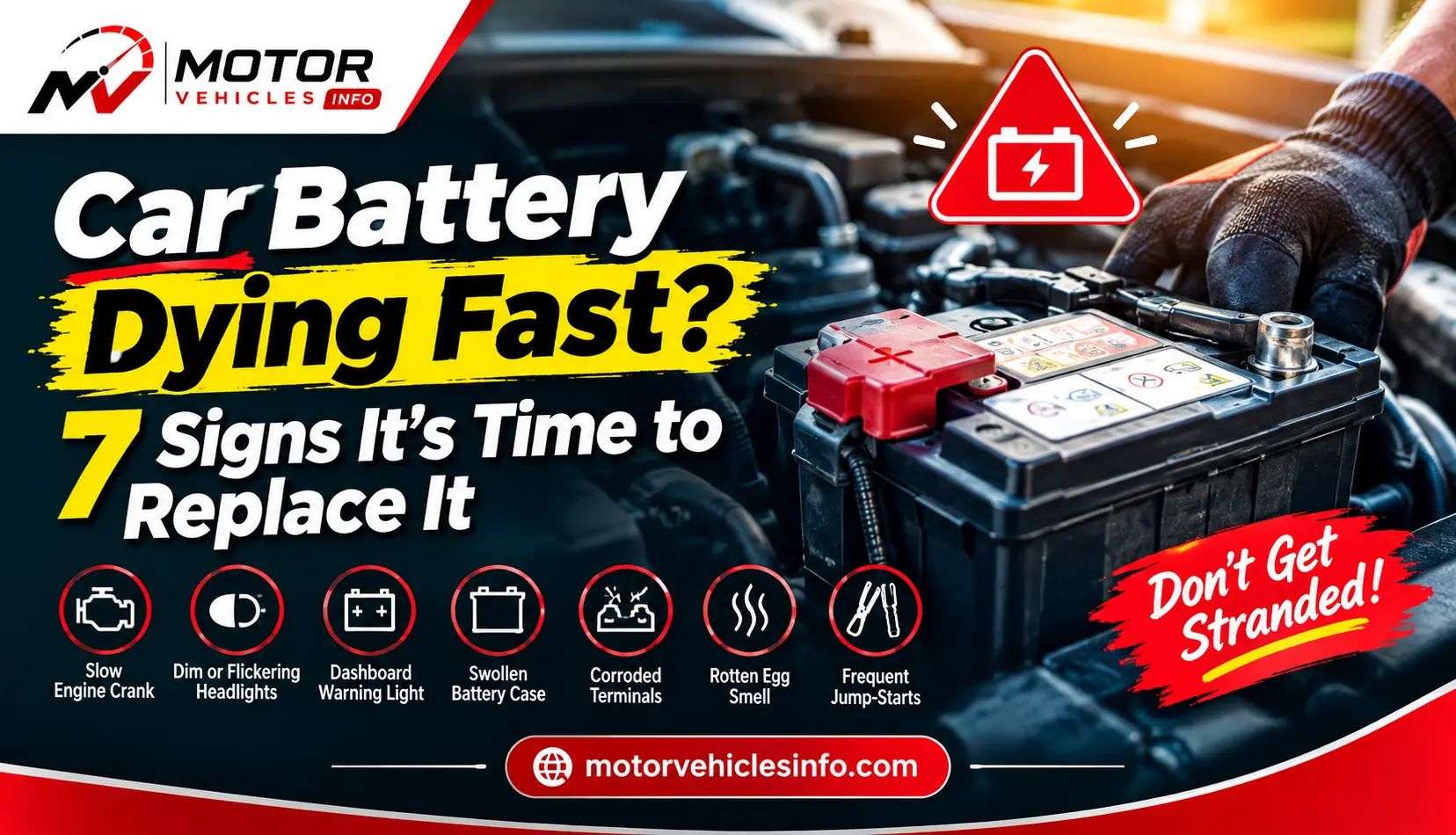
7 Warning Signs Your Car Battery Is Dying
Notice more than one of these at once? Don’t wait around, get it tested. RACV’s car battery guide covers a lot of the same red flags I’ll walk through below, and while you’re at it, it’s worth checking your manufacturer’s recall history too. Some electrical-system recalls, like this recent Subaru recall, can quietly mess with charging and battery performance on specific models.
1. Slow Engine Crank
This is usually the first thing people notice. A healthy battery spins the starter briskly. A weak one drags, and it drags worse on cold mornings, and it only gets worse from there — it doesn’t fix itself.
2. Dim or Flickering Headlights
Headlights looking a bit dimmer at idle? Flickering when you flip on the AC or turn up the radio? That’s a pretty reliable sign the car battery can’t keep up with the electrical load anymore.
3. Dashboard Battery Warning Light
Modern cars keep tabs on voltage constantly. So if a battery icon or a “check charging system” message pops up on your dash, that’s your car being pretty blunt about needing attention.
4. Swollen or Bloated Battery Case
Extreme heat can warp the plates inside enough to swell the plastic casing itself. Don’t try to test or jump-start a swollen battery. It’s a safety issue at that point, not a maintenance one, and it needs replacing right away.
5. Corroded Terminals
That white or bluish, powdery crust building up around the terminals gets in the way of the electrical connection. A bit of corrosion can sometimes be cleaned off and forgotten about. If it keeps coming back though, that’s usually the car battery telling you it’s on its way out.
6. A Rotten Egg Smell Under the Hood
Lead-acid batteries can give off a sulfuric smell when they’re overcharging or failing internally. Catch that rotten-egg odor near the engine bay and get things checked as soon as you reasonably can.
7. Needing Frequent Jump-Starts
If jumper cables have basically become part of your morning routine, that’s not just bad luck. It’s a car battery on borrowed time, and a jump-start was never meant to be anything more than a temporary patch.
How Long Does a Car Battery Actually Last? (Average Car Battery Life by Climate)
It takes an average of 3 to 5 years, but climate can make a difference much greater than people think. Ironically, heat affects batteries much more adversely than cold does. The warmer the environment is, the quicker the chemical processes within the battery take place, resulting in quicker evaporation of the electrolyte liquid.
| Climate | Typical Car Battery Life |
| Hot climates (Southern US, inland Australia) | 2–4 years |
| Moderate climates (UK, coastal Australia, mid-US) | 4–5 years |
| Cold climates (Northern US, Canada) | 3–5 years, but cold cranking amps matter more |
Cold weather doesn’t usually kill a battery outright. What it does is expose one that’s already weak. A battery sitting at maybe 60% health could start fine all through summer, then just refuse to turn over on the first genuinely freezing morning of the year. That’s really the argument for testing proactively rather than waiting until something goes wrong. The NRMA’s guide on car battery health checks suggests regular testing once a battery passes the three-year mark, even if nothing seems off yet.
How to Test a Car Battery at Home (Step-by-Step with a Multimeter)
You really don’t need a mechanic for this. A basic digital multimeter, $10 to $20 at pretty much any hardware store, tells you everything you need to know.
The engine and all the accessories must be switched off, then leave your car to rest for around 30 minutes to allow the surface charge to stabilize. Place the multimeter on the DC voltage setting with a 20V scale and touch the red probe on the positive terminal and the black probe on the negative terminal. A good or fully charged car battery will show a reading of 12.6 volts or more. If the reading is between 12.2 and 12.4 volts, then it indicates a partially charged battery. Below 12 volts means a dead battery.
Start the engine and check again — you want to see 13.7 to 14.7 volts, which tells you the alternator’s doing its job. Want a more thorough answer? Use a load tester, or swing by an auto parts store. Most, AutoZone and O’Reilly included, run a free battery test under actual load rather than just checking resting voltage.
If your readings keep coming in under 12.4 volts, or the voltage drops fast the second there’s any load on it, don’t keep hoping. Start shopping.
Car Battery Replacement Cost: What You’ll Actually Pay in 2026
What you end up paying depends on battery type, brand, and whether you’re installing it yourself or paying someone else to.
A standard flooded lead-acid battery runs 80–150 for the battery itself, or 100–200 installed. AGM batteries, required by a lot of newer stop-start vehicles, land at 150–280, or 180–320 installed. Premium options like Odyssey run 200–400 for the battery alone. Labor, if you’re not doing it yourself, is usually another 20–50, though plenty of retailers install it free with purchase.
Your vehicle matters here too. Trucks, SUVs, and cars with heavy electrical draw generally need a higher cold cranking amp (CCA) rating, and that pushes the price up. Check your owner’s manual for the correct group size and CCA rating before you buy anything — an underpowered battery might start your car today and still leave you stranded in a few months. Worth keeping half an eye on automotive news too, since part shortages occasionally push replacement costs up for a stretch.
Costco vs. Walmart vs. Auto Parts Stores: Where to Buy the Cheapest Car Battery
| Retailer | Typical Price Range | Warranty | Free Installation |
| Costco (Interstate/Kirkland battery) | 90–140 | 3-year free replacement, up to 5 years total | Yes, in most locations |
| Walmart (EverStart) | 80–130 | 2–3 years, prorated | Limited, varies by store |
| AutoZone / O’Reilly / Advance Auto | 100–220 | 2–3 years, varies by tier | Free basic install at some locations |
| Dealership | 150–350 | Matches vehicle warranty terms | Yes, included |
Costco batteries for cars consistently come out ahead on value. Mostly because the warranty is unusually generous relative to the price, though you do need a membership to shop there in the first place. The batteries for cars from Walmart are typically the least expensive option, which is actually not a terrible decision since you have to buy another one anyway within a few years. The auto parts stores are slightly more expensive, but at least you get the battery right away, free tests, and someone to check your number of groups and CCA right on the spot.
Are Odyssey Batteries Worth the Higher Price? A Quick Comparison
The Odyssey batteries are made of the AGM technology that keeps the acid trapped within a fiberglass mat rather than allowing it to slosh freely inside the battery. These batteries are much less vulnerable to vibrations, more tolerant of deep discharges, and last longer compared to regular flooded batteries.
| Feature | Standard Flooded Battery | Odyssey (AGM) Battery |
| Typical price | 80–150 | 200–400 |
| Typical lifespan | 3–5 years | 4–8 years |
| Vibration resistance | Moderate | Excellent |
| Deep-cycle tolerance | Poor | Strong |
| Best for | Everyday commuter cars | Off-road vehicles, stop-start systems, extreme climates |
For a normal daily commute, a decent standard battery does the job for a lot less money, and there’s no shame in going that route. But if you’re off-roading a lot, dealing with brutal summers or winters, or driving something with a stop-start system, Odyssey batteries genuinely can pay for themselves over the life of the car.
Best Car Battery Chargers to Extend Battery Life
A good car battery charger — some people call it an auto battery charger, others just a maintainer — keeps a car battery topped up during long stretches of inactivity. That right there is one of the most common, and most avoidable, reasons batteries die early.
The Battery Tender Plus is affordable, reliable, and switches to trickle mode automatically once it’s full — solid if your car doesn’t get driven much. The NOCO Genius5 can charge, maintain, and even bring a moderately discharged battery back to life, with settings built in for AGM types too. The CTEK MXS 5.0 is more of a premium pick, with an eight-step program that classic car owners swear by, though it works just as well on something you drive every day.
Plug one of these in during a long vacation, over the off-season, or right after you notice a slow crank, and honestly, it can add months, sometimes years, to a car battery’s life.
How to Extend Your Car Battery’s Lifespan (Prevention Tips)
A five-minute drive is not sufficient to allow the alternator to charge everything properly. Therefore, try to avoid driving your vehicle for such a short time if possible. Turn off the accessories when switching off the engine because lights, air conditioners, and stereos draw additional current from the battery during startup. Terminal corrosion needs to be cleaned off using a solution of baking soda and water, after which it should be dried. The car battery needs to be properly mounted because an improperly mounted battery will rattle against its tray.
This causes it to wear down more quickly than it would otherwise. Have it checked two times a year if possible. The best time would be just before the summer season and then before winter. Park in a garage or shade when possible because one of the biggest factors leading to early failure is heat. Lastly, when disposing of your battery, have it recycled because of the components it is made up of. If you’re in Australia, the B-cycle national battery recycling scheme has drop-off points nationwide, and NSW EPA’s safe battery recycling guidance is worth a look for state-specific rules.
Common Mistakes People Make With Car Batteries
Ignoring the early warning signs because, hey, the car still starts most mornings — that’s probably the most common one. Right behind it is buying whatever’s cheapest without checking the correct group size or CCA rating, and letting a car sit unused for weeks without a maintainer keeping the car battery topped up. Cleaning off corrosion without disconnecting the battery first is another one people don’t think twice about, and it risks a short circuit. And maybe the biggest mistake of all: treating a jump-start like it fixed something, rather than what it actually is: a warning sign that the car battery needs testing or replacing.
If you’re buying a used car, a weak battery can actually be a small clue about how well the previous owner looked after the vehicle overall. Worth pairing a quick battery check with a proper vehicle history review before you commit.
Final Thoughts
A dying car battery almost always tries to warn you first. Slow cranks, dim lights, a dashboard alert, one too many jump-starts — worth paying attention to, not brushing off. Testing a car battery yourself takes about ten minutes, and knowing roughly what replacement cost looks like ahead of time means the bill won’t blindside you. Whether you go with a budget Walmart battery, a well-warrantied Costco pick, or splurge on an Odyssey, catching the signs early is really what saves you money and hassle in the long run.
For more guides like this one, have a browse through the full article library at Motor Vehicles Info.
Ready to check your own battery? Grab a multimeter, run through the steps above, and if the numbers look weak, use everything here to compare Costco, Walmart, and Odyssey before you buy. A fresh battery costs a lot less than a tow truck does.
FAQs
How do I know if it’s my car battery or my alternator?
A weak car battery usually shows up before you’ve even started the engine; think slow cranking, dim interior lights. An alternator issue tends to show up after the car’s already running, like the battery light staying lit or the battery going flat again shortly after a jump-start. Checking for 13.7–14.7V with the engine running is a quick way to tell the two apart.
Can I jump-start a car with a bad battery repeatedly?
You can, but it’s a band-aid, not a fix. Doing it over and over puts real strain on the alternator and starter motor, and it’s usually a sign the car battery itself needs testing or replacing sooner rather than later.
How long does it take to charge a dead car battery?
A standard trickle charger takes anywhere from 4 to 24 hours depending on the battery’s size and how depleted it is. A fast charger can get you enough charge to start the car in around 30 minutes, though a full charge still takes a good while longer.
What’s the difference between cold cranking amps (CCA) and reserve capacity?
CCA is how much current a battery can put out at 0°F for 30 seconds, and it matters most for cold starts. Reserve capacity is more about how long the battery can keep the essentials running if the alternator ever fails on you.
Do electric vehicles have a 12-volt car battery too?
Yes, actually, and a lot of people are surprised by that. Even EVs rely on a small 12-volt battery to run accessories and “wake up” the high-voltage system, completely separate from the main traction pack.
How much does a car battery cost at Costco compared to Walmart?
Costco batteries usually run 90–140 with a three-year free-replacement warranty. Walmart’s EverStart batteries tend to cost 80–130 with a shorter, prorated warranty. For the extra 10–20, Costco’s generally the better long-term deal.
Are Odyssey batteries worth it for a daily driver?
For most commuters, a standard battery does just fine, honestly. Odyssey batteries really earn their price in vehicles with stop-start systems, extreme climates, or heavier electrical loads.
How often should I test my car battery?
Twice a year is a good rule of thumb, ideally before summer and before winter, plus any time you spot one of the seven warning signs above.