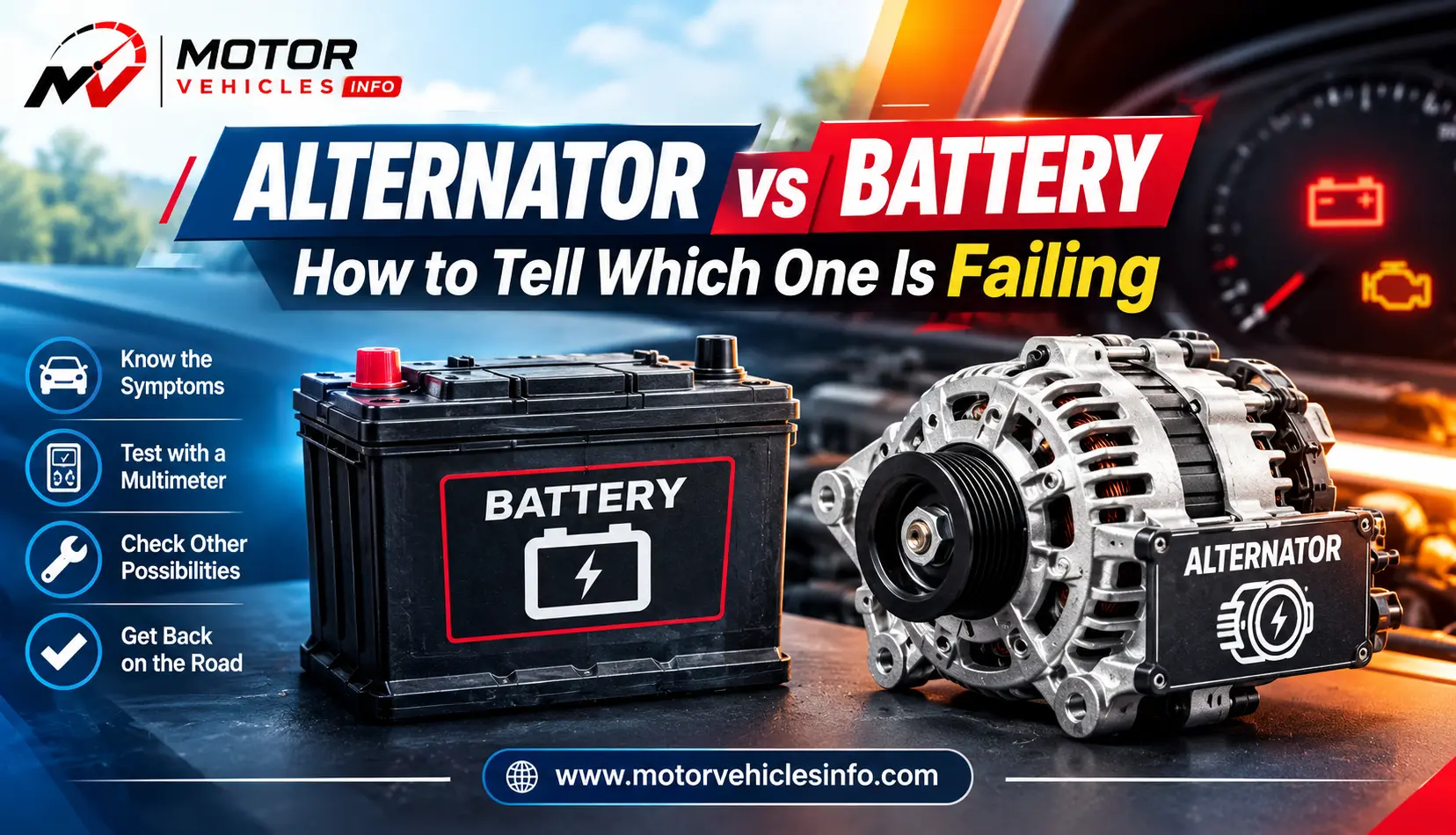
Your car won’t start, the lights look weak, and a little battery icon glows on the dash. Is it the alternator vs battery problem again? Many drivers guess wrong, and a wrong guess can mean paying for a part you never needed.
The good news is that you can usually settle the alternator vs battery question with a few simple checks. This guide explains what each part does, how to spot the symptoms, how to test with a multimeter, and when to call a pro. Whether you’re buying, fixing, or checking a used car, you’ll know which part is probably failing. For more ownership advice, browse our car guides.
Key Takeaways
- The alternator vs battery difference is simple: the battery starts the car, and the alternator runs the electrics and recharges the battery.
- A car that clicks or cranks slowly usually points to the battery. A car that starts but stalls, or dims while driving, usually points to the alternator.
- A healthy resting battery reads about 12.6 V. With the engine running, expect roughly 13.7 to 14.7 V.
- The starter, cables, fuses, belt, and parasitic drain can all mimic a bad battery or alternator.
- Many parts stores test both for free, so a battery or alternator check costs little.
Alternator vs Battery: What Each Part Does and Why They’re Easy to Confuse
The battery stores electricity in chemical form. It delivers a big burst of current to turn the starter and wake the electronics. The alternator is a belt-driven generator on the engine. Once the engine runs, it powers the whole car and tops up the battery. A malfunctioning charging system shortens battery life, which shows how closely the two parts are tied.
So why is alternator vs battery so confusing? A weak battery and a weak alternator share symptoms, such as slow cranking, dim lights, and warning lights. The real clue is timing. Battery trouble shows up at start-up. Alternator trouble shows up while you drive, or soon after a jump-start.
Battery vs Alternator: How They Work Together
Picture the battery as a bank account and the alternator as your paycheck. If the deposits stop, the balance falls until the car stalls. If the account is already damaged, even a good paycheck can’t fix it. That’s why a battery or alternator diagnosis usually needs two or three checks, not one.
Signs of a Bad Battery: 8 Bad Battery Symptoms to Watch For
Batteries usually fade over time. Time, heat, and vibration wear batteries down, and most give warning signs first. Here are the signs of a bad battery to watch for:
- Slow, labored cranking. The engine turns over like it’s tired, especially on cold mornings.
- Rapid clicking. You turn the key and hear clicks, but nothing starts.
- Weak lights with the engine off. Interior lights and headlights look dim before you start.
- Dashboard battery or check engine light. Some cars flag a weak battery.
- Swollen or leaking case. Heat can bloat the casing. A leak means replace it now.
- Rotten-egg smell. A sulfur odor suggests an overheated, leaking battery.
- Corroded terminals. White or blue-green crust chokes the current.
- Age. Most batteries last three to five years, and hot climates sit at the short end.
These bad battery symptoms hit hardest at start-up. That’s your first clue in any alternator vs battery diagnosis.
Bad Alternator Symptoms: How to Know If the Alternator Is Bad
When an alternator weakens, the car lives off battery reserve until it runs out. So bad alternator symptoms tend to appear while you drive. If you’re asking how to know if the alternator is bad, look for these:
- Warning light. A battery-shaped light, or “ALT” or “GEN,” glows or flickers while driving.
- Dimming or pulsing headlights. Lights brighten and fade with engine speed.
- Electrical oddities. Slow windows, weak wipers, a flickering dash, or a dying radio.
- Whining or grinding. Worn bearings or a loose belt can make noise.
- Burning smell. Hot wiring or a slipping belt smells like burnt rubber.
- Stalling. The engine cuts out once the battery drains.
- Repeat dead batteries. The car starts after a jump, then fails again.
Alternator vs Battery Confusion: Why Symptoms Overlap
An alternator that can’t charge leaves the battery empty. The empty battery then causes a no-start. The owner buys a new battery, and the trouble returns within days. That’s the classic alternator vs battery trap: the battery is the victim, not the cause.
Signs of a Bad Alternator vs Bad Battery: Side-by-Side Comparison Chart
Use this chart to compare the signs of a bad alternator vs bad battery. This alternator vs battery chart shows which column collects most of your symptoms.
| Symptom | More likely a bad battery | More likely a bad alternator |
| Won’t crank, only clicks | Very common | Only if the battery drained |
| Slow crank at start-up | Common | Possible if undercharged |
| Lights dim while driving | Rare | Common |
| Stalls while driving | Unlikely | Common |
| Runs after a jump, then dies fast | Unlikely | Very common |
| Runs fine after a jump, fails after sitting | Common | Rare |
| Warning light while driving | Sometimes | Common |
| Whining or burning smell | No | Common |
| Corrosion or swollen case | Common | No |
| Typical age at failure | 3 to 5 years | Roughly 5 to 10+ years |
As a rule of thumb, if the car dies while moving, suspect the alternator. If it won’t start but runs fine once jumped, suspect the battery. In many alternator and battery cases, both parts are worn at once.
The 5-Minute No-Tools Test: Jump-Start, Headlight, and Warning-Light Checks (Plus Myths to Avoid)
No multimeter? You can still run a decent battery vs alternator check in five minutes.
- Warning-light check. Turn the key to “on” without starting. The battery light should glow, then go out once the engine runs. If it stays lit, suspect the charging system.
- Headlight check. Switch on the headlights before starting. Very dim beams suggest a weak battery. Now start the engine and rev gently. Lights that stay dim, or fade at idle and brighten when you rev, point to a weak alternator.
- Jump-start check. Jump the car using the steps in your owner’s manual. Once it runs, remove the jumper cables safely. If the engine dies right away, the alternator isn’t carrying the load. If it keeps running but won’t restart later, the battery is the weak link.
Myths to Avoid When Testing Alternator vs Battery
- “Pull the battery cable with the engine running.” This old trick can send voltage spikes through modern electronics. Skip it.
- “A new battery fixes everything.” Not if a failing alternator killed the old one.
- “No warning light means the alternator is fine.” Early weakness doesn’t always trigger the light.
How to Test a Battery and Alternator with a Multimeter: Voltage Chart and What Each Reading Means
A basic multimeter turns the alternator vs battery guess into hard numbers. Set it to DC volts (20 V range), then touch the red lead to the positive terminal and the black lead to the negative. Mechanics commonly use the charge levels below.
| Reading | Conditions | What it means |
| 12.6 V or higher | Engine off, rested | Healthy, fully charged battery |
| 12.4 V | Engine off | About 75% charged |
| 12.2 V | Engine off | About 50% charged, low |
| 12.0 V or less | Engine off | Flat or failing battery |
| Below about 10 V | While cranking | Weak battery or poor connection |
| 13.7 to 14.7 V | Engine running | Alternator charging normally |
| Under 13.2 V | Engine running | Weak alternator or slipping belt |
| Over 15 V | Engine running | Overcharging, likely regulator fault |
Follow this order for a clean battery and alternator test:
- Let the car rest for an hour, then read the battery with the engine off.
- Start the engine and read again at idle.
- Turn on the headlights, blower, and rear defroster, then hold about 2,000 rpm.
- Watch whether the reading stays above roughly 13.2 V.
A low engine-off reading with a normal running reading points to the battery. A normal engine-off reading that drops toward 12 V with the engine running points to the alternator. Note that a battery can pass a rest test and still fail a load test, which a shop can run.
Expert tip: For any alternator vs battery test, remember stop/start cars use AGM or EFB batteries, and they can read slightly differently. Check your owner’s manual before judging the numbers.
It Might Be Neither: Starter, Cables, Fuses, Belt, and Parasitic Drain
Before you blame the alternator or battery, rule out these look-alikes:
- Starter motor. One loud click, or a whirr with bright lights, suggests a bad starter.
- Loose or corroded cables. A poor ground or terminal starves the starter. Clean and tighten them.
- Blown fuse or fusible link. This can break the charging circuit.
- Serpentine belt. A loose, glazed, or broken belt stops the alternator spinning. Squealing at start-up is a clue.
- Parasitic drain. Something draws power with the car off, such as a faulty module, dash cam, or aftermarket alarm. A draw above roughly 50 milliamps once the car sleeps deserves a closer look.
Why Batteries and Alternators Fail: Heat, Short Trips, Stop/Start Systems, and the Death Spiral
Heat quietly kills batteries by speeding up internal corrosion. Cold just exposes the damage. A battery may last five years or longer in cooler northern climates, but only about three in hot southern ones.
Short trips hurt too, because the battery never fully recharges after a quick start. Stop/start systems add more strain. The U.S. Department of Energy explains that the engine shuts off at every stop and restarts automatically. That constant cycling is why many of these cars need an AGM or EFB battery.
Alternators wear out from heat, worn bearings and brushes, regulator faults, oil leaks, and belt trouble. They also die early when forced to recharge a weak battery.
The Death Spiral: When the Alternator or Battery Damages the Other
A tired battery makes the alternator work harder. The alternator runs hot, wears faster, and charges poorly. The poorly charged battery then gets worse. Break the loop by testing the battery and alternator together, then replace what has truly failed. Sometimes that means both.
Used-car buyers: check the date code on the battery, run the alternator vs battery multimeter test, and watch the dash lights at start-up. A fresh battery in an older car can hide a weak alternator. For more pre-purchase advice, browse the Motor Vehicles Info article library.
Repair, Replace, or Both? Costs, Safe-to-Drive Limits, and Free Testing at AutoZone vs. a Repair Shop
An alternator costs more to fix than a battery, so the alternator vs battery diagnosis matters. Costs vary by vehicle and labor rates. New batteries typically run $100 to $350 before labor, and alternator parts about $500 to $900. Labor adds more, so get written quotes. When you buy a battery, ask about the core charge: EPA reports the U.S. recycles 99 percent of lead-acid batteries, helped by refundable core charges of $5 to $20.
Is it safe to drive? With a bad battery that still starts the car, you can usually drive, but don’t switch the engine off until you reach help. With a failing alternator, the car runs on battery reserve, which can last only minutes. Turn off the air conditioning, stereo, and heated seats, then head straight to a safe stop.
Free testing vs. a shop. AutoZone helps with the alternator vs battery question too, and many stores test batteries and charging systems at no charge, so ask your local branch. AAA members in many areas can also get free battery testing at AAA-owned Car Care Centers or Approved Auto Repair facilities. A repair shop goes deeper with load tests, parasitic draw checks, and belt and wiring inspections.
Common Alternator vs Battery Mistakes
- Replacing the battery without testing the alternator.
- Guessing alternator vs battery without testing either one.
- Ignoring a flickering battery light.
- Buying the wrong battery type for a stop/start car.
- Reusing corroded terminals.
FAQs
What is the main difference between an alternator vs battery?
The battery stores power and starts the engine. The alternator generates power while the engine runs and recharges the battery. If either fails, the other struggles to keep the car running.
Can a bad alternator ruin a new battery?
Yes. A failing alternator can undercharge a new battery and drain it flat, and a faulty regulator can overcharge and damage it. Always test the alternator when you replace a battery.
How do I know if it’s the alternator or battery when my car won’t start?
Check for clicking, dim lights, and the age of the battery first. If a jump-start works but the car dies soon after, the alternator is the likely culprit. If it runs fine after a jump and only fails after sitting, suspect the battery.
How long do an alternator and battery last?
Batteries typically last three to five years, while alternators often last five to ten years, or 100,000 miles or more. Heat, short trips, and heavy electrical loads shorten both.
What voltage should a good alternator produce?
Most alternators produce roughly 13.7 to 14.7 V at the battery with the engine running. Readings below about 13.2 V suggest a weak alternator. Readings above 15 V suggest overcharging.
Can I drive with a bad alternator?
Only for a short distance, and only to get to safety or a repair shop. The car will run on battery reserve until it dies. Switch off non-essential electrics to stretch that time.
Does AutoZone test the alternator and battery for free?
Many AutoZone stores offer free battery and charging system testing, though availability can vary. Call your local store first to confirm.
Which fails more often, the battery or alternator?
Batteries usually fail first, since they wear out in a few years. In the battery vs alternator comparison, alternators last longer but cost more to replace.
Final Thoughts
The alternator vs battery puzzle gets easier when you match symptoms to timing. Start-up trouble usually means the battery. Trouble while driving usually means the alternator. A multimeter, a jump-start test, and a quick look at belts, cables, and the starter will settle most alternator vs battery cases.
At Motor Vehicles Info, our goal is clear, well-researched guidance, as outlined on our about us page. This article is general information, so have a qualified mechanic confirm before you buy expensive parts.
Next time your car acts up, run through the battery vs alternator checks above before you buy anything. Keep up with the latest vehicle news. For more practical car help, visit Motor Vehicles Info.