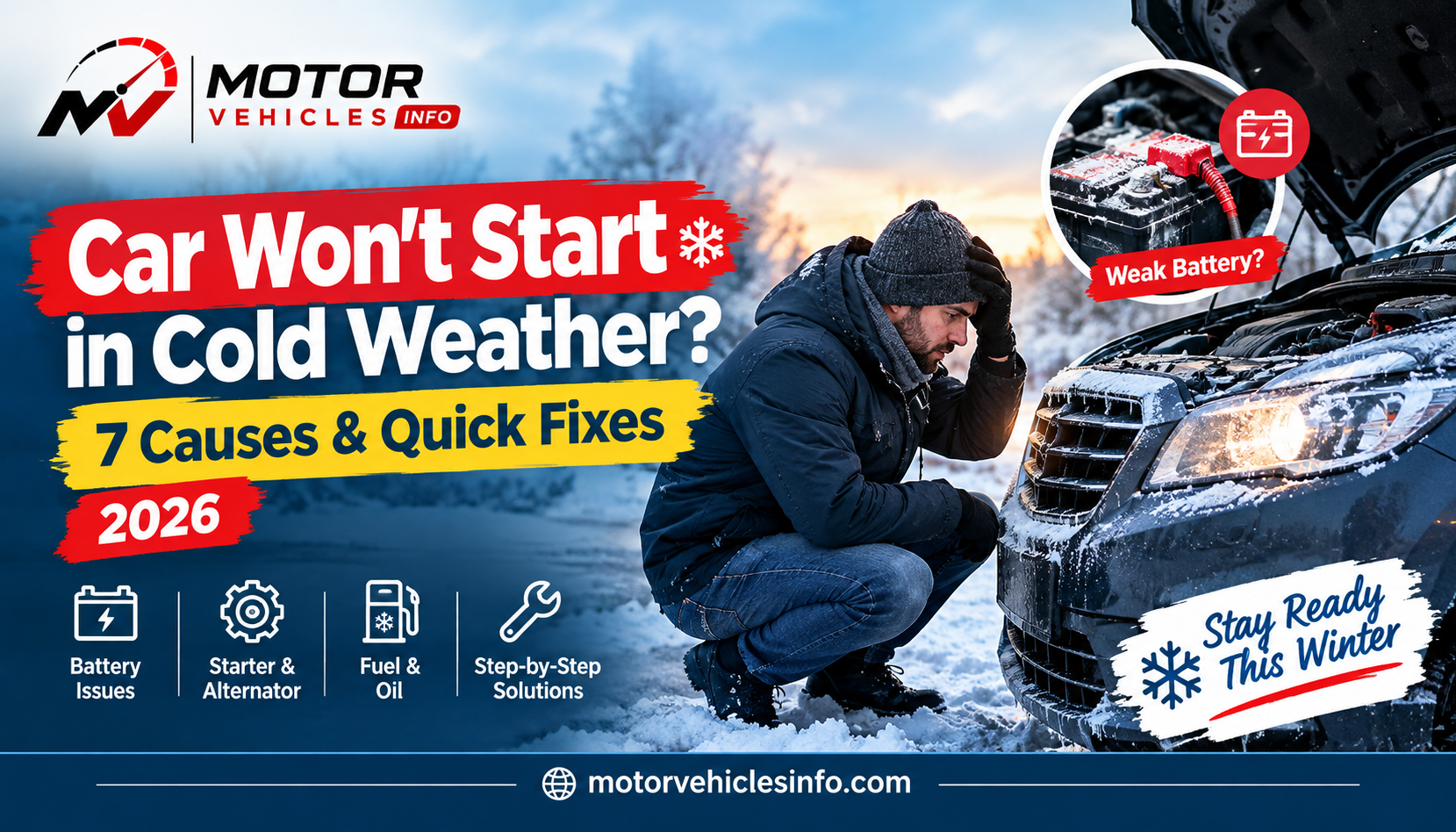
Picture this. It’s 6:40 on a freezing morning, you’re already running late, and the key turns to a sad little click. Nothing else. If your car won’t start in cold weather, you know exactly how that feels, and you’re in huge company. Roadside crews see the same story every year: the first hard frost brings a wave of dead batteries.
Here’s the reassuring part. When a car won’t start in the cold, the cause is usually dull and fixable. Below, I’ll walk you through seven suspects, show you how to read the noises your car makes, and explain how to jump-start a car without frying anything. I’ll also cover how to keep a car that won’t start cold from ambushing you twice. Want more everyday car advice afterwards? Our car guides and reviews are a good next stop.
Key Takeaways
- Most of the time, a car won’t start in cold weather because the car battery is weak or dead. Cold slows down the chemistry that makes electricity.
- Listen first. Clicking, slow cranking, and total silence each tell a different story when a car won’t turn over.
- Lights on but no start? Blame a tired battery, a dirty connection or the starter.
- Buying a new battery? Match or beat the cold cranking amp (CCA) number in your manual.
- A battery tender, block heater, and remote car starter make a cold-weather no-start far less likely.
Why Your Car Won’t Start in Cold Weather (What the Cold Does to Your Engine)
Cold doesn’t pick one target. It goes after three at once.
The battery suffers first. Its chemical reaction crawls, so it hands over less current right when the engine wants more. The US National Highway Traffic Safety Administration notes that gasoline and diesel engines both need more battery power to start in the cold. Then there’s the oil, which thickens up like cold honey and makes the starter push harder. Finally, fuel doesn’t vaporise well in freezing air, so the mix is weaker too.
Why a Car That Won’t Start in the Cold Often Has an Old Battery
A tired battery can cope with a mild autumn and then give up at the first frost. That explains the classic story. The car was fine all autumn, then the first proper frost arrives, and it won’t budge.
7 Reasons Your Car Won’t Start in the Cold
1. A Weak or Dead Battery: The Number One Reason a Car Won’t Start in Cold Weather
A car battery dead on a frosty morning is the culprit more often than anything else. Most last three to five years. An old one can hide its age for months, then quit overnight. Dim headlights and a lazy crank are your early warning.
2. Corroded or Loose Terminals: A Car That Won’t Start in the Cold
See that white or green crust on the battery posts? It blocks current. A perfectly good battery can’t deliver power through dirty clamps, so your car won’t start cold even though the battery itself is fine.
3. Thick Oil and a Car That Won’t Start in Cold Weather
Oil that’s too heavy for your climate goes stiff in freezing air. The starter groans, and the engine turns slowly or not at all. Check which grade your manufacturer recommends for winter.
4. A Failing Starter Behind a Car That Won’t Start Cold
Worn starters draw more current when it’s cold. One loud click with bright dash lights? Start suspecting the motor.
5. A Tired Alternator
The alternator tops up the battery while you drive. If it’s weak, the battery never fully recovers, and one icy night finishes the job.
6. Frozen or Gelled Fuel
Water in a fuel line can freeze. Diesel can turn waxy and thick. Either way, you get a car that won’t start in cold weather, cranking happily without ever catching.
7. Worn Spark Plugs or Glow Plugs
Petrol engines need a strong spark. Diesels rely on glow plugs to warm the cylinders. Parts that cope fine in summer often give up in a freeze.
Car Won’t Turn Over? Decode the Clicking, Slow Cranking or Silence
When a car won’t turn over, your ears give you the first clue.
- Rapid clicking: There’s enough juice to flick the relay but not to spin the engine. Think flat battery.
- Slow, heavy cranking: The engine turns, just badly. Weak battery, thick oil, or both.
- One big click: Power reaches the starter, but the starter won’t move. Look at the motor or its wiring.
- Total silence: Check terminals, fuses, and the ignition switch. A fully dead battery sounds exactly like this.
- Strong crank, no fire: The battery’s fine. Look at fuel, spark, or a frozen line.
Same weather, different fault. That’s why a car won’t start in the cold in so many different ways.
Car Won’t Start but Lights Work: What It Means in Cold Weather
“But my lights work, so the battery must be fine.” Not quite. Headlights sip current. A starter motor gulps hundreds of amps. A weak battery can light up the dash and still fail to crank.
Try this. Switch on the headlights and turn the key. If the beams sag badly, the battery is the problem. If they stay bright and you only hear a click, point your finger at the starter or its wiring. Either way, a car that won’t start in cold weather often shows both faults at once. Also check the gear selector, and look for a flashing immobiliser light on the dash.
Dead Battery, Bad Alternator or Failing Starter? A 5-Minute Diagnosis
You don’t need a workshop to learn why your car won’t start in cold weather. Go in this order.
- Check the terminals. Brush off any corrosion and tighten the clamps.
- Watch the headlights. If they dim hard while you crank, suspect the battery.
- Try a jump start. If it fires straight away, the battery was the problem.
- Watch the battery light. If it stays on while you drive after a jump, the alternator isn’t charging.
- Listen for a lone click. Bright lights plus one click usually means the starter.
| Symptom | Likely cause | First move |
| Rapid clicking, dim lights | Dead battery | Jump start, then test the battery |
| Slow cranking | Weak battery or thick oil | Test battery, check oil grade |
| Single click, bright lights | Failing starter | Inspect wiring, see a mechanic |
| Starts after a jump, dies later | Bad alternator | Get the charging system tested |
| Cranks but won’t fire | Fuel or spark fault | Check fuel, plugs and filter |
A quick example: One driver in outer Melbourne noticed her car crank a little slower for three mornings. On the fourth, a 2°C day, it died completely. The battery was four years old, and a new one fixed everything. The warning had been sitting there all week.
How to Jump Start a Car in Cold Weather (Step-by-Step and Safety Rules)
Knowing how to jump start a car is a core skill for any DIY owner whose car won’t start in the cold. The sequence below is the standard one roadside crews use, but check your owner’s manual too.
- Park the donor car close, but don’t let the two touch. Switch both off and set the handbrakes.
- Red clamp to the positive (+) post of the flat battery, then the other red clamp to the donor’s positive post.
- One black clamp goes on the donor’s negative (–) post.
- The last black clamp goes on bare, unpainted metal on the dead car’s engine. Never on the flat battery itself.
- Start the donor and let it run for a minute.
- Start the dead car and leave both running for several minutes.
- Take the cables off in reverse order, then drive for at least 20 minutes.
Safety rules when a car won’t start in cold weather:
- Don’t jump a battery that’s cracked, swollen or leaking.
- Keep the clamps apart and clear of moving parts.
- Avoid using a hybrid or electric car as the donor unless its maker says it’s fine.
- Unsure? Call roadside help. Nobody will judge you.
Cold Cranking Amps, Battery Replacement and the Best Battery for Winter
A jump start is only a bandage when a car won’t start in cold weather. If the battery is old, replace it. Cold cranking amp (CCA) tells you how much current a battery can deliver at 0°F (-18°C) for 30 seconds. A bigger number means stronger starts in freezing weather.
Choosing the Best Battery for a Car That Won’t Start in the Cold
When you shop for car battery replacement, keep these in mind:
- Match or beat the CCA in your manual.
- Get the right group size and terminal layout.
- Cars with stop-start tech usually need an AGM or enhanced flooded battery.
- Look for the manufacture date sticker. Fresh stock lasts longer.
Batteries typically last three to five years, and scorching summers plus freezing winters both shorten that. For the best battery for cars where you live, compare warranty, CCA and price rather than just the badge.
| Vehicle type | Typical CCA range | Note |
| Small petrol car | 300 to 500 | Check the manual first |
| Mid-size sedan or SUV | 500 to 700 | Go higher in very cold areas |
| Truck or large diesel | 700 to 1000+ | Diesels need more cranking power |
Buying used? A tired battery is a hidden cost, so run the car’s history before you pay. It also helps to know the difference between a VIN and a registration number, so you check the right identifier. More help sits in our registration and vehicle history guides.
How to Prevent a Cold-Weather No-Start: Battery Tender, Block Heater and Remote Car Starter
The cheapest fix for a car that won’t start in cold weather is stopping it before it happens.
A Battery Tender for a Car That Won’t Start in the Cold
A battery tender keeps the charge topped up while the car sits. Weekend cars and seasonal vehicles gain the most. NHTSA’s winter tips also say to have a mechanic check the battery, the charging system and the cable connections before the cold arrives.
Block Heaters and Remote Car Starters
A block heater warms the engine and oil, which is a lifesaver in deep-freeze regions. A remote car starter lets the engine idle for a few minutes before you leave. It won’t rescue a dying battery, though.
Expert tips for a car that won’t start in cold weather:
- Test the battery each autumn, especially after year three.
- Park in a garage or under cover when you can.
- Take a 30-minute drive once a week so the alternator can recharge.
- Keep the fuel tank at least half full to limit condensation.
- Switch off the heater, lights and radio before you crank.
Common mistakes when a car won’t start in cold weather:
- Cranking for more than five to ten seconds. It cooks the starter and drains the battery.
- Shrugging off a slow crank because “it still started.”
- Buying the cheapest battery with too low a CCA.
- Hooking jumper cables to the wrong terminals.
- Blaming the battery when the starter is the real problem.
Gas, Diesel, Hybrid and EV: Cold-Start Problems Beyond the Basics
Every powertrain has its own winter quirks, so a car won’t start in cold weather for different reasons depending on what’s under the bonnet.
- Petrol (gas): Look at spark plugs, thick oil, and moisture in the fuel system.
- Diesel: A diesel that won’t start in the cold often has gelled fuel or tired glow plugs. Winter-grade diesel helps.
- Hybrid: A hybrid that won’t start in cold weather may simply have a flat 12-volt battery.
- EV: An EV that won’t start in the cold has the same 12-volt weak spot, and range drops too. Our electric vehicle coverage digs into charging and battery care.
Fleet managers, log battery age for every vehicle. Recalls can cause electrical faults too, so check every VIN on a government site: NHTSA in the US, GOV.UK in the UK and Vehicle Recalls in Australia. Our write-up on the Subaru recall hitting Forester, Crosstrek and Ascent models shows how fast a notice can reach thousands of owners.
FAQs
Why won’t my car start in the cold but the battery is good?
If the battery tests fine, look at thick oil, a failing starter, corroded terminals or fuel trouble. A car that won’t start cold with a healthy battery very often has a starter or fuel issue.
At what temperature does the risk of a car that won’t start in cold weather begin?
Trouble often starts below about 5°C (41°F) and climbs sharply near freezing. An old battery can fail well above that.
Can a car battery be dead even if the lights work?
Yes. Lights need very little power, and cranking needs a lot. A weak battery can run the dash and still leave the car unable to turn over.
How long should I crank a car that won’t start in the cold?
Five to ten seconds at a time, then wait at least 30 seconds. Long repeated attempts overheat the starter and drain the battery further.
Does a remote car starter help when a car won’t start in cold weather?
Only if the battery is healthy. A remote car starter warms the engine before you drive, but it can’t revive a dead battery or replace a failing starter.
How do I jump start a car in cold weather safely?
Red to positive on both batteries, black to the donor’s negative, and the last black clamp to bare metal on the dead car’s engine. Start the donor, then the dead car, and drive for at least 20 minutes afterwards.
What is a good cold cranking amp rating?
Match or beat the number in your owner’s manual. Small cars often need 300 to 500 CCA, while trucks and diesels may need 700 or more.
How often should I replace my car battery?
Most last three to five years. If your car won’t start in cold weather and the battery is over three years old, get it tested before winter.
Do hybrids and EVs have cold-start problems too?
Yes. Both rely on a 12-volt battery to wake the vehicle, and that battery can go flat in freezing weather just like in a petrol car.
Final Thoughts
A car that won’t start in cold weather feels like a disaster, but it’s rarely a mystery. Start with the battery, listen to the sounds, and run the five-minute diagnosis before you call anyone. Replace an old battery before winter, pick the right cold cranking amp rating, and add a battery tender or block heater if you live somewhere properly cold.
Don’t wait for the first frost to learn that your car won’t start in the cold. Test your battery this week, toss a set of jump leads in the boot. For more practical help with buying, registering, and maintaining vehicles, head over to Motor Vehicles Info.