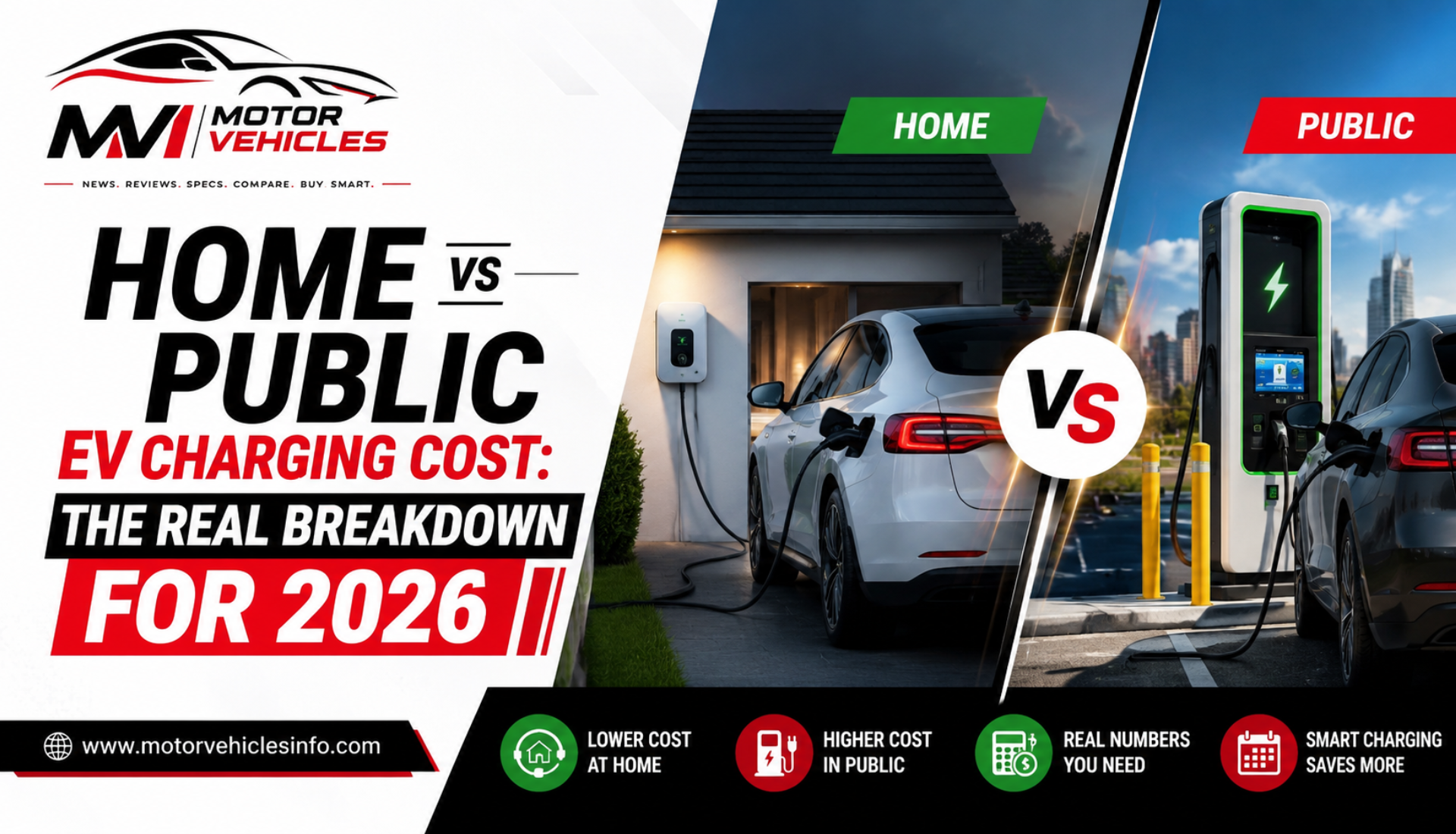
If you’re shopping for an EV or already own one, there’s a question you’ll ask yourself almost every week: should you plug in at home or pull into a public charging station? The answer isn’t as simple as “home is always cheaper.” Your EV charging cost depends on your electricity plan, the type of charger you use, where you live, and how often you’re on the road. In this guide, we’ll break down the real numbers so you can figure out exactly where your money is going — and where you can save.
Why EV Charging Cost Varies So Much
Unlike filling up at a gas station, where prices are fairly uniform, EV charging costs swing wildly depending on the source. A Level 2 home charger, a DC fast charger at a highway rest stop, and a workplace charging station can all give you very different bills for the exact same amount of energy. That’s because you’re not just paying for electricity — you’re also paying for speed, convenience, and the infrastructure behind it.
Understanding this difference is the first step to lowering your monthly charging spend, whether you’re driving a compact hatchback or a full-size electric SUV.
EV Charging Cost at Home: The Budget-Friendly Option
Home charging is where most EV owners do the bulk of their plugging in, and for good reason. According to U.S. Energy Information Administration data, average residential electricity rates in 2026 sit somewhere between 17 and 19 cents per kWh nationally, though this varies significantly by state. Using a Level 2 home charger, a typical EV with a 70–75 kWh battery costs roughly $12–$15 for a full charge. That works out to about 4–7 cents per mile depending on your vehicle’s efficiency.
This is the core reason EV charging cost at home is consistently the cheapest option available to EV drivers. There’s no markup, no network membership fee, and no idle penalty for staying plugged in a little too long. Many utility companies also offer time-of-use plans, letting you charge overnight at discounted off-peak rates that can shave another 20–40% off your bill. If you’re calculating your own numbers, the formula is simple: battery size in kWh multiplied by your local rate per kWh gives you the cost of a full charge.
For most EV owners, EV charging cost at home is the cheapest way to keep your battery topped up. Charging overnight using a standard Level 2 home charger typically costs between $0.10 and $0.15 per kWh, depending on your local utility rates. Many power companies also offer special off-peak or EV-specific rate plans, which can push your effective cost even lower if you charge between midnight and 6 AM.
A few reasons home charging wins on price:
- No markup for using someone else’s charging hardware
- Off-peak electricity rates are usually cheaper
- No idle fees or session charges
- You can charge slowly, which is gentler on your battery over time
The tradeoff is speed. Home charging is convenient for daily top-ups, but it’s not built for quick refills before a long drive.
EV Charging Cost at Charging Station: What You’re Really Paying For
Public charging flips the equation. Public charging tells a very different story. According to Kelley Blue Book’s cost analysis, EV charging cost at charging station locations typically ranges from $0.25–$0.40/kWh for Level 2 units to $0.45–$0.65/kWh for DC fast chargers, depending on the network and your location. EV charging cost at charging station locations is almost always higher than what you’d pay at home, sometimes by two to four times. Moreover, DC fast charger rates range anywhere between $0.30 and $0.60 per kWh, and there are even cases of networks charging customers on a per-minute basis rather than on per-kWh rates.
What makes the price higher?
- Charging networks have to cover real estate, hardware, and maintenance costs
- Fast chargers require heavier infrastructure and higher electricity draw
- You’re paying for speed — most fast chargers can add 100+ miles in 20-30 minutes
- Membership or subscription plans can lower per-session pricing
Public charging definitely does have a role, however, particularly when going on a trip or being away from home for an extended period of time. However, it is not something you should be doing if you are concerned about costs.
EV Charging Cost Per kWh: A Side-by-Side Look
To really understand where your money goes, it helps to look at the EV charging cost per kWh across different charging types. Here’s a general snapshot based on typical U.S. rates in 2026:
| Charging Type | Average Cost per kWh | Speed | Best For |
| Home Level 1 (standard outlet) | $0.10 – $0.14 | Slowest (2-5 miles/hour) | Overnight top-ups |
| Home Level 2 | $0.10 – $0.15 | Moderate (20-30 miles/hour) | Daily charging |
| Workplace Charging | $0.12 – $0.20 | Moderate | Commuters |
| Public Level 2 | $0.20 – $0.35 | Moderate | Shopping, errands |
| DC Fast Charging | $0.30 – $0.60 | Fast (100+ miles in 20-30 min) | Road trips, quick top-ups |
Such figures may vary depending on your location, power supplier, and if the charging station is offering any promotion at the time. As Qmerit’s long-term cost analysis confirms, home charging remains the clear winner on cost, while public fast charging can approach — and sometimes exceed — the cost per mile of a fuel-efficient gas car. However, the rule remains almost universal: the greater the rate of charging, the higher the price per kWh.
Using an EV Charging Cost Calculator to Plan Ahead
If you want exact numbers instead of averages, an EV charging cost calculator is worth using before you commit to a charging routine. Most calculators will require details about the size of your car’s battery, your electricity rate in your region, and how much you drive in a day to estimate how much money you will spend on charging per month and annually.
This is more helpful where one wants to compare home charging with public charging, or to determine whether it is cost-effective to install a home charger. In a number of instances, drivers find that using the charging calculator shows that changing your charging method to home is cost-effective in just one to two years.
Why Electric Vehicle Charging Cost Varies So Much by Location
Your electric vehicle charging cost isn’t just about home versus public — it’s also heavily influenced by where you live. States with lower electricity rates, like parts of the Pacific Northwest, can see home charging costs as low as $0.08–$0.10/kWh. Meanwhile, states with higher residential rates, such as parts of the Northeast, can push that figure above $0.29/kWh, nearly matching some public Level 2 rates elsewhere in the country.
The U.S. Department of Energy’s fueleconomy.gov tool lets you plug in your own vehicle and state to see this variance firsthand. This regional variation is exactly why a generic national average only tells part of the story. Before assuming EV ownership will automatically slash your fuel costs, it’s worth running your own numbers through an ev charging cost calculator using your actual utility rate and driving habits, rather than relying on nationwide estimates alone.
Commercial EV Charging Station Cost: What Businesses Should Know
If you’re a business owner considering installing chargers for employees or customers, commercial EV charging station cost is a different conversation entirely. Setting up Level 2 charging stations may cost several thousand dollars per station, while DC fast charging stations could even go to several tens of thousands of dollars considering all the costs involved.
Many businesses offset this with:
- State and federal incentive programs
- Charging network partnerships that cover hardware costs
- Pay-per-use models that generate revenue over time
For businesses in high-traffic areas, offering EV charging can also be a strong customer draw, making the upfront cost worth it long-term. For everyday drivers, this trend explains why public charging rates have been gradually climbing even as EV adoption grows, a shift also tracked by Consumer Reports in its ongoing EV ownership research.
Understanding EV Charging Station Types
Not all chargers are created equal, and knowing the different EV charging station types helps explain why costs vary so much:
- Level 1 – Uses a standard household outlet. Slow, but free to set up if you already have access to one.
- Level 2 – Requires a dedicated charger, either at home or public locations. The most common charging type for daily use.
- DC Fast Charging (Level 3) – The fastest option, mostly found along highways and in commercial hubs. Higher cost, but ideal for long trips.
Choosing the right mix of these charging types — rather than relying on just one — is usually the smartest way to balance cost and convenience.
Smart Ways to Lower Your Charging Bill
A few practical habits can meaningfully reduce your overall EV charging cost:
- Charge overnight on time-of-use plans to access off-peak discounts.
- Install a Level 2 home charger rather than relying solely on public infrastructure.
- Reserve DC fast charging for road trips, not daily commuting.
- Check for workplace or employer charging perks, which can eliminate a significant chunk of your monthly costs.
- Compare network pricing apps before choosing a public station, since rates can vary block by block.
If you’re still deciding between a hybrid and a full EV, it’s worth reading our comparison guide on hybrid vs electric vehicles to see how charging costs factor into the bigger ownership picture. And if you’re curious how a specific model stacks up in the real world, our 2025 Nissan LEAF review breaks down range and efficiency in detail.
Final Thoughts: Which One Actually Saves You Money?
The real breakdown is simple: home charging is your budget-friendly daily driver, and public charging is your convenient backup for the road. Understanding this difference — and building your charging habits around it — is the single biggest factor in whether your EV actually saves you money in 2026.
Thinking about making the switch to electric, or want help comparing charging setups for your next vehicle? Browse our full library of EV guides and vehicle reviews on Motor Vehicles Info, and drive into your next decision with the numbers already on your side.
Frequently Asked Questions
Which is more affordable, EV charging at home or charging at public stations?
Charging at home is much more affordable since it only costs half or even less than fast charging at public stations.
What is the price range for charging an EV at home?
It usually ranges from $8–$15 to charge the vehicle entirely.
Why is DC fast charging more costly than Level 2 charging?
DC fast charging needs special equipment that is more sophisticated and faster, which makes such networks impose higher prices on customers.
Is there any way to make public charging more affordable?
Indeed, there is a way, and that is by signing up for membership programs of charging stations.
Is EV charging cheaper than gas?
Yes, in most cases, it is if you charge the car mostly at home.