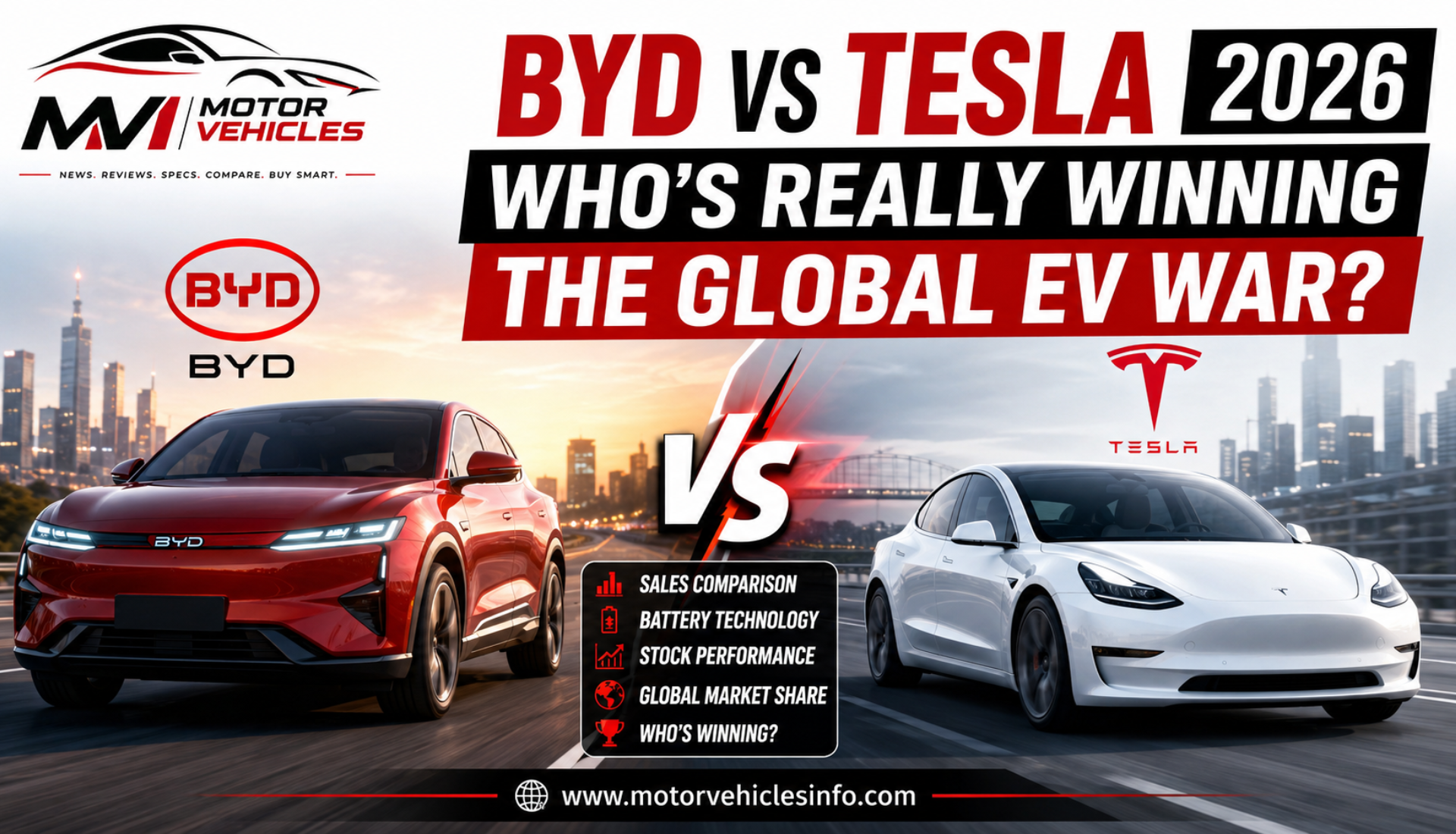
The rivalry between two auto giants has never been closer than it is right now. BYD vs Tesla 2026 has become the defining storyline of the electric vehicle industry, with the lead swinging back and forth almost every quarter. One minute BYD is celebrated as the world’s top EV seller; the next Tesla claws its way back to the top spot. So who is actually winning? The honest answer depends on which metric you’re looking at — deliveries, revenue, stock performance, or battery technology all tell a slightly different story. Let’s break it all down.
BYD vs Tesla Sales 2026: A Quarter-by-Quarter Tug of War
Here’s the one important thing to note about the BYD versus Tesla sales 2026 situation: neither has succeeded in dominating the market consistently for any quarter running.
By the end of 2025, BYD became the clear global leader in EVs by selling 4.6 million new energy vehicles, including 2.26 million all-electric vehicles, marking a 28% increase year-on-year. This was in comparison with the delivery of about 1.64 million vehicles by Tesla, which saw a decline of 9% compared to the previous year.
But here comes the twist in the tale. In Q1 2026, Tesla delivered a total of 358,023 EVs, outdoing BYD’s 310,389 fully electric cars as the Chinese buyers held back after the country had done away with the EV purchase-tax exemption scheme. However, this dominance did not last long, and BYD soon caught up by delivering 557,090 fully electric vehicles in comparison to Tesla’s 480,126 vehicles in Q2 2026.
This seesaw trend is precisely why global EV sales figures for 2026 require a thorough analysis.
Who Is Winning the EV War: Volume vs. Value
When people ask who is winning the EV war headlines, they’re usually assuming there’s one clean winner. In reality, the two companies are playing different games entirely.
BYD wins decisively on volume. Its strategy relies on vertical integration — producing its own batteries, semiconductors, and electronics — which lets it undercut competitors on price across a wide range of models, from the budget-friendly Dolphin to the luxury Yangwang U8. This price ladder gives BYD access to nearly every income bracket, especially in China, Southeast Asia, and increasingly Europe.
Tesla, on the other hand, is betting on margins and software. Its Q1 2026 earnings beat expectations, with revenue climbing 15.8% year-over-year to $22.39 billion and automotive gross margin expanding to 21.1%. A big part of that recovery came from Full Self-Driving subscriptions, which jumped 51% to 1.28 million active users — proof that Tesla increasingly sees itself as a software and autonomy company that happens to sell cars.
So in a Tesla vs BYD sales comparison, BYD leads on units sold, while Tesla leads on profitability per vehicle and technology monetization.
BYD vs Tesla 2026 Stock: Which One Looks Like the Smarter Bet
Investors watching BYD vs Tesla stock performance in 2026 have noticed a striking valuation gap. Tesla trades at a trailing P/E ratio north of 350, reflecting sky-high expectations for robotaxis, Optimus robots, and future AI ventures that haven’t materialized into meaningful revenue yet. BYD, by contrast, trades at a forward P/E of roughly 17-18, a valuation far closer to traditional automakers despite outselling Tesla globally.
The market capitalization of Tesla still remains much higher, more than ten times that of BYD, primarily because of investor expectations regarding Tesla’s plans not just with automobiles. The reason why BYD is considered undervalued can be supported by the concrete figures, such as a high growth rate of exports (exports increased by more than 50 percent in the first quarter of 2026), a record number of deliveries per month, and a product line that wins through price leadership.
BYD vs Tesla 2026 Battery: The Real Battleground
Beneath the sales numbers, the deeper competition is technological — specifically BYD battery vs Tesla innovation. BYD’s Blade Battery, based on Lithium Iron Phosphate (LFP) chemistry, is prized for being safer, cheaper to produce, and longer-lasting than traditional nickel-based cells, even if it sacrifices a bit of energy density. Combined with BYD’s in-house FinDreams electronics division, this vertical control allows the company to keep costs down across its entire vehicle lineup — something few rivals can replicate.
Tesla’s battery strategy leans more toward energy density and charging speed, supported by its Supercharger network and ongoing work on 4680 cell technology. While Tesla’s energy storage division (Powerwall, Megapack) has historically been a growth engine, it actually saw a 12% revenue dip in early 2026, suggesting BYD’s battery-first approach is currently gaining more real-world traction, particularly in mass-market and commercial EV segments.
EV Market Share 2026: The Bigger Picture
Looking at the bigger picture, EV Market Share 2026 proves that the whole industry is growing up instead of blowing up. By 2026, global electric vehicle sales will hit about 22.7 million — no big leap from 2025. That suggests that explosive annual growth is coming to an end and the struggle for market share begins.
BYD vs Tesla 2026 — Comparison Table
| Metric | BYD | Tesla |
| 2025 Global EV Sales | 4.6M NEVs (2.26M BEVs) | 1.64M vehicles |
| Q1 2026 BEV Deliveries | 310,389 | 358,023 |
| Q2 2026 BEV Deliveries | 557,090 | ~480,126 |
| H1 2026 Total BEVs | 867,479 | 838,149 |
| Core Battery Tech | Blade Battery (LFP) | 4680 cells / NCA-NMC |
| Market Cap (approx.) | ~$100–130B | ~$1.3–1.4T |
| Forward P/E Ratio | ~17–18 | ~200+ |
| Strategic Focus | Volume, vertical integration, exports | Software, autonomy, energy storage |
| Global Strength | China, Southeast Asia, Europe expansion | North America, premium segment |
So, Who’s Really Winning?
However, there is no one winner, and this very fact is what makes the BYD vs Tesla 2026 story fascinating. Measuring success by the number of cars on the road, BYD has won; measuring success by innovation story, brand strength, and technological vision, Tesla has a lot more cards to play. In 2026, there will be no winner but rather a two-horse race emerging that will change the face of the entire EV industry worldwide, even for the traditional car manufacturers desperately struggling to catch up.
For readers who want deeper dives into specific EV models, ownership costs, and buying guides, motorvehiclesinfo.com has detailed breakdowns worth checking out, including practical comparisons on EV maintenance costs and battery lifespan guides that go beyond the sales headlines.
Frequently Asked Questions
Is BYD actually larger than Tesla in 2026?
Yes, in terms of sheer volume — BYD has outsold Tesla in 2025 and even in Q2 2026 despite Tesla taking back the first place in Q1 2026.
Should I invest in BYD shares rather than in Tesla?
BYD is cheaper and has greater sales growth, while Tesla shares come at a premium because of autonomous driving and robot investments – it all depends on how risky an investor you are.
Which battery chemistry is superior, BYD or Tesla?
The former has the safer and cheaper Blade Battery (LFP), while the latter prefers cells with higher energy density and faster charging – they are both suitable for different applications.
Would Tesla be able to take back the global leadership in EV sales in 2026?
Maybe – since both companies have changed places several times before, but BYD export growth suggests that BYD will stay ahead of Tesla.
Who produces cheaper EVs?
BYD undoubtedly – its price range is significantly lower than the one for Tesla’s cheapest cars, especially in Asia and Europe.
Curious which EV actually fits your budget and driving needs — BYD or Tesla? Explore in-depth model comparisons, ownership costs, and real owner reviews at motorvehiclesinfo.com before you make your next EV decision.